Exploring the Meaning of Argureos in Greek
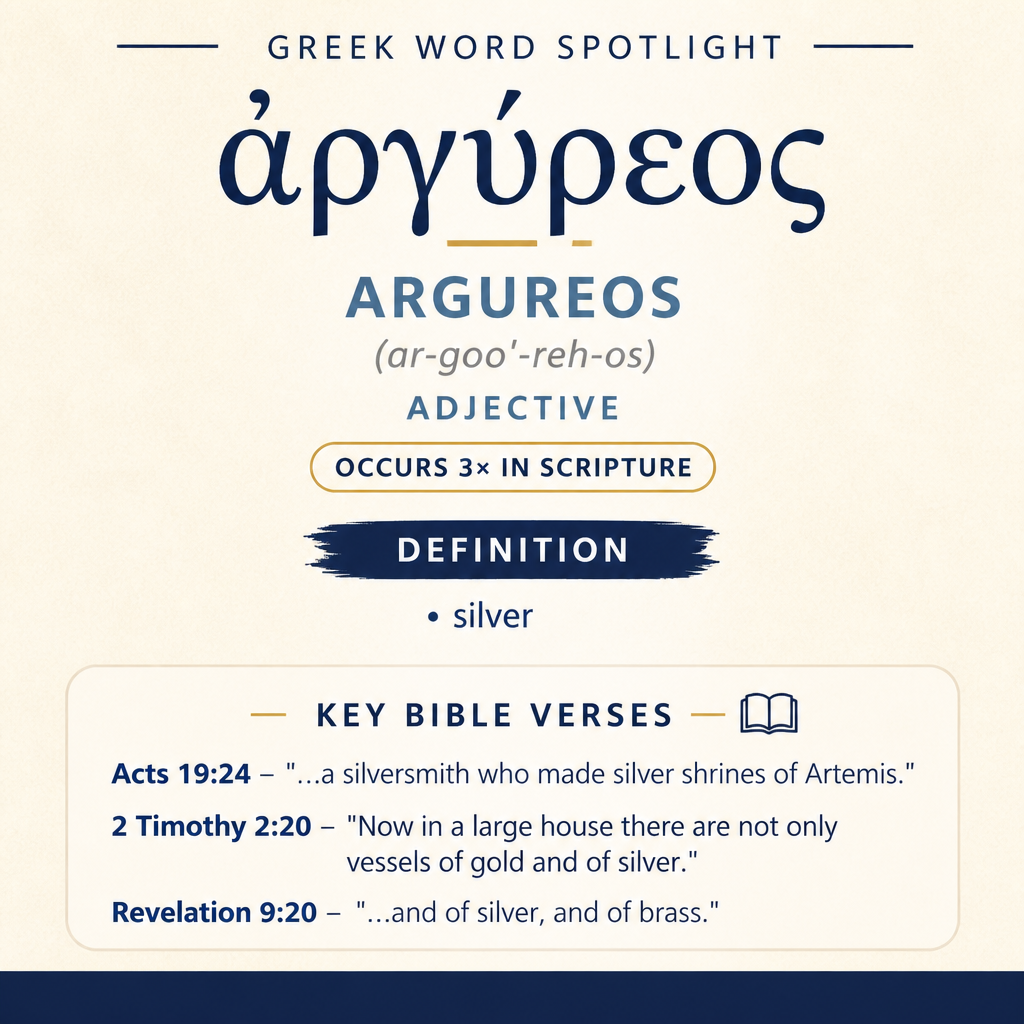
ἀργύρεος means “silver” and appears three times in Scripture: Acts 19:24, 2 Timothy 2:20, and Revelation 9:20.
Scripture Occurrences
This word occurs 3 times in Scripture: Acts 19:24; 2 Timothy 2:20; Revelation 9:20.
Learn More →Context Examples
It describes “silver shrines” in Acts 19:24 and “vessels of… silver” in 2 Timothy 2:20.
Learn More →ἀργύρεος describes something as “silver” and appears in three New Testament passages. In each setting it marks material composition, whether in commercial craft, household goods, or idol materials.
Root and Related Words
ἀργύρεος (Argureos) is related to ἄργυρος (argyros), “silver” (Strong’s G696).

Occurrences
Acts 19:24 — “For a certain man named Demetrius, a silversmith who made silver shrines of Artemis, brought no little business to the craftsmen,”
Here ἀργύρεος specifies the material of the “shrines of Artemis.” The verse places silver craftsmanship within a local economy: Demetrius is identified by his trade (“a silversmith”), and the silver shrines are the product that “brought no little business to the craftsmen.” By marking the shrines as silver, the adjective helps explain why this work supports a network of artisans; the shrines are not generic religious items but objects made from a valuable metal, suitable for sale and capable of sustaining significant commerce. The word functions as a concrete descriptor that ties religious devotion (shrines of Artemis) to material production and financial gain (business for craftsmen).
2 Timothy 2:20 — “Now in a large house there are not only vessels of gold and of silver, but also of wood and of clay. Some are for honor, and some for dishonor.”
In this sentence ἀργύρεος belongs to a list of materials used to classify “vessels” within “a large house.” The pairing “gold and … silver” places silver among the precious-metal options, contrasted with “wood” and “clay.” The point of the illustration depends on recognizable differences in substance: materials suggest differing uses and differing esteem. The text then draws a distinction in function and status—“Some are for honor, and some for dishonor”—so the mention of silver contributes to the sense of a household inventory that contains both high-status items and common ones. The adjective grounds the metaphor in ordinary experience: people know what it means for an object to be made of silver, and that knowledge supports the honor/dishonor contrast the verse expresses.
Revelation 9:20 — “The rest of mankind, who were not killed with these plagues, didn’t repent of the works of their hands, that they wouldn’t worship demons, and the idols of gold, and of silver, and of brass, and of stone, and of wood; which can’t see, hear, or walk.”
In Revelation 9:20, ἀργύρεος appears in a catalog of idol materials: “gold… silver… brass… stone… wood.” The phrase “the works of their hands” links these idols to human manufacture, and the adjective “silver” emphasizes the tangible, crafted nature of what is being worshiped. Silver here is not presented as neutral raw material; it is named as one substance among several from which “idols” are made, objects associated in the same sentence with the refusal to repent and with worship directed toward “demons.” The closing clause—“which can’t see, hear, or walk”—underscores the lifelessness of such images, and the list of materials (including silver) highlights their physicality: they are made things, impressive perhaps in substance, yet incapable of the actions that characterize living beings. ἀργύρεος thus contributes to a portrayal of idolatry as devotion fixed on manufactured objects of metal, stone, and wood.
Sense and Usage
Across these passages, ἀργύρεος consistently serves as a material adjective: it marks that an item is silver in substance. The three contexts show how that single descriptor can function in different kinds of discourse.
In Acts 19:24, the adjective operates within economic and artisanal language. A “silversmith” making “silver shrines” presents silver as a worked material that can be shaped into portable religious objects. The verse explicitly links those objects to “business” and to “craftsmen,” so the silver quality is part of why the production matters in that scene: silver shrines are marketable goods, and the adjective participates in characterizing the product being sold.
In 2 Timothy 2:20, ἀργύρεος participates in a domestic inventory and a moral classification. The text does not dwell on craft or commerce; instead it uses the range of materials found in “a large house” as a way of speaking about differentiated roles (“for honor… for dishonor”). Within that comparison, silver stands on the “precious” side of the contrast, alongside gold, opposite wood and clay. The adjective helps the reader feel the realism of the illustration by naming a specific, familiar material associated with durable and valued household goods.
In Revelation 9:20, the word functions within a polemical list. Silver is one of the named substances from which “idols” are made, and the verse directly connects those idols to worship that should have been abandoned in repentance. Here the adjective helps build the cumulative effect of the catalogue: whether the idol is made of expensive metal (gold, silver) or more common material (stone, wood), it remains a manufactured object that “can’t see, hear, or walk.” The mention of silver therefore contributes to the breadth of the indictment, spanning from precious to ordinary materials while maintaining the same evaluation of the resulting objects.
Together these three uses show ἀργύreος marking silver as a recognizable feature of an object—something that can imply value and desirability (shrines that generate business; household vessels contrasted with wood and clay) and that can also be implicated in the critique of what people choose to honor and worship (idols of silver). The adjective stays concrete, attached to physical items, while the surrounding sentences supply the differing moral or social significance of those items in their respective scenes.
Imagery
The word’s imagery is consistently tactile and material: shaped shrines, household vessels, and crafted idols. Acts presents silver as worked into religious miniatures that sustain craftsmen; 2 Timothy places silver among the materials that distinguish honorable and dishonorable vessels in a large home; Revelation includes silver among the substances of idols that remain inert—“which can’t see, hear, or walk”—even as people persist in worshiping them.
Sources: Lexical data from Strong’s Exhaustive Concordance and the Translators Brief Lexicon of Extended Strongs for Greek (STEPBible, CC BY). Occurrence data from the Translators Amalgamated Greek New Testament (STEPBible, CC BY). Scripture quotations from the World English Bible (public domain).