
Understanding the Meaning of Aptaistos in Greek
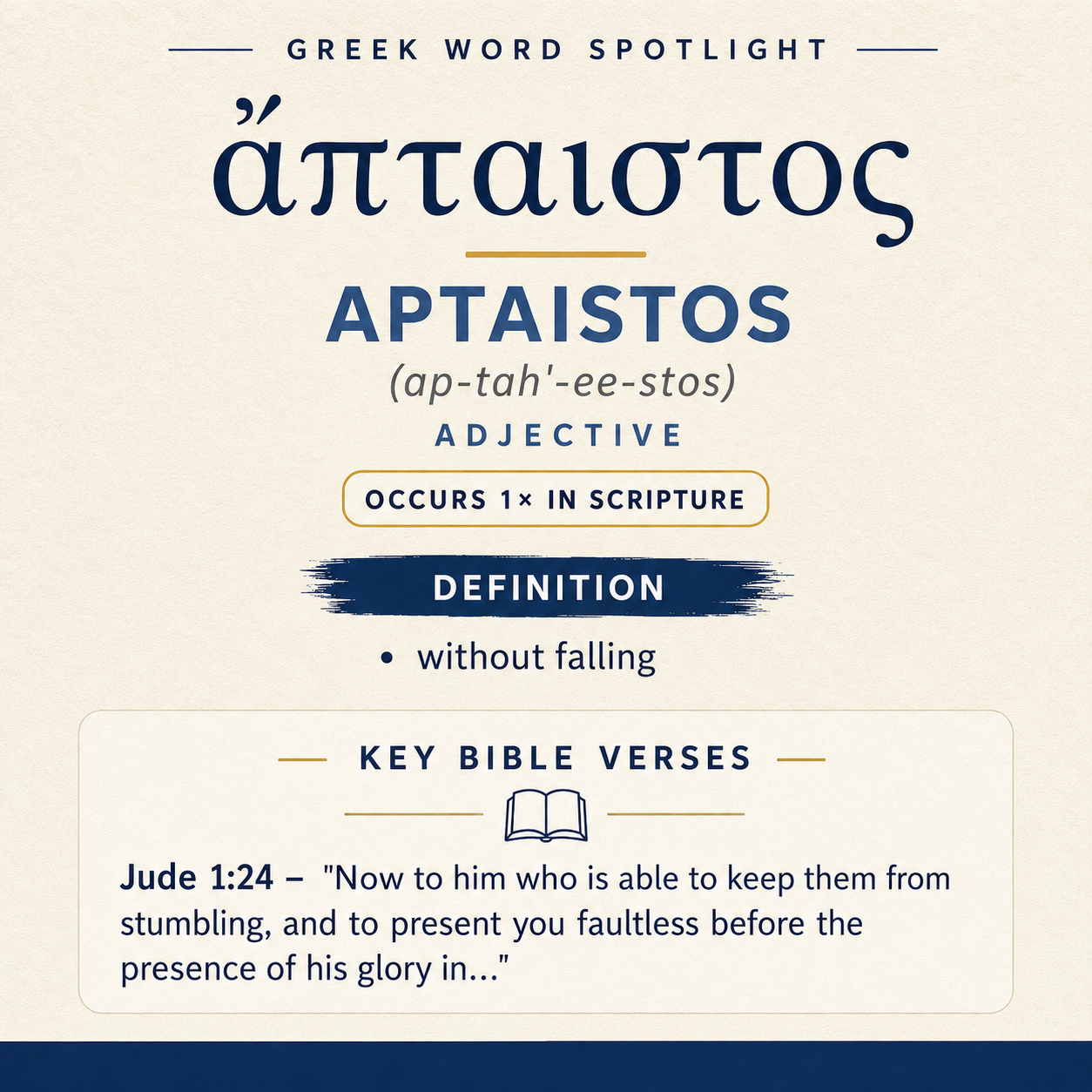
ἄπταιστος means “without falling” and appears once in Scripture, in Jude 1:24.
Verse Context
In Jude 1:24, it is used in a statement about keeping from stumbling and presenting faultless.
Learn More →ἄπταιστος expresses the idea of being “without falling” and appears in the closing doxology of Jude. In that setting it characterizes the outcome God is able to secure for those addressed.
Root and Related Words
ἄπταιστος (Aptaistos) is connected with πταίω (ptaio), “to stumble” (Strong’s G4417), and with the prefixed element α (Alpha), “Alpha” (Strong’s G1), as noted in Strong’s derivation information. The formation links the adjective’s sense to the concept of stumbling.

Occurrences
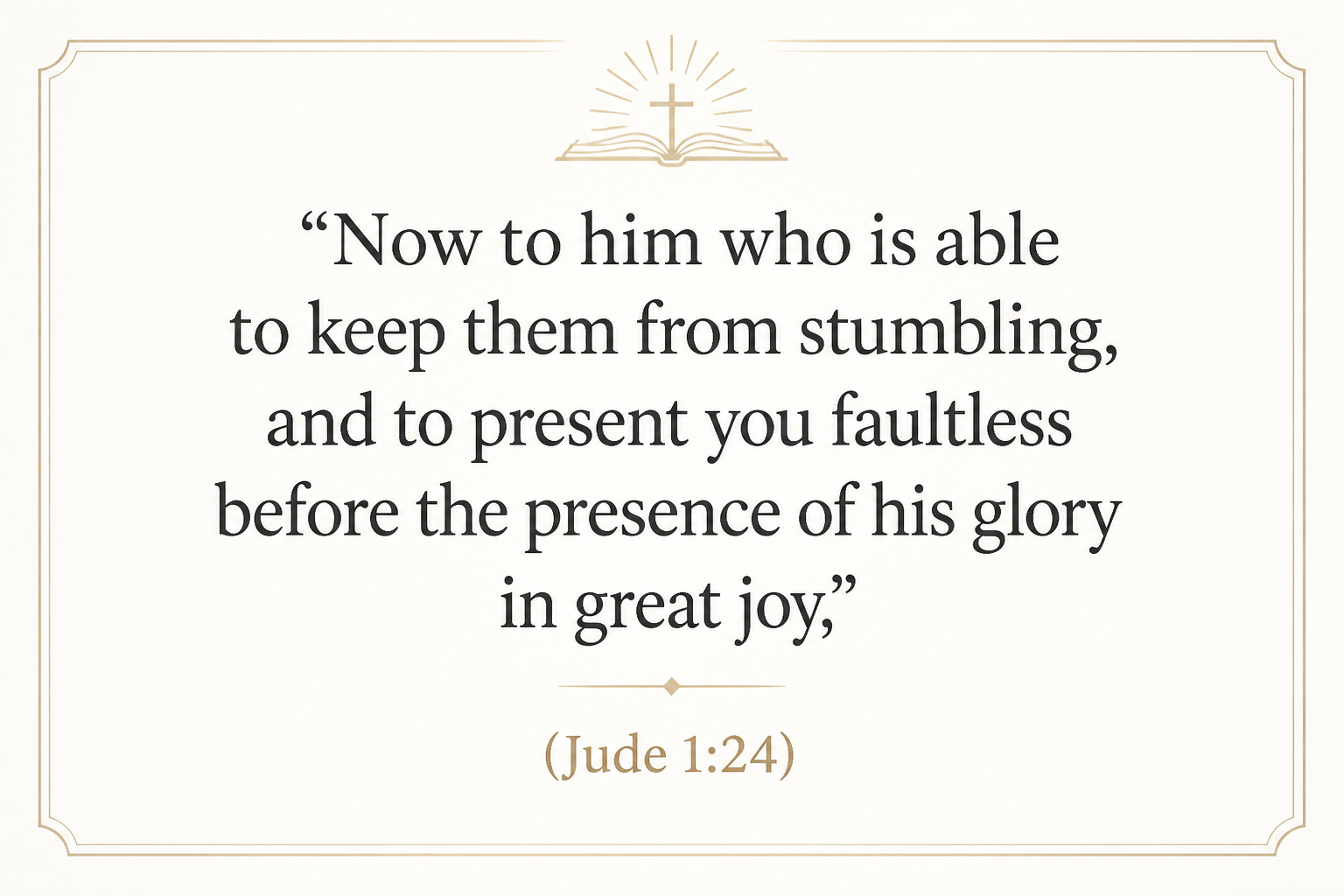
“Now to him who is able to keep them from stumbling, and to present you faultless before the presence of his glory in great joy,” (Jude 1:24)
In Jude’s concluding praise, the word belongs to a pair of divine actions: keeping “from stumbling” and presenting the people addressed in a state suited to standing “before the presence of his glory.” The line moves from the danger implied by “stumbling” to the successful arrival implied by being “present[ed]” in a condition described as “faultless,” and it frames both as what God “is able” to do. Within this single sentence, ἄπταιστος supports the picture of a safeguarded course that does not end in a fall, culminating in an appearance before God marked by “great joy.”
Sense and Usage
The definition “without falling” naturally fits Jude’s explicit mention of “stumbling,” since stumbling is the immediate narrative image for a fall that interrupts forward movement. Jude’s wording sets the concern in relational and eschatological space: the goal is not merely avoiding a misstep in isolation, but arriving to be “present[ed]… before the presence of his glory.” The adjective’s force, then, is not abstract; it is tethered to a journey-like sequence in which prevention (“keep… from stumbling”) yields a final standing (“present you… before the presence of his glory”).
Because the doxology emphasizes divine capability—“to him who is able”—the term functions less as a self-description of the community and more as a description of what God can secure for them. The imagery is practical and bodily: not falling, not collapsing, not failing to remain upright. Yet Jude places that practical image in the highest setting imaginable within the verse itself: the “presence of his glory.” In this way, ἄπταιστος bridges ordinary experience (the hazard of stumbling) and ultimate access (being brought safely into God’s presence), allowing the closing praise to hold together protection along the way and readiness at the end.
The collocation with “faultless” in the same clause adds a second descriptor of the presented state, and Jude binds both descriptors to the same act of divine presentation. Without extending beyond the given definition, the line shows how “without falling” can be heard as fitting for someone brought into a setting where stumbling would be out of place: “before the presence of his glory.” The result is emotionally colored as well—“in great joy”—so that the absence of falling is not painted as tense or precarious, but as a secure, celebratory outcome within God’s saving ability.
Imagery
Jude 1:24 frames “without falling” through the simple, vivid picture of a person kept from a stumble and then brought to stand in a glorious presence. The movement from possible collapse to stable presentation gives the doxology its momentum: God is praised as the one who brings his people safely through the danger implied in “stumbling” into the joy of an unhindered standing before him.
Sources: Lexical data from Strong’s Exhaustive Concordance and the Translators Brief Lexicon of Extended Strongs for Greek (STEPBible, CC BY). Occurrence data from the Translators Amalgamated Greek New Testament (STEPBible, CC BY). Scripture quotations from the World English Bible (public domain).




