Exploring the Meaning of Apseudes in Greek
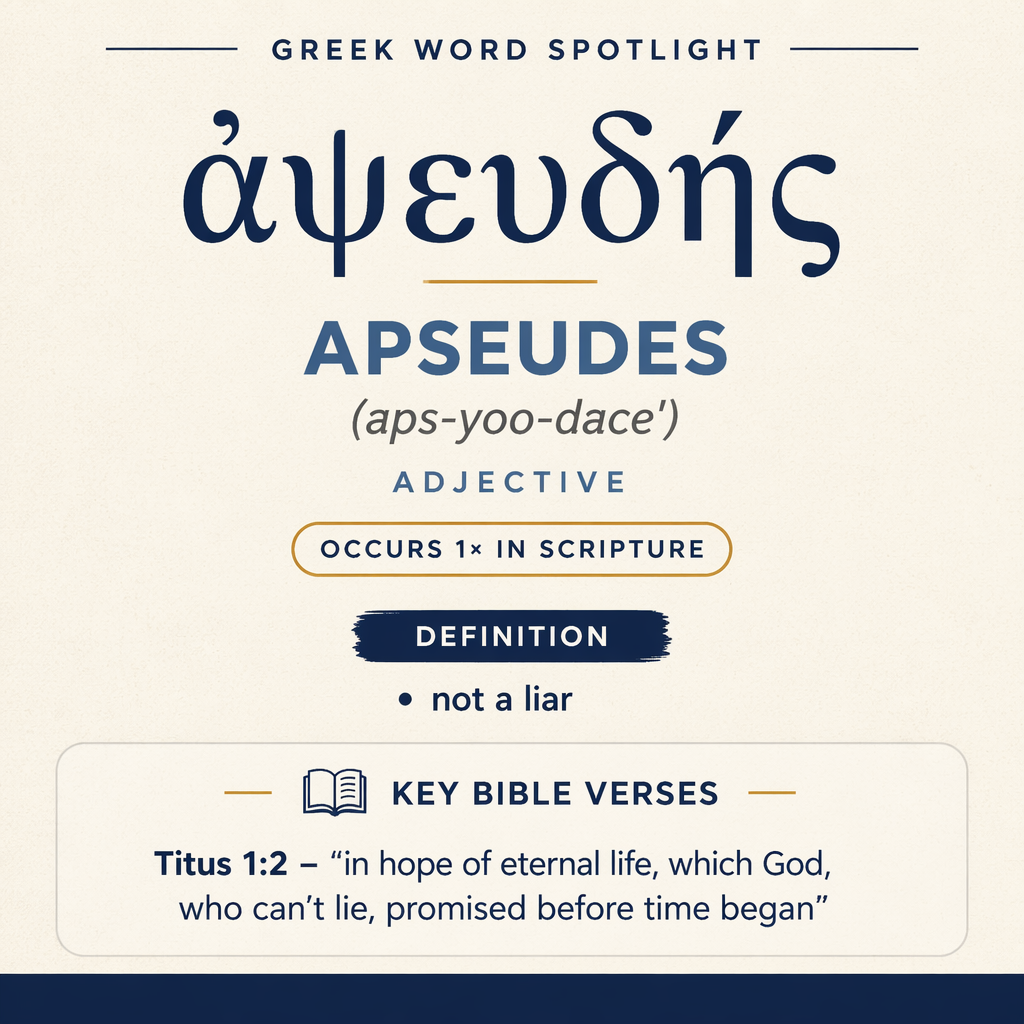
ἀψευδής means “not a liar” and appears once in Scripture, in Titus 1:2.
Biblical Usage
It occurs one time in Scripture, in Titus 1:2. There it describes God as the one who can’t lie.
Learn More →Promise Context
In Titus 1:2, it appears in the statement about hope of eternal life. That eternal life is something God promised before time began.
Learn More →ἀψευδής means “not a liar.” It appears once, in Paul’s opening description of the basis for “hope of eternal life” and the character of the God who promised it.
Root and Related Words
ἀψευδής is connected with pseudos (ψεῦδος), “lie.”

Occurrences
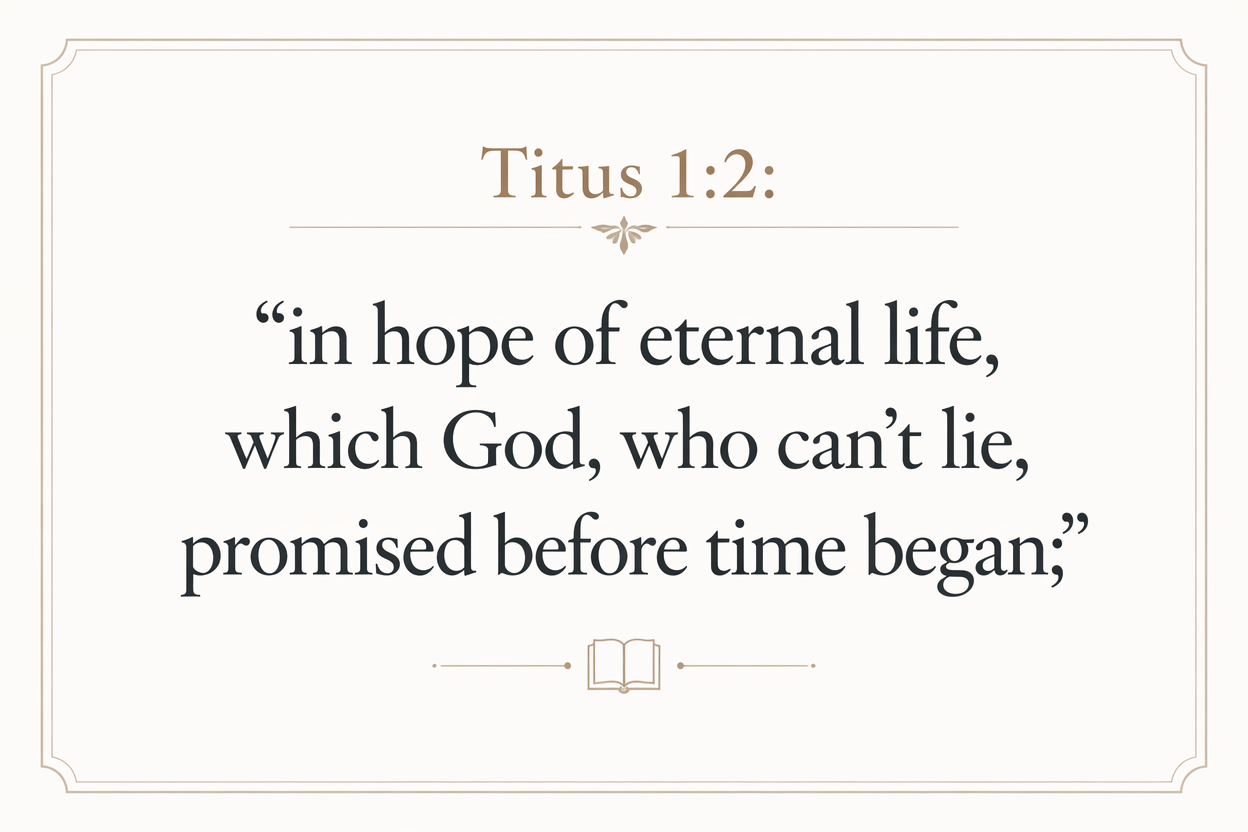
Titus 1:2: “in hope of eternal life, which God, who can’t lie, promised before time began;”
Here ἀψευδής is applied to God within a tightly argued opening statement. The phrase “in hope of eternal life” looks forward to a promised outcome, and the clause “which God, who can’t lie, promised” grounds that hope in God’s character. ἀψευδής functions as an assurance-term: the promise has the full backing of the promiser’s truthfulness, so the “hope” named in the line is not mere wish or uncertainty but a confidence anchored in who God is. The verse frames this in temporal breadth—“promised before time began”—so the force of “who can’t lie” is not limited to a single moment of speaking; it describes the kind of speaker God is in relation to the promise that stands behind the present Christian expectation.
The placement is also rhetorically pointed. Instead of merely stating that God made a promise, the text specifies the kind of promise-maker God is. By attaching ἀψευδής directly to God, the clause does not primarily characterize human conduct or prescribe an ethic in this sentence; it supports the reliability of a divine commitment. In this way, ἀψευδής strengthens the logical bridge from “promise” to “hope”: the readers are invited to rest the weight of their expectation on a promiser defined by an incapacity for lying.
Sense and Usage
The sense “not a liar” is expressed in Titus 1:2 by the idiom “who can’t lie,” which treats the quality as more than a momentary choice. The term’s contribution is to mark a speaker as one for whom lying is excluded, so that what is spoken can be received as dependable. Within the verse’s compact theology of promise, this quality functions as a warrant: if the promiser is “not a liar,” then the content of the promise—here, “eternal life”—is presented as secure enough to sustain “hope.”
Because the word appears in a statement about God promising, its use is tightly bound to speech and commitment. The adjective does not merely negate a general fault; it serves the discourse purpose of reinforcing trust in a pledged future. The result is that the reader’s focus is drawn to the integrity of the divine word as the foundation for the community’s forward-looking confidence.
Imagery
The verse’s imagery is the simple but weighty scene of a promise given and held across time: “promised before time began” and now standing behind “hope of eternal life.” Within that scene, ἀψευδής portrays God as a promise-giver whose speech does not break down into deception, so the future named in the promise can be awaited without suspicion.
Sources: Lexical data from Strong’s Exhaustive Concordance and the Translators Brief Lexicon of Extended Strongs for Greek (STEPBible, CC BY). Occurrence data from the Translators Amalgamated Greek New Testament (STEPBible, CC BY). Scripture quotations from the World English Bible (public domain).