
Understanding the Significance of Apokueo in Greek
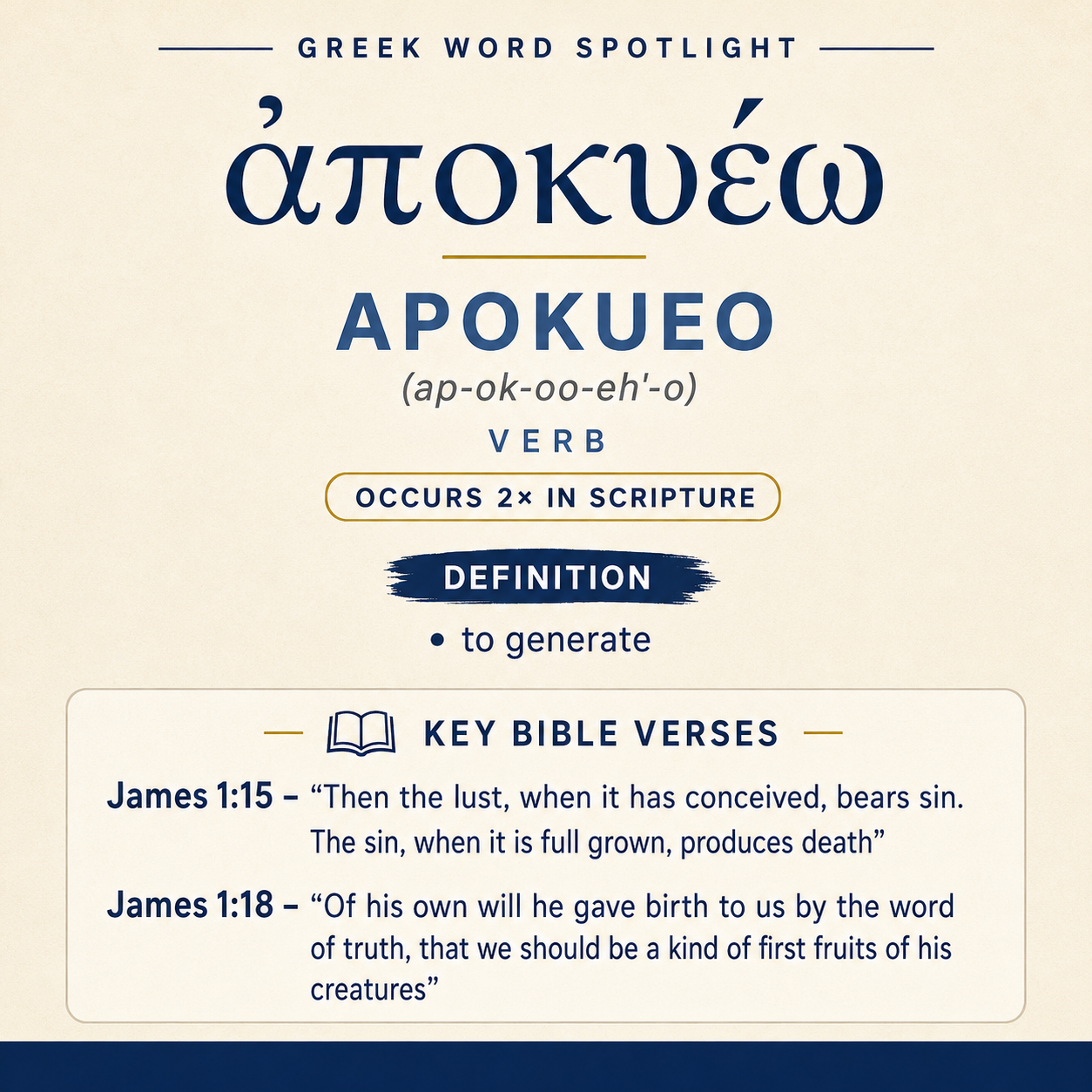
ἀποκυέω means “to generate” and appears twice in Scripture, both in James 1:15 and James 1:18.
Core Meaning
ἀποκυέω is defined as “to generate.” The term describes bringing forth an outcome or birth.
Learn More →James Occurrences
It occurs two times in Scripture, both in James. The references are James 1:15 and James 1:18.
Learn More →Verse Contexts
James 1:15 uses it for sin producing death. James 1:18 uses it for God giving birth to us by the word of truth.
Learn More →ἀποκυέω means “to generate.” It appears twice in James, once in a negative chain from desire to death and once in a positive description of God’s will bringing a people into being.
Root and Related Words
ἀποκυέω is linked with ἀπό (apo), “away from” (Strong’s G575), and κῦμα (kyma), “a wave” (Strong’s G2949).

Occurrences
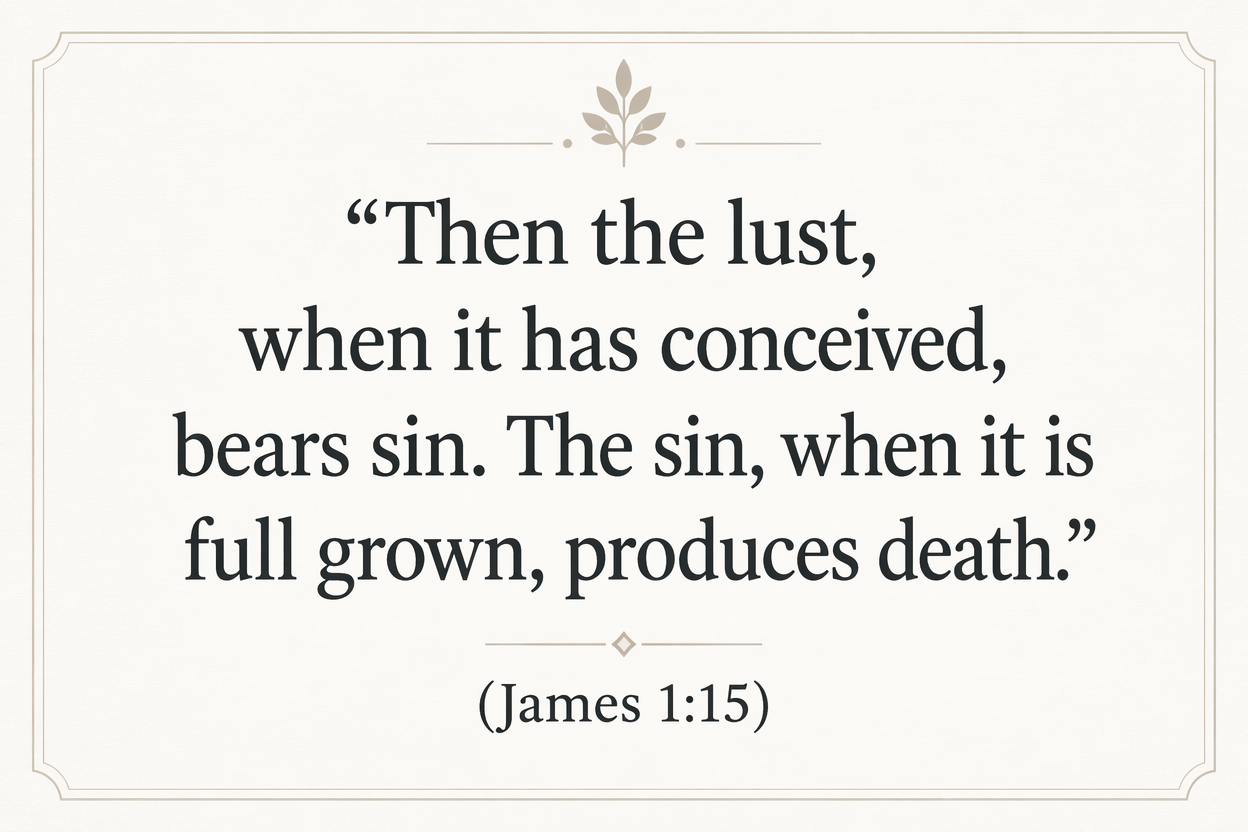
“Then the lust, when it has conceived, bears sin. The sin, when it is full grown, produces death.” (James 1:15)
Here ἀποκυέω is the final verb in a progression described in the language of conception and development. The sentence begins with “lust” that “has conceived,” then moves to what it “bears,” and finally reaches the point where “sin” becomes “full grown” and “produces death.” In this scene, ἀποκυέω names an outcome that comes forth from an internal process: what begins as desire and becomes sin is pictured as maturing until it generates a further result. The verb therefore carries the weight of inevitability within the image: the passage does not merely say that death follows sin, but that death is brought forth as the generated product when sin reaches its mature state (“full grown”).
The context also marks a change in subject across the clauses: the first action is attached to “lust,” the second to “lust” again (“bears sin”), and the final action is attached to “sin” itself (“produces death”). That shift makes ἀποκυέω function as the climax of the chain. It is not simply the initial spark but the culminating act of bringing forth, set at the moment where the process is complete (“when it is full grown”).
“Of his own will he gave birth to us by the word of truth, that we should be a kind of first fruits of his creatures.” (James 1:18)
In James 1:18, ἀποκυέω stands in a very different setting: the subject is God’s deliberate intention, expressed as “Of his own will.” The verb is rendered “he gave birth to us,” placing the action in the category of purposeful origination rather than the organic escalation portrayed in 1:15. The generating act is described as occurring “by the word of truth,” so the verse frames the result (“us”) as coming into being through an agent or means identified as that “word of truth.”
The clause that follows (“that we should be a kind of first fruits of his creatures”) gives the generating act a defined goal. ἀποκυέω, as used here, is not an end in itself; it is the decisive act that establishes a new status for the ones generated. The phrase “a kind of first fruits” suggests a representative portion within a larger whole (“his creatures”), so the verb’s contribution is to mark the beginning of a purposeful ordering: a people are brought forth so that they stand as an initial or leading portion among what belongs to God.
Sense and Usage
Across these two occurrences, “to generate” is expressed through vivid birth-and-growth imagery, but the passages differ sharply in the nature of what is generated and in the character of the generating source. In James 1:15, generation is the end point of a moral sequence: desire conceives, sin results, and once that sin is mature it generates death. The action is portrayed as arising from within the chain itself, with “sin” functioning as the immediate generator. The verse’s structure ties generation to maturity—“when it is full grown”—so the generated result is presented as what emerges when an already-existing reality reaches completion.
In James 1:18, generation is attributed to intention (“Of his own will”) and is associated with an articulated means (“by the word of truth”) and purpose (“that we should be a kind of first fruits”). The focus is not on a process that runs on its own momentum, but on a deliberate act that brings about a defined outcome. The generated product is not a further consequence of something maturing toward an inevitable end; it is the intended creation of “us” with a stated role among “his creatures.”
Read together, the two uses show how ἀποκυέω can sit at the end of a sequence (the final product of a developing condition) or at the beginning of a new identity (the initiating act that establishes a people). In both, the verb marks a transition from an antecedent condition to a resultant reality: in 1:15 the antecedent is “sin” that has become “full grown,” and the resultant is “death”; in 1:18 the antecedent is God’s will acting “by the word of truth,” and the resultant is “us” in the position of “first fruits.”
Imagery
James places ἀποκυέω inside family-and-harvest pictures that make consequences tangible. One line evokes a hidden beginning (“conceived”) that becomes visible in what is brought forth (“bears,” “produces”); the other speaks of a deliberate beginning (“gave birth to us”) that results in a distinctive portion (“first fruits”). In both scenes, the verb gives concreteness to origin and outcome: something comes into being from a source, and the nature of that source—lust and sin in one case, God’s will and the word of truth in the other—defines what is generated.
Sources: Lexical data from Strong’s Exhaustive Concordance and the Translators Brief Lexicon of Extended Strongs for Greek (STEPBible, CC BY). Occurrence data from the Translators Amalgamated Greek New Testament (STEPBible, CC BY). Scripture quotations from the World English Bible (public domain).




