
Exploring the Meaning of Aphobos in Greek
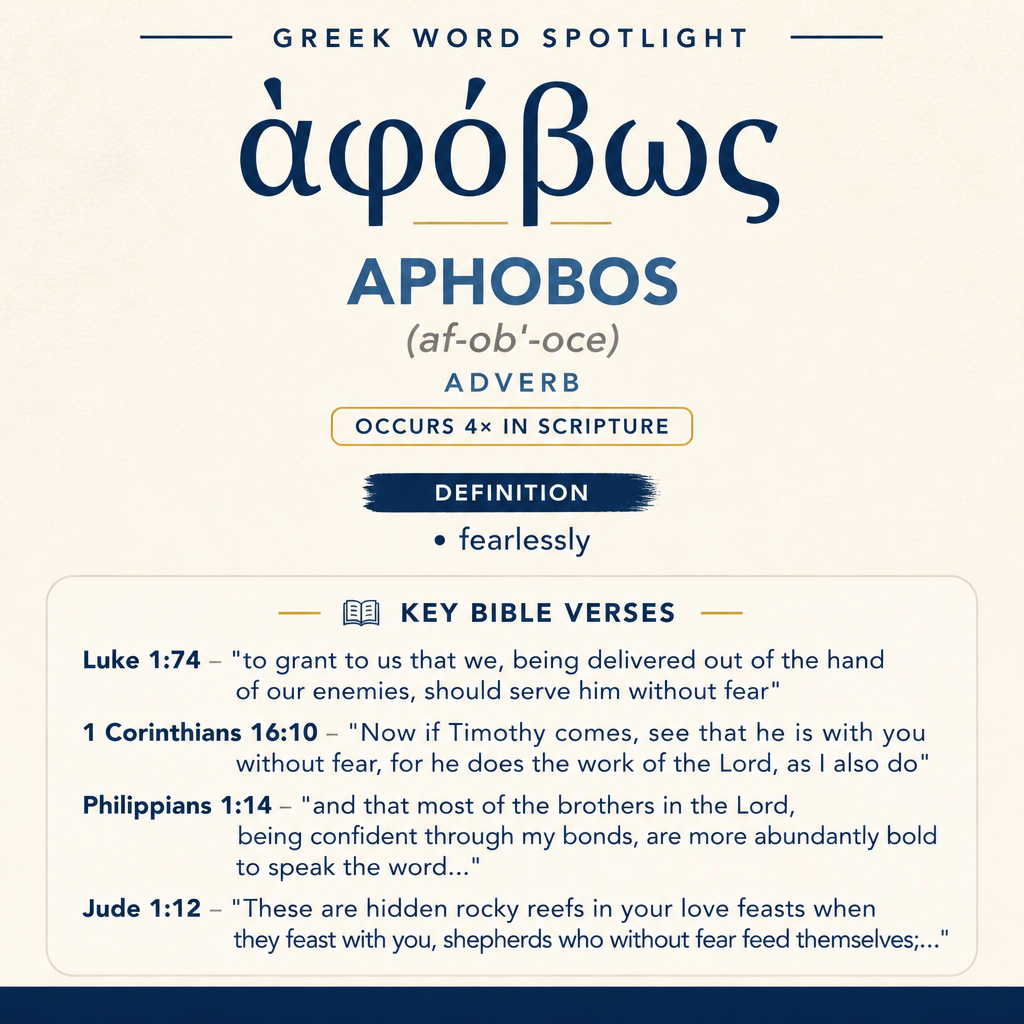
ἀφόβως means “fearlessly” and appears in Luke 1:74; 1 Corinthians 16:10; Philippians 1:14; and Jude 1:12.
Core Meaning
ἀφόβως is translated “fearlessly” and rendered “without fear” in several passages.
Learn More →Where It Appears
This word occurs four times in Scripture: Luke 1:74; 1 Corinthians 16:10; Philippians 1:14; and Jude 1:12.
Learn More →Context Snapshots
It describes serving God “without fear” (Luke 1:74) and receiving Timothy “without fear” (1 Corinthians 16:10). It also appears in Philippians 1:14 and Jude 1:12.
Learn More →ἀφόβως expresses the manner “fearlessly,” describing action carried out without being governed by fear. It appears in four New Testament passages that range from worship and ministry to speech and communal conduct.
Root and Related Words
ἀφόβως is associated with phobos (φόβος), “fear” (Strong’s G5401), and is also linked to A (α, Ἀλφα), “Alpha” (Strong’s G1).

Occurrences
Luke 1:74: “to grant to us that we, being delivered out of the hand of our enemies, should serve him without fear,”
Here the adverb marks the quality of the service rendered to God: it is carried out “without fear.” The line grounds this fearless service in deliverance “out of the hand of our enemies,” so the manner of serving is presented as a result of rescue from threat. The wording frames fearlessness not as recklessness but as a freed posture—service no longer constrained by hostile power.
1 Corinthians 16:10: “Now if Timothy comes, see that he is with you without fear, for he does the work of the Lord, as I also do.”
In this instruction about receiving Timothy, ἀφόβως describes the social environment the community is to provide: he is to be “with you without fear.” The adverb attaches to Timothy’s presence among them, indicating that his stay and work should be untroubled by apprehension. The clause that follows—“for he does the work of the Lord”—ties that fearless setting to the recognition and support of his ministry; the community’s conduct should make room for the Lord’s work to proceed in a manner unpressured by fear.
Philippians 1:14: “and that most of the brothers in the Lord, being confident through my bonds, are more abundantly bold to speak the word of God without fear.”
In Philippians, fearlessness is applied to speech: the brothers “speak the word of God without fear.” The verse builds a chain of ideas: confidence arises “through my bonds,” and that confidence issues in greater boldness; the adverb then characterizes the manner of their speaking as free from fear. The placement of ἀφόβως after “bold to speak” intensifies the picture of courageous proclamation: not only increased boldness, but speech carried on without the inhibiting force of fear.
Jude 1:12: “These are hidden rocky reefs in your love feasts when they feast with you, shepherds who without fear feed themselves; clouds without water, carried along by winds; autumn trees without fruit, twice dead, plucked up by the roots;”
Jude uses ἀφόβως in a sharply negative portrayal. Certain people are depicted at communal meals as “hidden rocky reefs,” and the adverb modifies their self-serving behavior: they are “shepherds who without fear feed themselves.” The fearless manner here is not praised; it is part of the indictment. Within the verse’s string of images—reefs that endanger, clouds that give no water, fruitless trees uprooted—“without fear” paints their self-feeding as brazen and unchecked, done in the very setting of “your love feasts” where care for others should be expected.
Sense and Usage
Across these passages, ἀφόβως consistently marks a way of acting that is unrestrained by fear, yet the moral coloring depends on the activity it describes. In Luke, fearlessness belongs to worshipful service that follows deliverance; it is the manner of serving God once enemies no longer hold power. In 1 Corinthians, it becomes an ethical directive for community life: believers are to arrange their fellowship so that a fellow worker can be among them in a state of freedom from intimidation. In Philippians, it characterizes public testimony—speech made more courageous in the context of hardship, so that the word of God is spoken without fear’s limiting pressure.
Jude shows that the same fearlessness can describe shamelessness when attached to corrupt conduct. The adverb itself still indicates a fear-free manner, but its effect is to expose the audacity of self-indulgent “shepherds” who exploit communal settings. Thus ἀφόβως is flexible: it can commend courageous service and speech, or it can condemn an unafraid boldness that ignores accountability and damages others. The word’s contribution is therefore primarily adverbial and situational—identifying the emotional and social posture in which an act is carried out—while the surrounding context supplies whether that posture is fitting or corrupt.
In three occurrences (Luke, 1 Corinthians, Philippians), fearlessness functions as an enabling condition for faithful action: service, ministry partnership, and proclamation proceed unhindered. In Jude, fearlessness functions as a diagnostic sign: the lack of fear accompanies self-feeding and the dangerous presence of those likened to reefs, empty clouds, and dead trees. The shared thread is that fear is absent; what differs is whether that absence frees obedience or frees exploitation.
Imagery and Force
The passages attach vivid relational and communal force to “without fear.” Luke sets it against enemies’ hands and depicts worship as liberated service. Paul’s instruction in 1 Corinthians places it within hospitality and the daily realities of receiving a visiting worker. Philippians places it in the sphere of speaking, where bonds and confidence shape the courage of the community. Jude places it at the table, where meals meant to express love become hazardous; fearlessness there highlights a hard, self-protecting confidence that refuses to tremble even when harming others. Taken together, ἀφόβως can evoke the calm of freed worship, the safety of supportive fellowship, the courage of public speech, or the brazenness of selfish leadership, depending on the scene it modifies.
Sources: Lexical data from Strong’s Exhaustive Concordance and the Translators Brief Lexicon of Extended Strongs for Greek (STEPBible, CC BY). Occurrence data from the Translators Amalgamated Greek New Testament (STEPBible, CC BY). Scripture quotations from the World English Bible (public domain).




