
Exploring the Meaning of Anthupatos in Greek
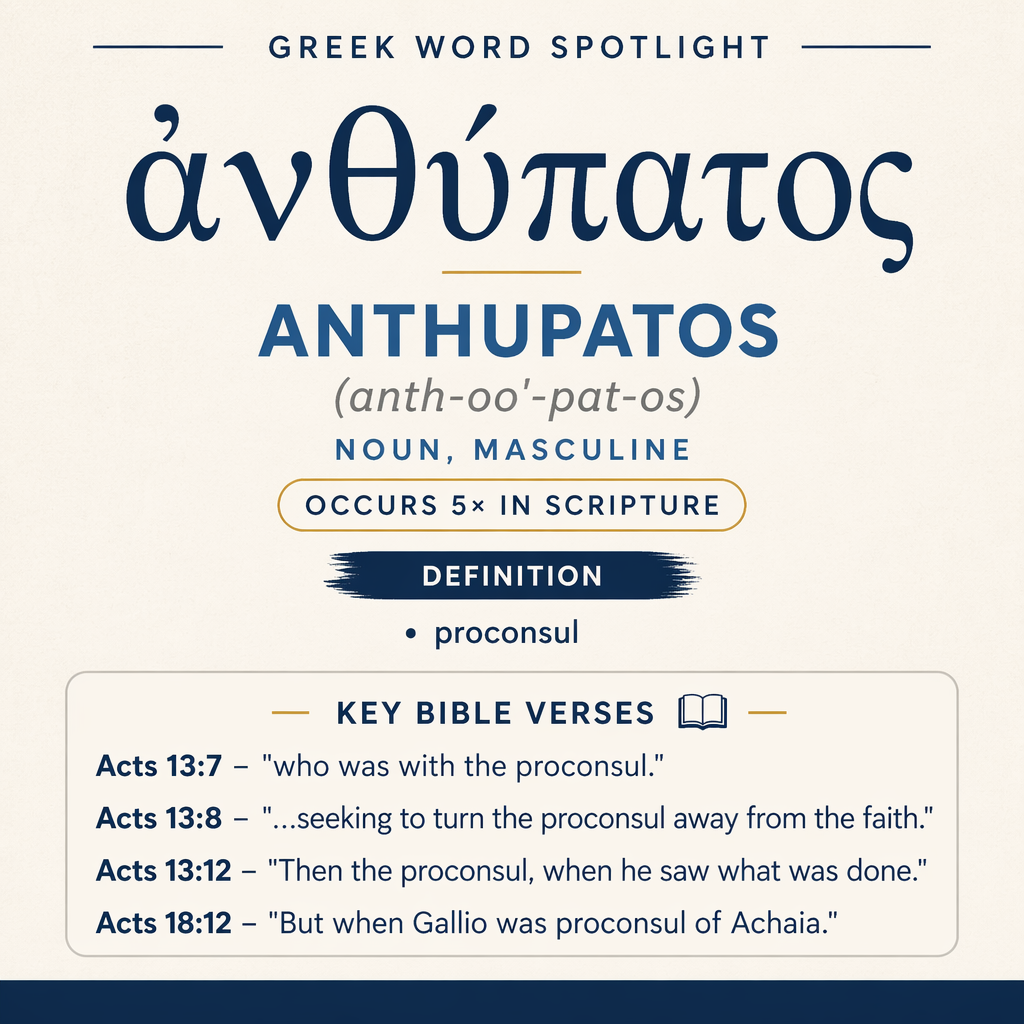
ἀνθύπατος means “proconsul” and appears five times in Acts (13:7, 13:8, 13:12; 18:12; 19:38).
Core Meaning
ἀνθύπατος is the Greek word translated “proconsul.” It refers to an official holding that title in Acts.
Learn More →Acts 13 Context
In Acts 13:7–8, Sergius Paulus is called the proconsul who summons Barnabas and Saul. In Acts 13:12, the proconsul believes after seeing what was done.
Learn More →Other Occurrences
Acts 18:12 identifies Gallio as proconsul of Achaia. Acts 19:38 mentions proconsuls in connection with open courts and legal matters.
Learn More →ἀνθύπατος designates a “proconsul,” a high-ranking civic official mentioned in several narrative settings in Acts. The word appears in scenes where the gospel is heard, opposed, evaluated, and—at times—carried into the ordinary procedures of public life.
Root and Related Words
ἀνθύπατος is connected with anti (ἀντί), “for,” and hyper (ὑπέρ), “above/for.”

Occurrences
Acts 13:7 — “who was with the proconsul, Sergius Paulus, a man of understanding. This man summoned Barnabas and Saul, and sought to hear the word of God.”
Here ἀνθύπατος marks Sergius Paulus as an official of public standing, but the emphasis in the sentence falls on his personal initiative: “This man summoned Barnabas and Saul.” The title frames the meeting as more than a private conversation; the word places the request to “hear the word of God” within a setting shaped by authority, access, and the ability to call others into one’s presence. In this scene, the proconsul’s rank is not portrayed as a barrier to hearing; instead it becomes the circumstance through which Barnabas and Saul are formally summoned.
Acts 13:8 — “But Elymas the sorcerer (for so is his name by interpretation) withstood them, seeking to turn the proconsul away from the faith.”
In the next verse the same title becomes the pivot point of conflict. Elymas “withstood them,” and his aim is explicitly targeted: “to turn the proconsul away from the faith.” ἀνθύπατος therefore identifies the specific person whose response matters in the immediate dispute. The word also intensifies the stakes: the attempted diversion is not merely the obstruction of generic listeners, but the deliberate effort to redirect a person whose role is already highlighted. The narrative makes the proconsul the contested hearer; his official identity is part of what makes him an object of opposition.
Acts 13:12 — “Then the proconsul, when he saw what was done, believed, being astonished at the teaching of the Lord.”
Here ἀνθύπατος ties the outcome back to the contested moment: “Then the proconsul … believed.” The title remains in view even as the verse speaks of perception and reaction: he “saw what was done” and was “astonished at the teaching of the Lord.” By keeping the official designation in the foreground, the verse presents belief and astonishment as occurring in a public figure, not an anonymous bystander. The word helps the reader track continuity—this is the same proconsul sought and then targeted—and it locates his response in relation to observable events (“what was done”) and to instruction (“the teaching of the Lord”).
Acts 18:12 — “But when Gallio was proconsul of Achaia, the Jews with one accord rose up against Paul and brought him before the judgment seat,”
In this courtroom-adjacent setting, ἀνθύπατος situates the action within a defined provincial administration: “Gallio was proconsul of Achaia.” The immediate consequence is procedural and public: opponents “rose up against Paul” and “brought him before the judgment seat.” The title is therefore part of the narrative’s legal framing. It signals that what follows concerns a setting where charges can be brought and adjudication sought, with the proconsul’s tenure providing the temporal and governmental context for the confrontation.
Acts 19:38 — “If therefore Demetrius and the craftsmen who are with him have a matter against anyone, the courts are open, and there are proconsuls. Let them press charges against one another.”
In this occurrence, ἀνθύπατος appears in the plural and functions as part of an appeal to ordinary civic mechanisms. The speaker points to available structures: “the courts are open, and there are proconsuls.” The word is not tied to a named individual here; instead it represents an accessible feature of the public order—recognized officials associated with formal legal process. In the same breath as “courts,” the title underscores that disputes can be handled through established channels: “Let them press charges against one another.” The plural usage broadens the term from a specific office-holder in a narrative episode to a category of officials whose presence supports due process.
Sense and Usage
Across these passages, “proconsul” functions as more than a biographical detail. In Acts 13, ἀνθύπατος marks a hearer whose social position is explicit, and the narrative repeatedly keeps that position in view as the word of God is requested (“sought to hear the word of God”), resisted (“seeking to turn the proconsul away from the faith”), and finally received (“believed”). The title helps the reader track the same person through successive movements—summoning, opposition, and response—so that belief is narrated not as a detached spiritual moment but as the culmination of a public encounter.
In Acts 18, the term’s sense operates within a judicial atmosphere: the proconsul’s office is the backdrop against which adversaries coordinate and move Paul toward a “judgment seat.” ἀνθύπατος thus signals an administrative environment where public accusations and hearings belong. In Acts 19, that administrative environment is made explicit: “the courts are open” and “there are proconsuls.” Here the word carries the practical implication that recognized officials exist to whom matters may be brought, and it supports the urging of orderly dispute resolution (“press charges”).
Read together, the occurrences show ἀνθύπατος used in two complementary ways: (1) as a title attached to an identifiable individual whose decisions and reactions are narrated, and (2) as a plural category within the civic landscape, paired with “courts,” representing the availability of official venues for complaints. In both patterns, the word anchors scenes in the public realm—summons, opposition, belief that is observed and described, and legal proceedings conducted in open institutions.
Imagery in Acts
The word’s imagery in these passages is administrative and public: an official who can summon visitors, a contested audience whose turning “away” or believing matters, and a civic system with open courts where charges may be pressed. Whether centered on “Sergius Paulus” and “Gallio” or generalized to “proconsuls” alongside open courts, ἀνθύπατος evokes the world of recognized authority where matters are heard, tested, and answered in public view.
Sources: Lexical data from Strong’s Exhaustive Concordance and the Translators Brief Lexicon of Extended Strongs for Greek (STEPBible, CC BY). Occurrence data from the Translators Amalgamated Greek New Testament (STEPBible, CC BY). Scripture quotations from the World English Bible (public domain).





