
Exploring the Meaning of Anthropos in Greek
ἄνθρωπος (Anthropos) means “a human” and occurs 560 times in Scripture, including Matthew 4–6.
Matthew Examples
In Matthew 4:4 it appears in “Man shall not live by bread alone.” In Matthew 4:19 it appears in “fishers for men.”
Learn More →ἄνθρωπος refers to “a human,” a straightforward term for people in ordinary life and in moral and religious instruction. In the passages cited here (all from Matthew), it appears in sayings that contrast human sight and approval with God’s, and in instructions about how humans live, learn, forgive, and perceive good works.
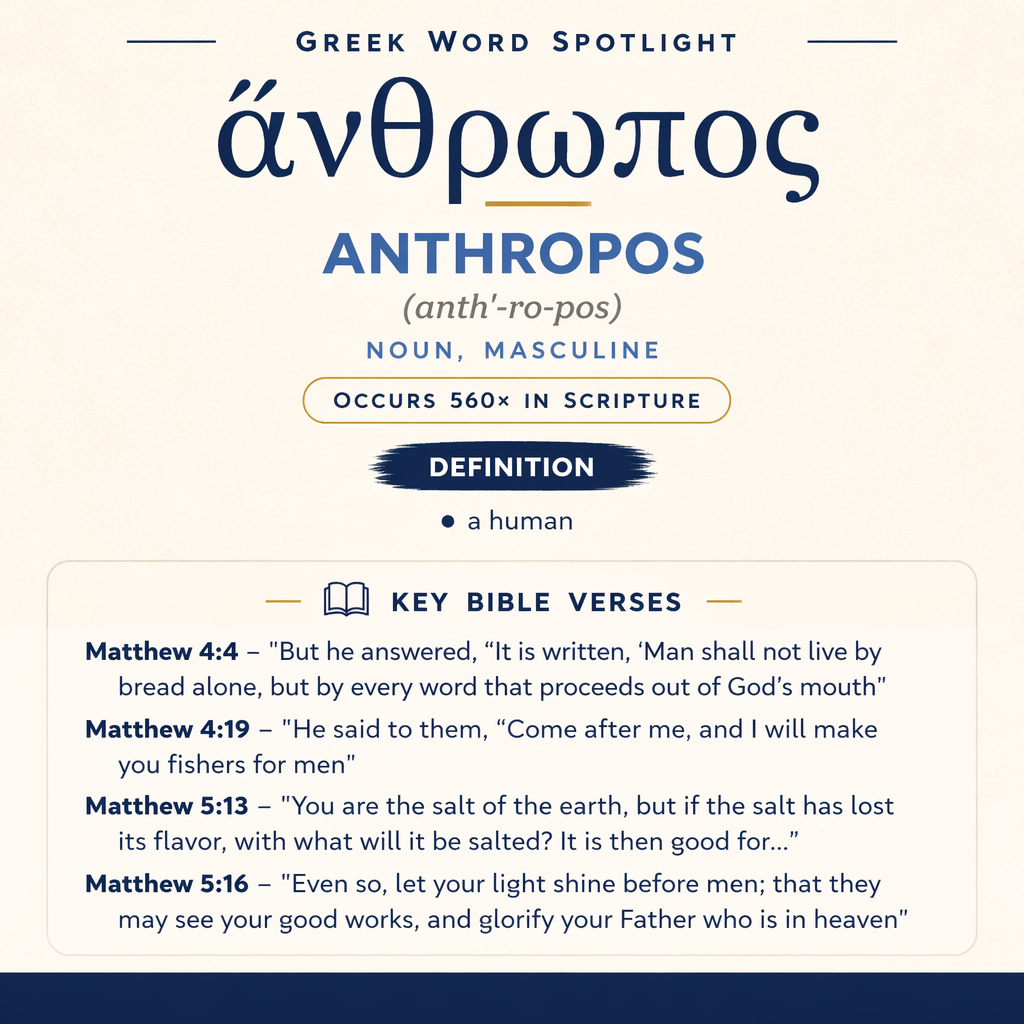
Occurrences
Matthew 4:4: But he answered, “It is written, ‘Man shall not live by bread alone, but by every word that proceeds out of God’s mouth.’ ”
Here ἄνθρωπος (“Man”) is used generically for a human being as such. The saying places “Man” as the subject of “shall not live,” describing what sustains human life: not only “bread,” but “every word that proceeds out of God’s mouth.” The contribution of ἄνθρωπος is to keep the statement universal and representative—about humans and their living—rather than describing a narrow group.

Matthew 4:19: He said to them, “Come after me, and I will make you fishers for men.”
In “fishers for men,” ἄνθρωπος names the object of the disciples’ future work: humans are the ones to be gathered, not animals or fish. The phrase depends on the metaphor of fishing while remaining anchored in the concrete target: people. The word sets the mission’s direction toward human beings as the ones affected by the call, the pursuit, and whatever “making” them into “fishers” entails in the statement.
Matthew 5:13: “You are the salt of the earth, but if the salt has lost its flavor, with what will it be salted? It is then good for nothing, but to be cast out and trodden under the feet of men.
Here ἄνθρωπος appears in a plural sense (“men”) within a vivid image: flavorless salt is “cast out” and “trodden under the feet of men.” The word supplies the human agents in the scene—the ones whose feet do the trampling. In the logic of the saying, humans are the ordinary public who treat what is “good for nothing” as disposable, making the warning tangible and social rather than purely abstract.
Matthew 5:16: Even so, let your light shine before men; that they may see your good works, and glorify your Father who is in heaven.
In “before men,” ἄνθρωπος marks the human audience for visible behavior. Humans are the ones who “see your good works,” and the aim described is that this human seeing leads to glorifying “your Father who is in heaven.” The word frames the public setting: deeds are done in a world of human observers, yet the outcome envisioned moves beyond humans to God.
Matthew 5:19: Whoever, therefore, shall break one of these least commandments, and teach others to do so, shall be called least in the Kingdom of Heaven; but whoever shall do and teach them shall be called great in the Kingdom of Heaven.
This saying addresses conduct and instruction in community life (“teach others”), and its evaluations are expressed as what someone “shall be called” within “the Kingdom of Heaven.” In this context ἄνθρωπος supports the relational setting implied by “teach others” and “shall be called”: humans are the ones who break, do, teach, and speak about status (“least” or “great”). The statement’s focus remains on human actions and human instruction under a higher kingdom’s standard.
Matthew 6:1: “Be careful that you don’t do your charitable giving before men, to be seen by them, or else you have no reward from your Father who is in heaven.
“Before men” again uses ἄνθρωπος to name the human audience, now in a warning. The goal “to be seen by them” makes humans the evaluators whose notice can become the motive for giving. The word anchors the contrast between being seen by humans and receiving “reward” from “your Father who is in heaven,” so that the act’s audience—human or divine—shapes its spiritual consequence.
Matthew 6:2: Therefore when you do merciful deeds, don’t sound a trumpet before yourself, as the hypocrites do in the synagogues and in the streets, that they may get glory from men. Most certainly I tell you, they have received their reward.
Here ἄνθρωπος is explicitly tied to “glory from men.” Humans are the source of a kind of recognition that can be pursued through public display (“in the synagogues and in the streets”). The word identifies the audience whose praise is being sought, and the saying treats that praise as a complete “reward” in itself—what hypocrites obtain when their aim is human glory.
Matthew 6:5: “When you pray, you shall not be as the hypocrites, for they love to stand and pray in the synagogues and in the corners of the streets, that they may be seen by men. Most certainly, I tell you, they have received their reward.
In prayer, ἄνθρωπος again names the human watchers: hypocrites pray publicly “that they may be seen by men.” The word emphasizes prayer as an act that can be performed with a human audience in mind, turning devotion into a public display. As in the prior verse, the human gaze functions as the intended payoff, and that payoff is described as the entirety of what they receive.
Matthew 6:14: “For if you forgive men their trespasses, your heavenly Father will also forgive you.
Here ἄνθρωπος appears as the recipients of forgiveness: “forgive men their trespasses.” Humans are the ones who commit “trespasses” against others and the ones toward whom forgiveness is extended. The word keeps the instruction concrete and interpersonal; forgiveness is not framed as a mere feeling but as an action directed toward other humans, linked to the Father’s forgiving response.
Matthew 6:15: But if you don’t forgive men their trespasses, neither will your Father forgive your trespasses.
The same human-to-human relationship continues, now stated negatively. ἄνθρωπος identifies those whose wrongs might be withheld from forgiveness, and the result is presented as a corresponding withholding by “your Father.” The word maintains the relational symmetry: humans are both offenders (in “their trespasses”) and those who need forgiveness (in “your trespasses”), so the instruction touches ordinary human conflicts and their spiritual implications.
Matthew 6:16: “Moreover when you fast, don’t be like the hypocrites, with sad faces. For they disfigure their faces, that they may be seen by men to be fasting. Most certainly I tell you, they have received their reward.
In fasting, ἄνθρωπος again provides the viewing public: the hypocrites alter their appearance “that they may be seen by men to be fasting.” The word gives fasting a social setting in which piety can be advertised. The emphasis falls on humans as the perceivers of an outward sign (“sad faces,” “disfigure their faces”), and the perceived act becomes a performance aimed at human recognition.
Matthew 6:18: so that you are not seen by men to be fasting, but by your Father who is in secret, and your Father, who sees in secret, will reward you.
Finally, ἄνθρωπος marks the audience explicitly rejected: fasting should be done “so that you are not seen by men.” The contrast is sharpened by pairing human sight with the Father “who sees in secret.” The word’s role is to define one possible horizon for religious practice—public human observation—over against the hidden divine observation that leads to reward.

Sense and Usage
Across these sayings, ἄνθρωπος consistently denotes humans in ordinary, observable life: as those who live and need sustenance (Matthew 4:4), as those who become the focus of a calling and gathering (Matthew 4:19), and as the public whose feet, eyes, and opinions shape social experience (Matthew 5:13; 5:16). The term naturally fits maxims that speak generically (“Man shall not live…”) as well as plural references to people as a group (“men”) who see, glorify, reward with praise, and respond to public actions.
A notable pattern is the repeated framing of human beings as observers. “Before men” and “seen by men” recur in the instructions on giving, prayer, and fasting (Matthew 6:1–2; 6:5; 6:16; 6:18). In these lines, ἄνθρωπος is not merely a neutral label for persons; it helps construct a moral contrast between action aimed at human recognition and action oriented toward the Father’s hidden sight. Humans can supply “glory” and a kind of immediate “reward,” but the sayings treat such recognition as limited when it becomes the goal. The term thus participates in a two-audience framework: a person can act for humans to see, or act with the Father as the decisive witness.
At the same time, ἄνθρωπος also marks humans as moral agents and neighbors. In forgiving “men their trespasses” (Matthew 6:14–15), humans are not spectators but relational partners—people who offend and people who must choose forgiveness. The word keeps the instruction grounded in the everyday world of wrongs and reconciliation, while tying human relationships to the Father’s response. In Matthew 5:19, the sphere of human action includes obedience, disobedience, teaching, and social naming (“shall be called”), again showing ἄνθρωπος as the ordinary human domain within which kingdom evaluations become visible.
Imagery and Setting
The passages use ἄνθρωπος to place spiritual instruction in recognizably human spaces: “synagogues,” “streets,” and “corners of the streets” (Matthew 6:2; 6:5), along with the public “before men” where light shines and deeds are seen (Matthew 5:16). Even the warning image of discarded salt being “trodden under the feet of men” (Matthew 5:13) depends on the ordinary movement of human bodies through public places. In these scenes, humans are both the community within which conduct is displayed and the relational field in which obedience, teaching, forgiveness, and public perception take place.
Sources: Lexical data from Strong’s Exhaustive Concordance and the Translators Brief Lexicon of Extended Strongs for Greek (STEPBible, CC BY). Occurrence data from the Translators Amalgamated Greek New Testament (STEPBible, CC BY). Scripture quotations from the World English Bible (public domain).




