
Exploring the Meaning of Anthropoktonos in Greek
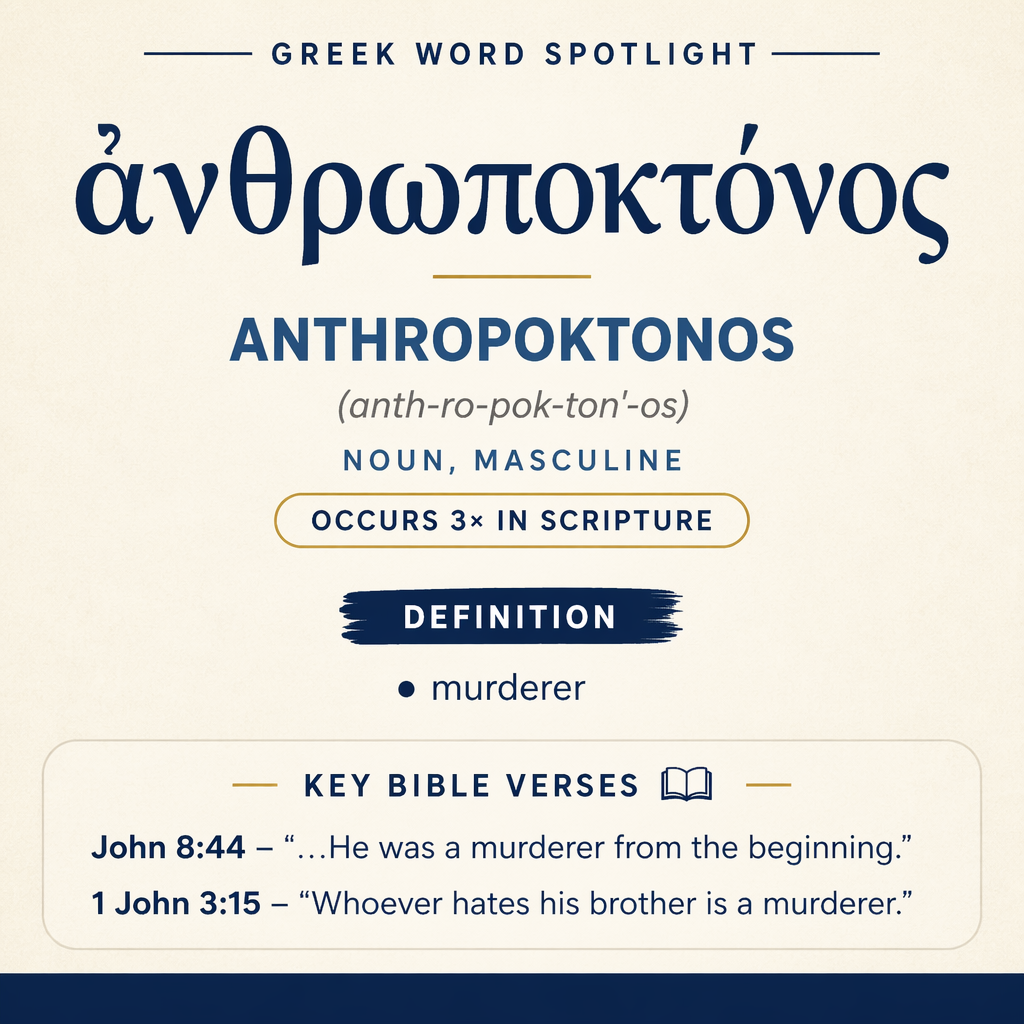
ἀνθρωποκτόνος means “murderer” and occurs three times in Scripture, including John 8:44 and 1 John 3:15.
Epistle Warning
In 1 John 3:15, whoever hates his brother is called “a murderer,” and no murderer has eternal life remaining in him.
Learn More →ἀνθρωποκτόνος means “murderer,” a sharply condemning designation used in John and 1 John. In these passages it serves both to characterize the devil’s nature and to expose the moral seriousness of hatred within the community.
Root and Related Words
ἀνθρωποκτόνος is related to anthropos (ἄνθρωπος), “a human” (Strong’s G444). The compound form ties the idea of murder directly to humanity as its object, marking the word as a pointed label rather than a neutral description.

Occurrences
“You are of your father, the devil, and you want to do the desires of your father. He was a murderer from the beginning, and doesn’t stand in the truth, because there is no truth in him. When he speaks a lie, he speaks on his own; for he is a liar, and the father of lies.” (John 8:44)
Here “murderer” functions as a defining trait in a cluster of moral descriptors. The speaker sets “murderer” alongside the devil’s relationship to “truth” and “lie,” placing killing and deceit within the same portrait: “doesn’t stand in the truth,” “there is no truth in him,” “he is a liar.” In this setting ἀνθρωποκτόνος is more than an accusation about isolated acts; it marks a settled character—“from the beginning”—that aligns with “the desires” of a father whom the audience is warned they resemble. The force of the term is heightened by its placement as an explanatory ground for the charge: wanting “to do the desires of your father” is made concrete by naming what that father is. The word therefore works rhetorically to make the devil’s “fatherhood” morally intelligible: he is “the father of lies,” and he is also “a murderer,” so those who imitate him are portrayed as taking on the same destructive pattern of life.
“Whoever hates his brother is a murderer, and you know that no murderer has eternal life remaining in him.” (1 John 3:15)
In this sentence “murderer” is applied not to a supernatural adversary but to “whoever hates his brother.” The statement is categorical: hatred is not treated as a lesser fault that merely resembles murder; it is named with the same term. The word thereby intensifies the moral evaluation of hate by placing it under a label associated with the taking of life. The second clause presses the consequence: “no murderer has eternal life remaining in him.” In context, ἀνθρωποκτόνος links a concealed inner posture (“hates”) to a decisive verdict about life “remaining” within a person. The term operates as a bridge between inward disposition and ultimate outcome: what may appear as an attitude toward “his brother” is brought under a name that carries the weight of exclusion from “eternal life.” The effect is to deny moral neutrality to hatred; by calling the hater a “murderer,” the text frames hatred as incompatible with the presence of life within.
Sense and Usage
Across its occurrences, ἀνθρωποκτόνος serves as a moral epithet that exposes what is lethal in spirit or practice. In John 8:44 it belongs to a profile that contrasts truth and falsehood, portraying murder and lying as congruent expressions of a single corrupt identity. The word stands inside a chain of clauses—“doesn’t stand in the truth,” “no truth in him,” “speaks a lie,” “he is a liar”—so that “murderer” participates in a larger depiction of hostility to what is true and life-giving. The term thus helps the passage describe an origin and pattern: a fatherhood defined by destructive desires.
In 1 John 3:15 the same label is transferred to interpersonal relationships: hatred toward “his brother” earns the name “murderer.” This usage shows how the word can function to unmask the ethical reality of an inner stance without waiting for an outward act to be described. The text does not narrate violence; it names hatred with the vocabulary of killing, then immediately attaches a spiritual assessment—“no murderer has eternal life remaining in him.” In this way ἀνθρωποκτόνος becomes a diagnostic term: it identifies a person as belonging to a category whose defining feature stands in contradiction to “eternal life.”
Both passages use the word to draw boundaries. John 8:44 draws a boundary of origin and allegiance—“your father, the devil”—and the term “murderer” anchors that boundary in concrete moral character. 1 John 3:15 draws a boundary of communal ethics—how one regards “his brother”—and “murderer” marks hatred as a boundary-crossing offense with life-and-death implications. In each, the label is meant to shock the hearer into recognizing that what is at stake is not merely behavior but the kind of life that is present within a person.
Imagery
The word carries the imagery of taking human life, and in these texts that imagery is pressed into service for moral clarity. John 8:44 places “murderer” at the beginning of a portrait where lies and the absence of truth define a destructive source; 1 John 3:15 places “murderer” at the end of a warning where hatred toward a “brother” is shown to expel “eternal life” from within. In both, the imagery of murder heightens the seriousness of spiritual and relational corruption by speaking of it in terms of death.
Sources: Lexical data from Strong’s Exhaustive Concordance and the Translators Brief Lexicon of Extended Strongs for Greek (STEPBible, CC BY). Occurrence data from the Translators Amalgamated Greek New Testament (STEPBible, CC BY). Scripture quotations from the World English Bible (public domain).




