
Exploring the Meaning of Anthrax in Greek
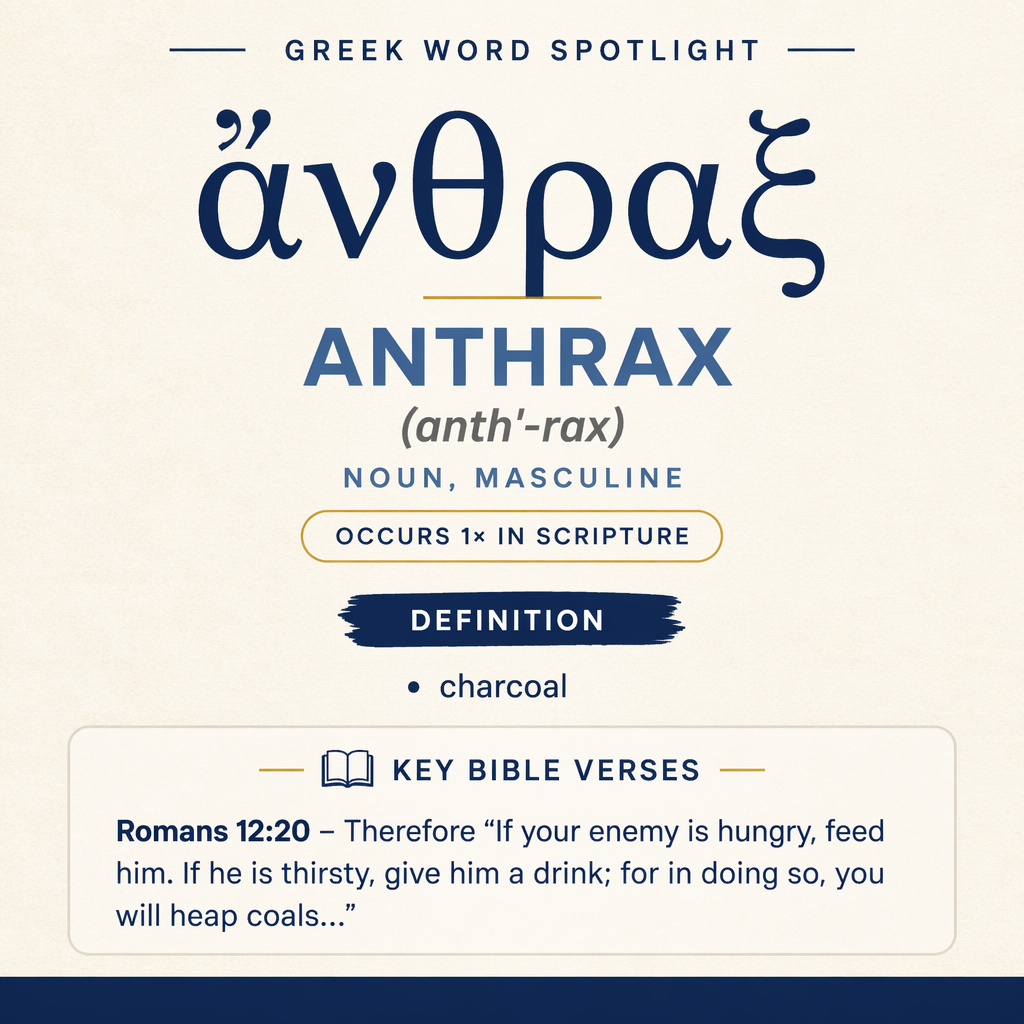
ἄνθραξ means “charcoal” and appears once in Scripture, in Romans 12:20.
Context in Romans
In Romans 12:20 it appears in the phrase “heap coals,” within instructions to feed and give drink to an enemy.
Learn More →ἄνθραξ refers to charcoal and appears in Paul’s instruction on responding to an enemy in Romans 12:20. In that setting it functions as a vivid image within a short chain of practical commands.
Occurrences
Therefore “If your enemy is hungry, feed him. If he is thirsty, give him a drink; for in doing so, you will heap coals of fire on his head.” (Romans 12:20)
In Romans 12:20 the word names the material that makes up “coals of fire.” The sentence moves from concrete acts of mercy (“feed him… give him a drink”) to an explanation introduced by “for,” which grounds those acts in an arresting consequence: “you will heap coals of fire on his head.” By choosing charcoal as the substance of the “coals,” the imagery is anchored in an everyday fuel—something that can be gathered, piled, and that when lit yields intense heat. The verb “heap” makes the picture tactile and accumulative: not a single ember, but a piled mass. Within the flow of the quotation, the charcoal-coals image is not presented as an alternative to feeding and giving drink, but as what those acts accomplish in relation to the “enemy.” Thus ἄνθραξ contributes a concrete, sensory element—heat-bearing coals—set alongside ordinary food and drink, intensifying the portrayal of how benevolence is to be rendered even across hostility.

Sense and Usage
The meaning “charcoal” fits the verse’s emphasis on material, handled realities. Hunger and thirst are met with food and drink; likewise, the result is pictured in terms of something that can be physically collected and placed. Charcoal, unlike a more general term for fire, points to a burnable substance that can be present either as prepared fuel or as burning coals. The phrase “coals of fire” uses charcoal to express fire in a concentrated, portable form: coals can be carried and heaped, and their heat is sustained rather than momentary. This matches the verse’s action verb, “heap,” which implies an intentional accumulation.
Because the context is interpersonal—“your enemy”—the charcoal imagery serves as a metaphorical consequence that follows an act of tangible kindness. The verse does not describe a campfire or domestic hearth directly, but it borrows the physical properties of charcoal-coals (their capacity to be piled and to burn) to speak about what happens “in doing so,” that is, in feeding and giving drink. The intensity of the image lies in the combination of commonplace material (charcoal coals) with an unexpected placement (“on his head”). The wording invites the reader to feel the weight and heat suggested by such a heap, even while the surrounding commands remain calm, ordinary, and compassionate. In this way ἄνθραξ helps the sentence move from routine provisions to a sharper, more memorable picture that underscores the gravity of the moral response being described.
As used here, ἄνθραξ is not introduced with explanation; it functions as a familiar item drawn from daily life. Charcoal is the kind of object that can readily be counted, gathered, and stacked, which makes it suited to the verb “heap.” The metaphor’s force depends on that concreteness: the reader can imagine coals because they are physical pieces, not just a flame. Thus the word’s sense is carried not by abstract description but by the implied qualities of charcoal in a “coals of fire” pile—density, accumulation, and the capacity to convey burning heat.
Imagery
Romans 12:20 places charcoal-coals within a sequence that begins with addressing bodily need and ends with a striking image. The picture of “coals of fire” heaped “on his head” is intentionally memorable: it draws on something as ordinary as fuel for heat and cooking, yet frames it as a dramatic outcome tied to acts of generosity toward an adversary. The imagery works precisely because charcoal is a concrete substance that can be piled; the verse harnesses that physicality to make the results of mercy feel weighty and real.
Sources: Lexical data from Strong’s Exhaustive Concordance and the Translators Brief Lexicon of Extended Strongs for Greek (STEPBible, CC BY). Occurrence data from the Translators Amalgamated Greek New Testament (STEPBible, CC BY). Scripture quotations from the World English Bible (public domain).




