Understanding the Meaning of Anexereunetos in Greek
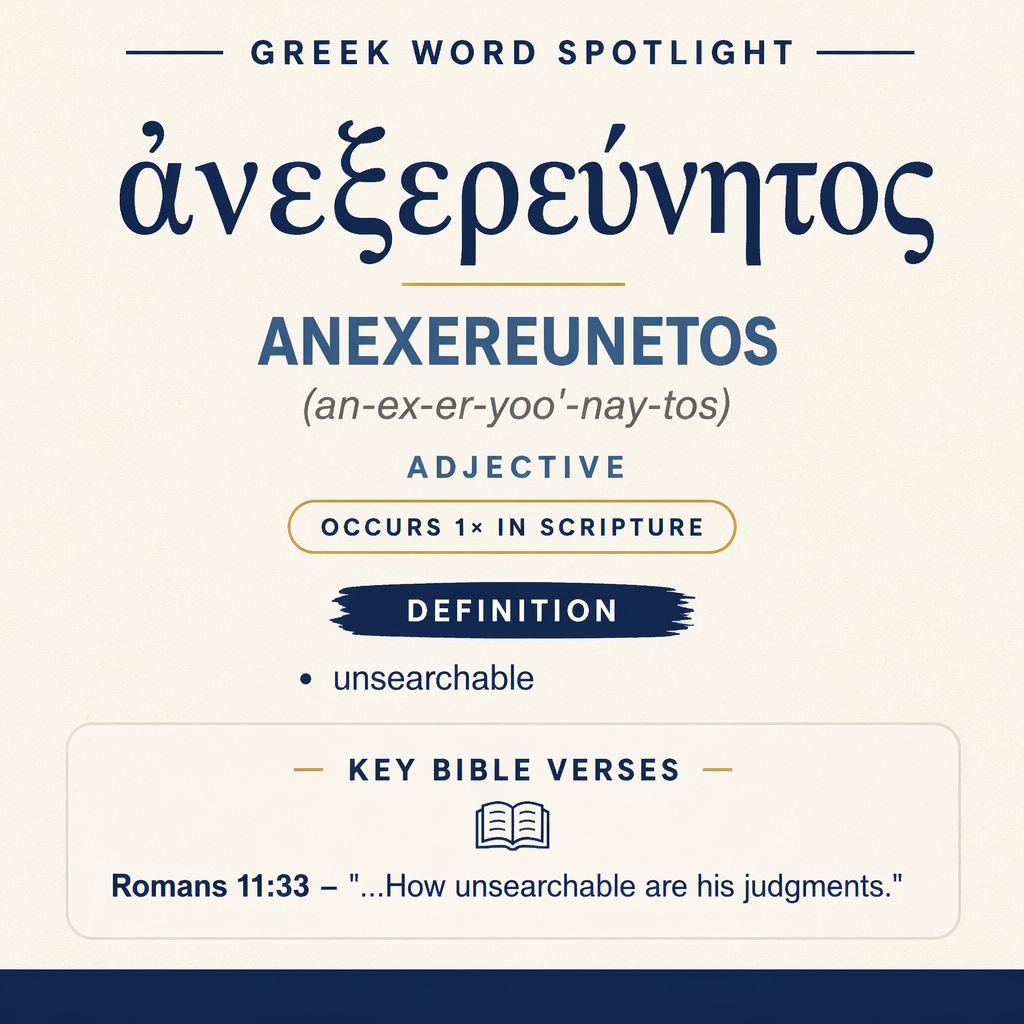
ἀνεξερεύνητος means “unsearchable” and appears once in Scripture, in Romans 11:33.
Scripture Occurrence
It occurs 1 time in Scripture. The occurrence is in Romans 11:33.
Learn More →Romans Context
In Romans 11:33, it describes God’s judgments as unsearchable, alongside his ways.
Learn More →ἀνεξερεύνητος means “unsearchable” and appears in Romans 11:33, where it characterizes God’s judgments within a doxology about divine wisdom and knowledge. In that setting the adjective helps express the felt limit of human tracing and measurement when faced with God’s dealings.
Root and Related Words
ἀνεξερεύνητος is connected with the verb exereunao (ἐξερευνάω), “to search out” (Strong’s G1830). Strong’s also links it to A (α, Ἀλφα), “Alpha” (Strong’s G1).

Occurrences
“Oh the depth of the riches both of the wisdom and the knowledge of God! How unsearchable are his judgments, and his ways past tracing out!” (Romans 11:33)
In Romans 11:33, ἀνεξερεύνητος stands in a pair of exclamations that respond to “the depth of the riches both of the wisdom and the knowledge of God.” The line does not present God’s judgments as merely complicated; it presents them as reaching beyond the limits of searching. The surrounding wording frames this as a reaction of astonishment (“Oh the depth… How…!”), so the adjective functions rhetorically as part of praise: the speaker’s wonder rises from the recognition that God’s “judgments” cannot be fully searched through.
The word also contributes a sharp contrast inside the verse itself. First, the doxology points to abundance and profundity (“depth,” “riches,” “wisdom,” “knowledge”); then it turns to the human side of the encounter—what happens when one tries to follow the line of God’s decisions and assessments (“his judgments”). The adjective places a boundary around the act of inquiry: the judgments are positioned as beyond the reach of a search that would claim completeness. As the verse moves immediately to “his ways past tracing out,” ἀνεξερεύνητος helps establish a parallel picture: judgments that cannot be searched, and ways that cannot be tracked to their end. In that pairing, “unsearchable” carries the force of an impossibility of exhaustive investigation, matching the verse’s language of “depth” and “past tracing out.”
Sense and Usage
Within its lone New Testament setting, ἀνεξερεύνητος works as a reverent limit-word. It marks God’s judgments as a reality that resists the kind of searching that would lay everything open, account for every turn, and render the whole comprehensible as a finished map. The verse’s structure ties the adjective to two closely related domains: (1) God’s inner plenitude (“the depth of the riches… of the wisdom and the knowledge of God”), and (2) God’s outward action (“his judgments… his ways”). The effect is to connect the unsearchability of judgments to the depth of divine wisdom and knowledge: the judgments are unsearchable not because they are arbitrary, but because they belong to a depth that evokes doxology.
The immediate parallel expression, “his ways past tracing out,” helps clarify how “unsearchable” is being heard in context. The imagery is not of a hidden object that one might eventually uncover with enough effort, but of a route that cannot be fully tracked. In this verse, then, ἀνεξερεύνητος expresses a kind of transcendent excess: God’s judgments surpass the capacity of a search to master them. The adjective thereby supports the tone of worship that runs through the exclamation. It does not suspend thought; rather, it places thought in its proper posture—one that can acknowledge “wisdom” and “knowledge” in God while confessing that God’s judgments outrun the searcher’s reach.
Imagery
Romans 11:33 surrounds ἀνεξερεύνητος with images of depth and tracking. The “depth of the riches” sets a vertical, plunging sense of magnitude, while “ways past tracing out” suggests a path that cannot be followed to its end. In that combined imagery, “unsearchable” evokes not emptiness but an expanse—judgments belonging to a wisdom and knowledge so deep that searching does not arrive at a final boundary.
Sources: Lexical data from Strong’s Exhaustive Concordance and the Translators Brief Lexicon of Extended Strongs for Greek (STEPBible, CC BY). Occurrence data from the Translators Amalgamated Greek New Testament (STEPBible, CC BY). Scripture quotations from the World English Bible (public domain).