Exploring the Meaning of Anaphaino in Greek
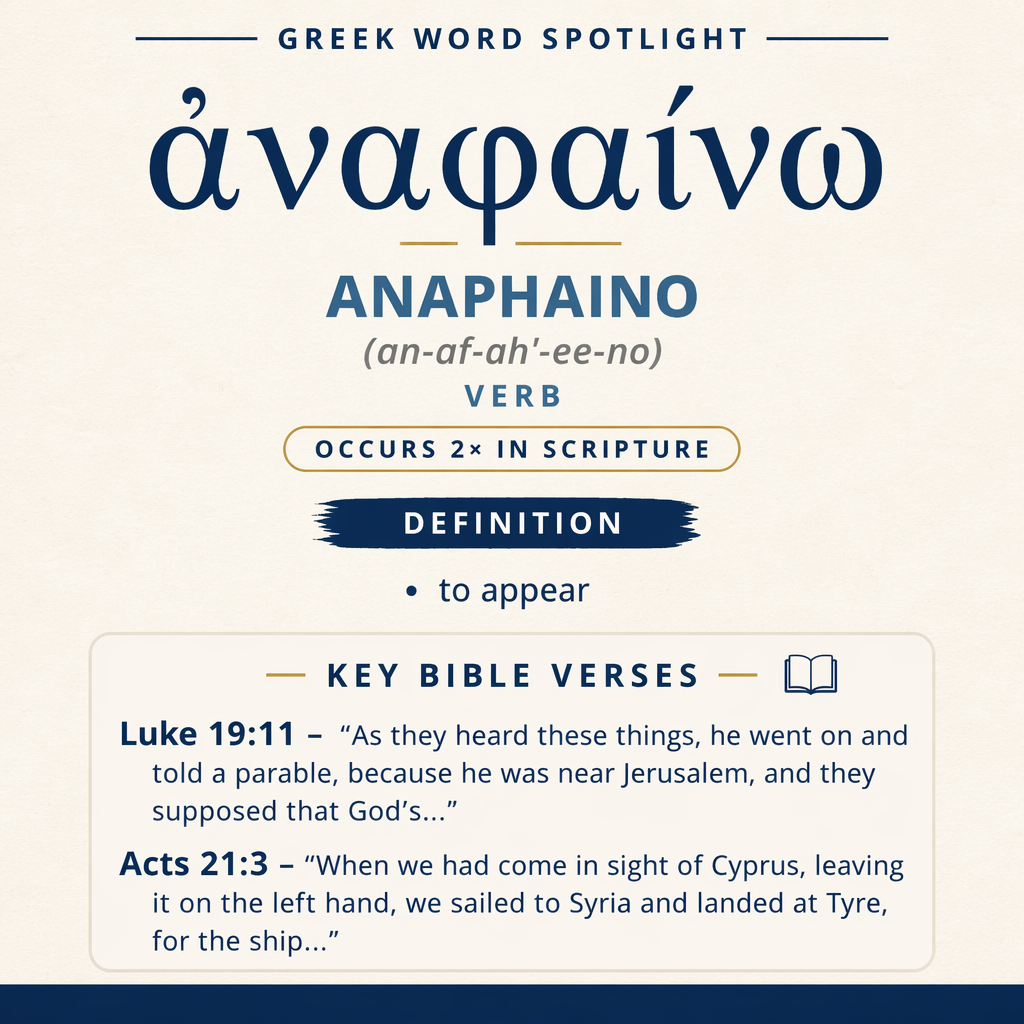
ἀναφαίνω means “to appear” and occurs twice in Scripture: Luke 19:11 and Acts 21:3.
Scripture Occurrences
This word occurs 2 times in Scripture: Luke 19:11 and Acts 21:3.
Learn More →Verse Context
In Luke 19:11 it appears in a setting where Jesus tells a parable near Jerusalem. In Acts 21:3 it is used when Cyprus comes in sight during a voyage.
Learn More →ἀναφαίνω means “to appear.” In the New Testament it is used in a context of expectation about what will be revealed near Jerusalem and in a travel narrative where a prominent landmark comes into view at sea.
Root and Related Words
ἀναφαίνω is associated with the particle ana (ἀνά), glossed “each,” and the verb phaino (φαίνω), glossed “to shine/appear.”

Occurrences
“As they heard these things, he went on and told a parable, because he was near Jerusalem, and they supposed that God’s Kingdom would be revealed immediately.” (Luke 19:11)
In Luke’s scene, the idea of “appearing” is tied to timing and expectation. The crowd’s supposition is not merely that something will be real, but that it will come into view—become evident—“immediately.” The narrative frame is concrete: “he was near Jerusalem,” and the nearness of a major city shapes the crowd’s assumption about what is about to happen. Within that moment, the concept of appearing functions as a perceived threshold: what is currently anticipated but not yet visible is expected to cross into the open without delay. Luke then notes that Jesus “told a parable” in response to that assumption, signaling that the expectation of an imminent appearing is a significant part of the situation being addressed.
The verb’s force here leans on the difference between what people think is about to show itself and what has not yet done so. The point is not that the Kingdom is discussed abstractly, but that it is imagined as something that could become manifest in a way that would be recognizable to those present. The immediate setting (“as they heard these things”) also makes the expectation sound reactive: their interpretation of recent words and circumstances leads them to believe an appearing is imminent. Thus the term contributes the sense of an anticipated disclosure that would be clear enough to settle the question by being seen as “revealed.”
“When we had come in sight of Cyprus, leaving it on the left hand, we sailed to Syria and landed at Tyre, for the ship was there to unload her cargo.” (Acts 21:3)
In Acts, “appearing” is expressed as a maritime sighting: Cyprus comes into view as the ship advances. The narrative is anchored in motion and direction. The wording “had come in sight of Cyprus” depicts a moment when what was previously beyond the horizon becomes visible to the travelers, and that visibility then becomes a navigational reference point—“leaving it on the left hand.” Here the notion of appearing is not about expectation of an event but about a landscape feature becoming perceptible as the journey progresses.
This usage is practical and observational. The ship’s course is described through what can be seen: the island appears, the crew passes it, then they “sailed to Syria and landed at Tyre.” The appearing of Cyprus divides the voyage into stages and helps the reader picture the route. In such a travel log, the verb serves to mark the transition from open sea to a defined geography, where the appearance of land confirms location and enables the next actions. The sighting is also fleeting in the sense that the ship does not stop at Cyprus; it is viewed, oriented to (“on the left hand”), and then left behind as the journey continues toward Tyre, where a different purpose—unloading cargo—drives the stop.
Sense and Usage
Across these two passages, “to appear” is used for something that becomes perceptible in a way that changes what follows. In Luke 19:11, the appearing is expected to be immediate and decisive: it is bound to the crowd’s assumption about what is on the verge of being made manifest near Jerusalem. The emphasis falls on imminence (“immediately”) and on the hoped-for transition from anticipation to open recognition (“revealed”). The concept of appearing therefore carries a temporal edge: a question of when what is expected will become visible and evident.
In Acts 21:3, the appearing is spatial and observational: land that was not in view becomes visible as the ship draws near. The term’s contribution is not a claim about what the sailors believe will happen, but a description of what their eyes and position now allow them to perceive. The appearance of Cyprus is not an endpoint but a moment of confirmation and orientation in movement. That concrete sighting then shapes the narration of the route—Cyprus is placed “on the left hand,” and the voyage continues toward Syria and a landing at Tyre.
Read together, these uses show how “appearing” can work either as a hoped-for disclosure (something thought to be about to show itself) or as a straightforward emergence into sight (something becoming visible with approach). In both cases, the word sits at a boundary between hiddenness and visibility. In Luke the boundary is imagined and timed—people suppose an immediate revealing. In Acts the boundary is encountered in travel—approach yields sight. The common thread is the shift from what is not yet evident to what has now come into view, whether in expectation or in experience.
Imagery
The two scenes supply distinct but complementary pictures. Luke 19:11 places “appearing” alongside a crowd’s readiness for a sudden unveiling near Jerusalem: a sense of imminence, as though the next moment could bring what they are waiting to see. Acts 21:3 grounds “appearing” in the slow certainty of a voyage, when an island rises into sight and becomes a fixed point on the horizon before slipping past “on the left hand.” Together they frame appearing as both a hoped-for manifestation and a seen arrival into view.
Sources: Lexical data from Strong’s Exhaustive Concordance and the Translators Brief Lexicon of Extended Strongs for Greek (STEPBible, CC BY). Occurrence data from the Translators Amalgamated Greek New Testament (STEPBible, CC BY). Scripture quotations from the World English Bible (public domain).