
Exploring the Meaning of Anaperos in Greek
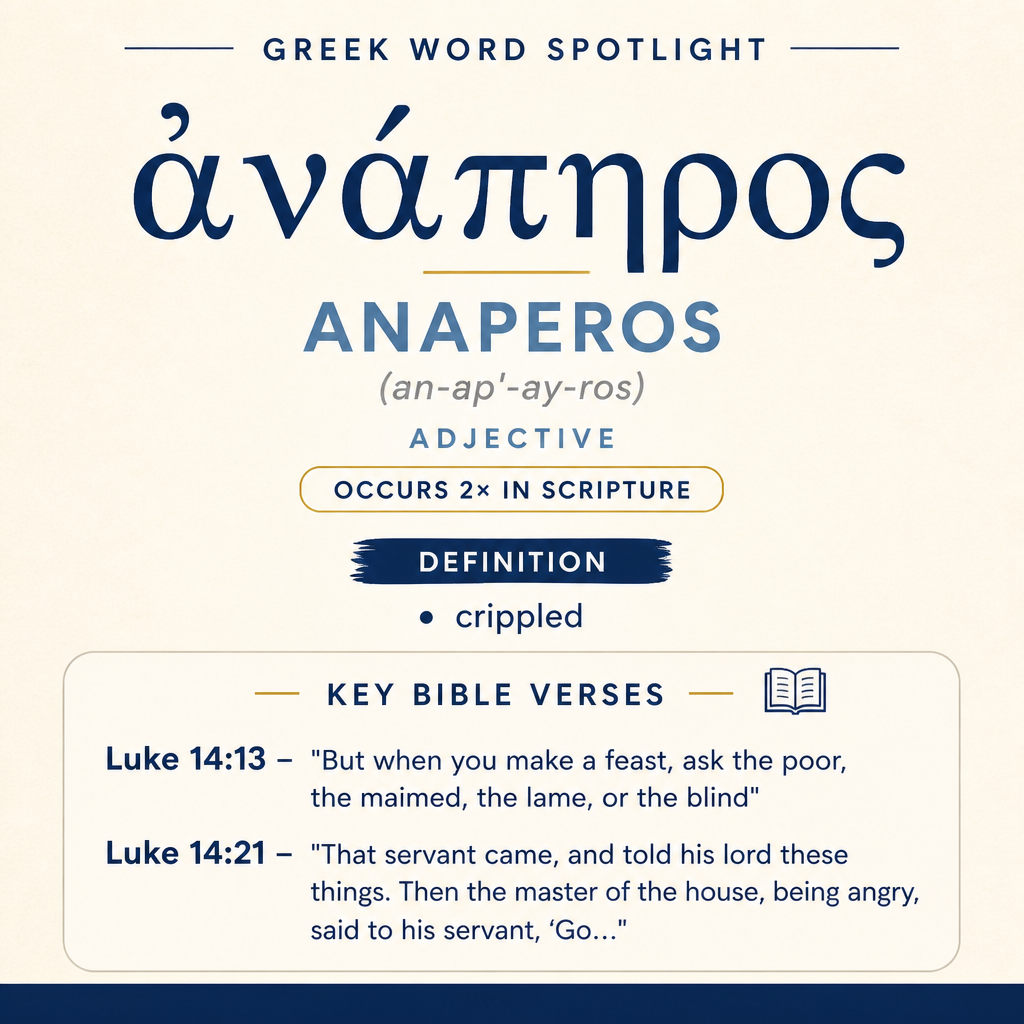
ἀνάπηρος means “crippled” and appears twice in Scripture, both in Luke 14:13 and Luke 14:21.
Luke 14 Context
In Luke 14:13 it appears in a list including “the poor” and “the maimed.” In Luke 14:21 it appears within the master’s command to his servant.
Learn More →ἀνάπηρος describes someone who is “crippled” and appears in Jesus’ teaching about a feast and an invitation. In both places it stands among other descriptors for people on the margins of public life, named as fitting guests at a table.
Root and Related Words
ἀνάπηρος is related to ana (ἀνά), glossed “each.”
Occurrences
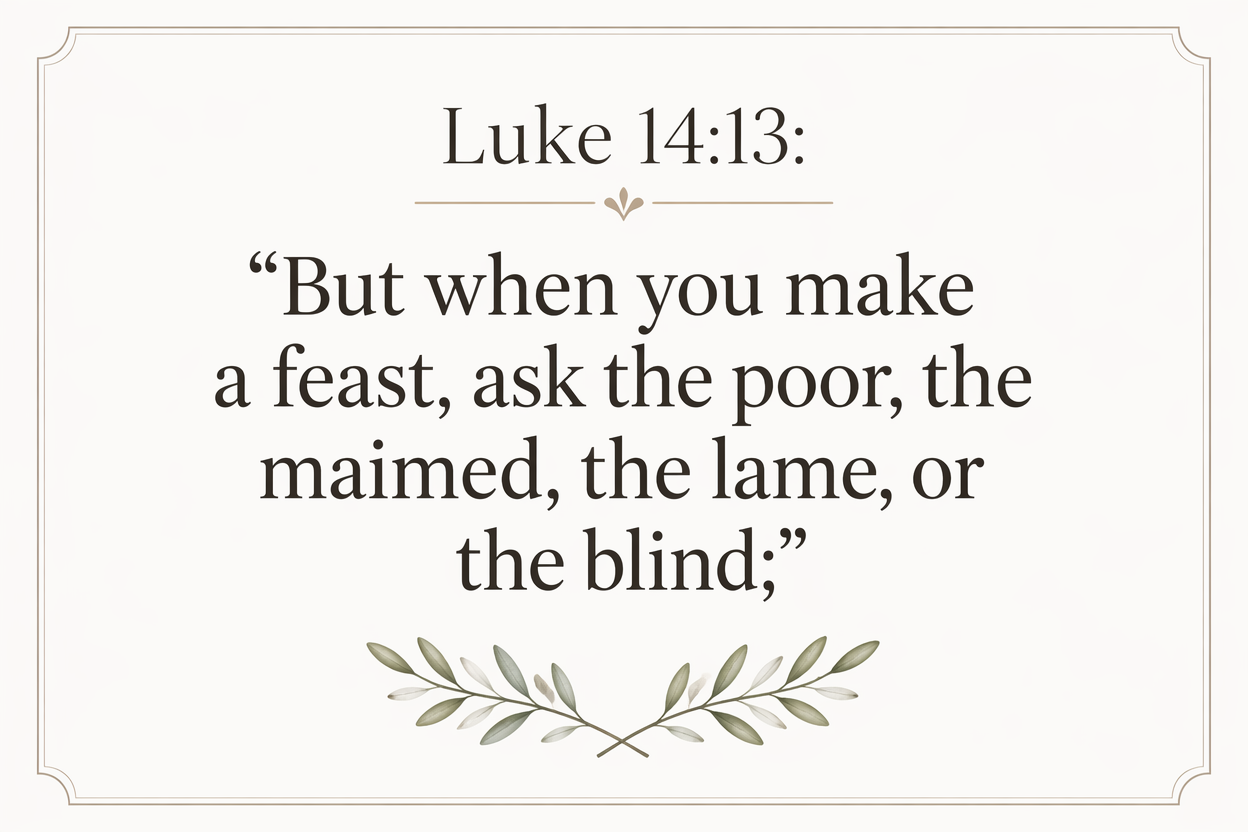
Luke 14:13: “But when you make a feast, ask the poor, the maimed, the lame, or the blind;”
Here ἀνάπηρος is rendered “the maimed” within a list that also includes “the poor,” “the lame,” and “the blind.” The setting is a “feast,” and the imperative “ask” frames the word as part of a deliberate choice of invitees. The term functions as a concrete descriptor: it identifies people whose bodies bear a disabling impairment and therefore may be overlooked when invitations follow social advantage. Placed alongside economic need (“the poor”) and other physical limitations (“the lame,” “the blind”), “the maimed” contributes to a composite picture of those who are unlikely to be included by ordinary hospitality.
The grammar of the line is tightly practical: “when you make a feast” points to a real social occasion, and the direct address implies the host’s agency. In that context, ἀνάπηρος helps define the kind of guest list being commended—one that is not shaped by a guest’s ability to repay, enhance status, or comfortably participate in the usual expectations of banqueting. The word’s force is not abstract; it names a bodily condition that would have immediate social consequences in the scene of a meal.
Luke 14:21: ““That servant came, and told his lord these things. Then the master of the house, being angry, said to his servant, ‘Go out quickly into the streets and lanes of the city, and bring in the poor, maimed, blind, and lame.’”
In this verse ἀνάπηρος again appears as “maimed,” but now inside a narrated command in which a “master of the house” directs a “servant.” The instruction is urgent—“Go out quickly”—and the search is expansive within an urban setting: “the streets and lanes of the city.” The word thus participates in a scene of active gathering rather than a simple recommendation. Those described as “poor, maimed, blind, and lame” are not imagined as waiting at the door; they are sought out and “bring in” becomes the decisive action.
The master’s emotional posture—“being angry”—colors the command. The anger is not directed at the “poor, maimed, blind, and lame,” who are instead the recipients of a summons into the house. In this narrated moment, ἀνάπηρος contributes to the portrayal of the people who are accessible in “streets and lanes,” the kind of inhabitants a servant could find when sent out quickly. The word marks a class of persons whose physical impairment would make them visible in the public spaces described and whose inclusion is framed as an authoritative response to the situation the servant has reported.
The placement of “maimed” between “poor” and “blind” keeps the term in a cluster of descriptors rather than as a standalone label. Yet it still carries its own weight: it differentiates one kind of limitation from another. In the logic of the command, the list is not redundant; it multiplies categories to fill the house with people who would not be first in line for prestigious invitations, and ἀνάπηρος is one of the concrete categories by which that wider inclusion is expressed.
Sense and Usage
Across these two uses, ἀνάπηρος (“crippled”) functions as a social descriptor within the setting of hospitality. The word does not operate as a medical explanation, a diagnosis, or a moral evaluation; it is simply one of the identifying terms by which certain people are recognized in the public world of the passages. The repeated pairing with “poor,” “blind,” and “lame” shows that it belongs to a vocabulary of vulnerability and disadvantage: a host who invites such people is choosing guests who likely lack the ordinary resources, mobility, or social standing associated with reciprocal banquet culture.
The immediate collocations help define how “crippled” is being used. First, it is coordinated with other nouns (“the poor, the maimed, the lame, or the blind”) in a directive about whom to “ask” when preparing a feast. Second, it is coordinated in a similar list in a command to “bring in” people found in “streets and lanes.” In both settings, the word’s meaning remains stable, but its role in the discourse shifts slightly: in Luke 14:13 it is part of an ethical reorientation of the host’s guest list; in Luke 14:21 it is part of the concrete execution of a master’s order to populate the house. The repetition strengthens recognition—this is not a one-off adjective, but a recurring category in the scene’s social imagination.
The term also carries an implicit contrast within the banqueting setting without needing to name the contrasting group. A “feast” is a context where the able-bodied often move with ease—arriving, reclining, eating, and socializing according to custom. By naming those who are “maimed,” the passage signals that the table envisioned here makes room for people whose bodies may not fit the default assumptions of such gatherings. The word therefore does narrative work: it makes the act of invitation more vivid and more costly in ordinary social terms, because the host’s generosity is directed toward those whose presence underscores need rather than advantage.
Because ἀνάπηρος appears in lists, it also participates in the rhetorical effect of accumulation. Naming multiple kinds of hardship broadens the circle of invited guests. “Poor” speaks to economic limitation; “blind” and “lame” point to sensory and mobility limitations; “maimed” adds another kind of physical impairment. Together these terms depict a community segment defined not by a shared virtue or profession but by conditions that typically reduce access to honor, comfort, and inclusion. In that composite portrait, ἀνάπηρος contributes a specific facet of bodily disadvantage that supports the larger emphasis on welcoming those commonly passed over.
Imagery
The imagery attached to ἀνάπηρος in these passages is domestic and urban at once: a prepared feast inside a house, and a servant moving through “streets and lanes of the city” to gather guests. “The maimed” evokes bodies marked by impairment entering a space of provision and fellowship. In both verses the word is tied to movement toward a table—first through a host’s intentional invitation, and then through the master’s command that such people be brought in—so the term becomes part of the picture of a house opened wide to those ordinarily left outside the circle of celebratory meals.
Sources: Lexical data from Strong’s Exhaustive Concordance and the Translators Brief Lexicon of Extended Strongs for Greek (STEPBible, CC BY). Occurrence data from the Translators Amalgamated Greek New Testament (STEPBible, CC BY). Scripture quotations from the World English Bible (public domain).




