Exploring the Meaning of Anamimnesko in Greek
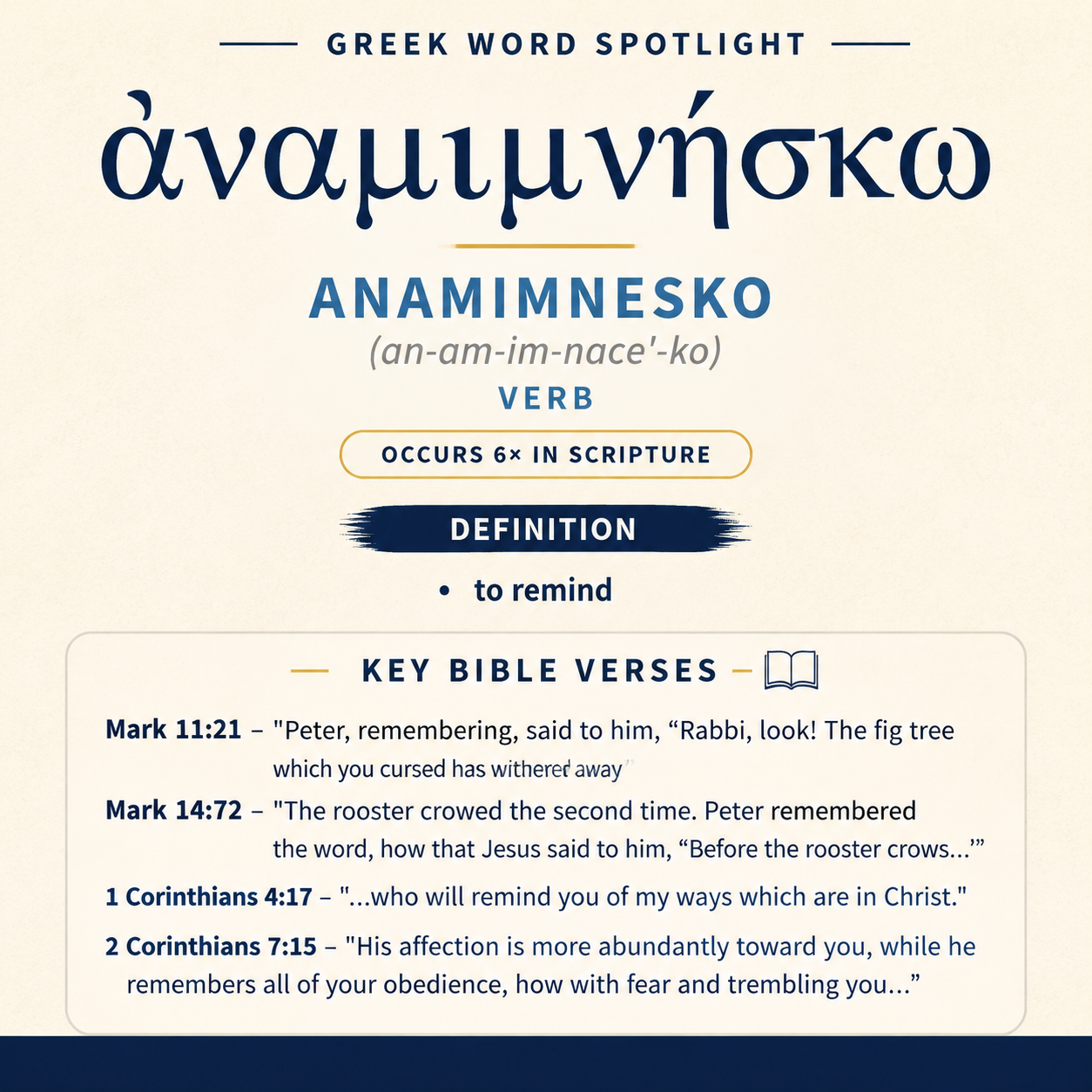
ἀναμιμνήσκω means “to remind” and occurs six times in Scripture: Mark 11:21; Mark 14:72; 1 Corinthians 4:17; 2 Corinthians 7:15; 2 Timothy 1:6; Hebrews 10:32.
Core Meaning
ἀναμιμνήσκω means “to remind.” It is used for remembering words, events, and actions.
Learn More →Gospel Occurrences
In Mark 11:21 and 14:72, Peter remembers: the withered fig tree and Jesus’ word about the rooster crowing.
Learn More →Church Exhortation
Paul uses it for reminding and remembering in 1 Corinthians 4:17, 2 Corinthians 7:15, and 2 Timothy 1:6. Hebrews 10:32 calls believers to remember the former days.
Learn More →ἀναμιμνήσκω means “to remind,” and it appears in scenes of recalled words and renewed attention across the Gospels, Paul’s letters, and Hebrews. The occurrences range from Peter’s sudden recollection to apostolic exhortation that calls earlier instruction and experience back into view.
Root and Related Words
ἀναμιμνήσκω is connected with ana (ἀνά), “each,” and mimnesko (μιμνήσκω), “to remember.”

Occurrences
Mark 11:21 — “Peter, remembering, said to him, “Rabbi, look! The fig tree which you cursed has withered away.””
Here the verb marks Peter’s mental return to what had happened earlier: Jesus’ curse of the fig tree. The reminder is not delivered as a formal lesson but as an awakened recollection that prompts speech (“said to him”) and directs attention (“look!”) to a visible outcome (“has withered away”). In this scene, reminding is tied to recognition in the moment, connecting a prior word to its present effect.
Mark 14:72 — “The rooster crowed the second time. Peter remembered the word, how that Jesus said to him, “Before the rooster crows twice, you will deny me three times.” When he thought about that, he wept.”
The remembering is tightly anchored to a specific “word” Jesus had spoken and to an audible trigger (“The rooster crowed the second time”). The recollection is not neutral: it brings Jesus’ prediction into sharp focus alongside Peter’s actions, and the verse traces a movement from remembering (“Peter remembered the word”) to internal processing (“When he thought about that”) to an emotional response (“he wept”). The verb therefore functions in the narrative as the turning point where earlier speech becomes personally confronting in the present.
1 Corinthians 4:17 — “Because of this I have sent Timothy to you, who is my beloved and faithful child in the Lord, who will remind you of my ways which are in Christ, even as I teach everywhere in every assembly.”
In this letter, reminding is something intentionally arranged through a messenger (“I have sent Timothy to you”). The content of what is brought back to mind is described as “my ways which are in Christ,” and the reminder is framed as consistent with Paul’s broader teaching practice (“even as I teach everywhere in every assembly”). The verb thus describes a pastoral action: Timothy’s presence and instruction are meant to reawaken the community’s grasp of Paul’s pattern of life and teaching, aligning them with what they have already been shown.
2 Corinthians 7:15 — “His affection is more abundantly toward you, while he remembers all of your obedience, how with fear and trembling you received him.”
Here remembering operates within a relationship and explains growing affection. The memory is specific and comprehensive in its scope (“all of your obedience”) and is illustrated by the manner of reception (“with fear and trembling you received him”). The verb portrays an ongoing recollection that continues to shape present feeling (“His affection is more abundantly toward you”), so the reminder is not merely informational; it sustains an attitude of warmth grounded in remembered conduct.
2 Timothy 1:6 — “For this cause, I remind you that you should stir up the gift of God which is in you through the laying on of my hands.”
This instance presents reminding as direct exhortation. The verb introduces a call to action: “you should stir up the gift of God which is in you.” The reminder connects Timothy’s present responsibility with a past event (“through the laying on of my hands”), drawing a line from earlier reception to renewed activity. In this setting, reminding is a means of reactivating what is already possessed (“which is in you”) rather than introducing something unfamiliar.
Hebrews 10:32 — “But remember the former days, in which, after you were enlightened, you endured a great struggle with sufferings;”
The command to remember is aimed at perseverance by calling earlier experience back into view. The “former days” are characterized by a sequence: enlightenment (“after you were enlightened”) followed by costly endurance (“you endured a great struggle with sufferings”). The verb functions rhetorically to make past faithfulness present again, so that the audience’s memory of endurance becomes a resource for their current situation.
Sense and Usage
Across these passages, “to remind” works in two closely related directions: it can describe a person’s own recollection arising within an event, and it can describe one person acting upon another so that what is already known becomes active again. In Mark, remembering emerges as an inward recognition that is triggered by circumstances: Peter’s notice of the withered fig tree follows his recalling of Jesus’ earlier word (Mark 11:21), and the crowing rooster brings Jesus’ prediction into consciousness with painful clarity (Mark 14:72). In both cases, the remembered material is connected to Jesus’ speech, and the act of remembering alters the present moment—prompting an exclamation in one scene and tears in the other.
In the letters, reminding is more overtly deliberate and relational. Paul can arrange for reminding to occur through Timothy, with the goal that the Corinthians recall “my ways which are in Christ” in continuity with teaching given “everywhere in every assembly” (1 Corinthians 4:17). The verb thus supports communal stability: what has been taught is to be brought to mind again so it governs present practice. In 2 Corinthians 7:15, the remembering belongs to “him” whose “affection” increases as he calls to mind their “obedience” and their reception “with fear and trembling.” Reminding here is not framed as correction but as a sustaining memory that deepens affection.
2 Timothy 1:6 and Hebrews 10:32 show reminding as exhortation that links past realities to present responsibility. Timothy is urged to “stir up the gift of God which is in you,” and the reminder explicitly reaches back to “the laying on of my hands,” tying a prior moment to ongoing stewardship. Hebrews similarly directs attention backward—“remember the former days”—but with a communal aim: the recollection of enlightenment followed by endurance in suffering is meant to shape how the community understands its present trials. In both, the reminder is a call for continued faithfulness grounded in remembered experience.
Seen together, these uses show that reminding involves more than recalling facts; it brings prior words, teachings, actions, or experiences forward so they interpret and direct the present. The remembered content varies—Jesus’ spoken word, apostolic “ways,” obedience received and observed, a gift to be stirred, and endured suffering—but the function remains consistent: reminding reconnects earlier realities with current response.
Imagery
The passages attach reminding to vivid anchors: a fig tree “withered away” (Mark 11:21), the sound of a rooster crowing “the second time” (Mark 14:72), the arrival of a trusted coworker sent to “remind you” (1 Corinthians 4:17), remembered “obedience” received “with fear and trembling” (2 Corinthians 7:15), the stirring of an internal “gift of God” linked to a past laying on of hands (2 Timothy 1:6), and “former days” defined by enlightened endurance amid “sufferings” (Hebrews 10:32). In each setting, reminding is portrayed as the bridge that brings what is earlier into the force of the present moment.
Sources: Lexical data from Strong’s Exhaustive Concordance and the Translators Brief Lexicon of Extended Strongs for Greek (STEPBible, CC BY). Occurrence data from the Translators Amalgamated Greek New Testament (STEPBible, CC BY). Scripture quotations from the World English Bible (public domain).