
Understanding the Meaning of Anabibazo in Greek
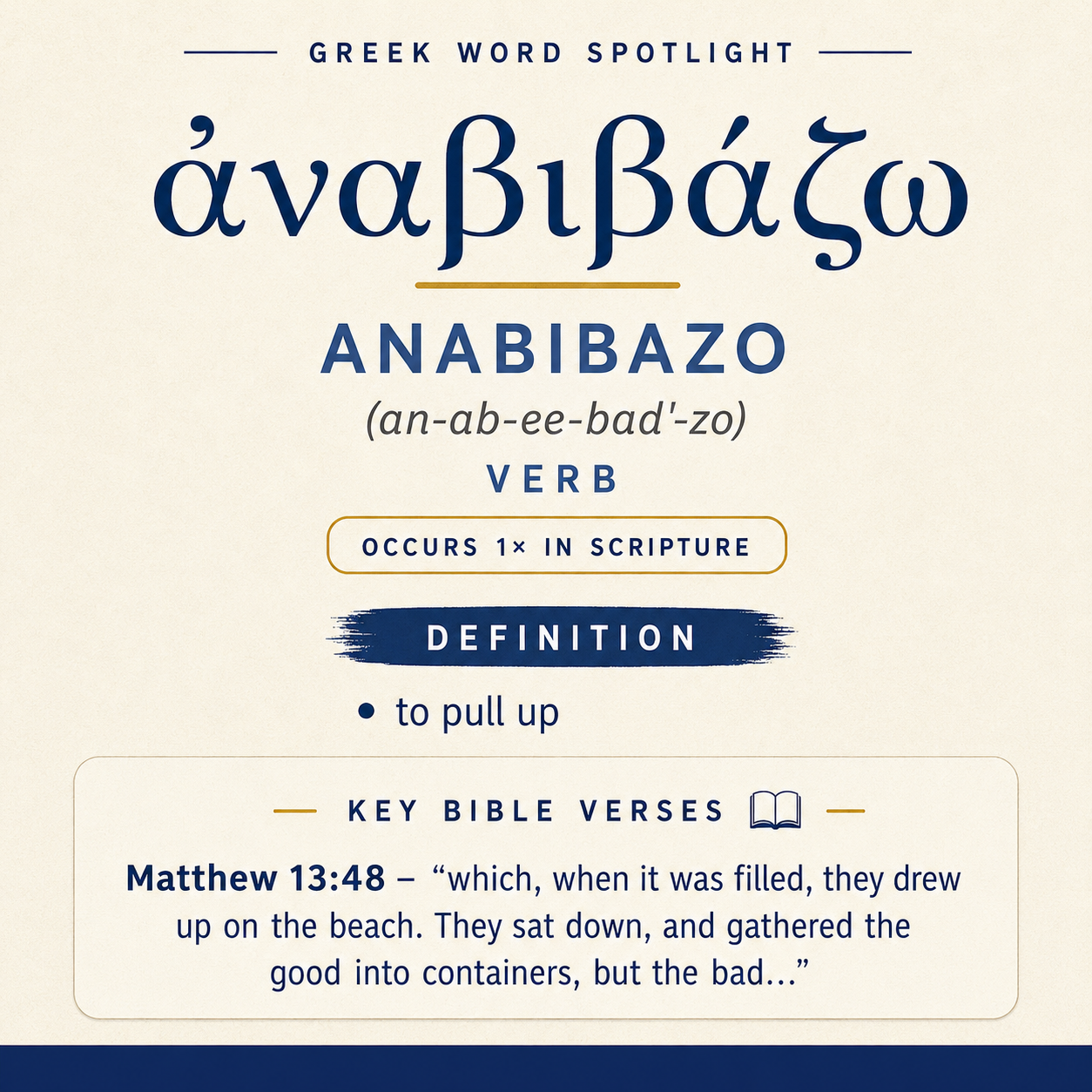
ἀναβιβάζω means “to pull up” and appears once in Scripture, in Matthew 13:48.
Biblical Occurrence
This verb occurs 1 time in Scripture. Its single occurrence is in Matthew 13:48.
Learn More →Verse Context
In Matthew 13:48, it describes drawing something up onto the beach when it was filled.
Learn More →ἀναβιβάζω means “to pull up,” and it appears in the parable of the net in Matthew 13:48. In that scene it names the decisive action that brings what has been gathered out of the water and onto the shore for sorting.
Root and Related Words
ἀναβιβάζω is connected with the preposition ἀνά (ana), “each” (Strong’s G303), and the noun βάσις (basis), “foot” (Strong’s G939). Together these related elements frame the verb as a compound expression whose form points to a movement characterized by direction and footing, fitting the concrete, physical action described in its lone Gospel occurrence.

Occurrences
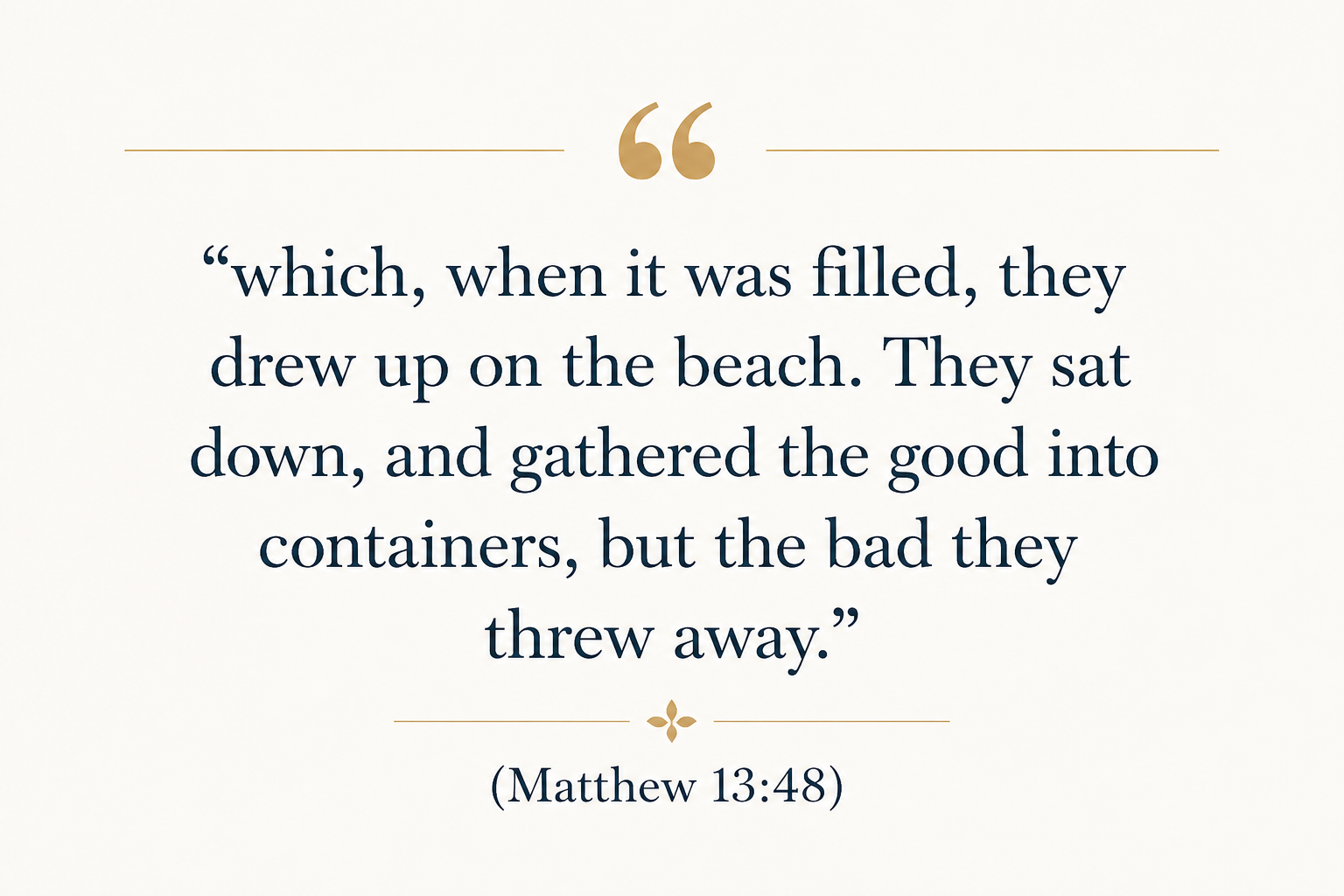
“which, when it was filled, they drew up on the beach. They sat down, and gathered the good into containers, but the bad they threw away.” (Matthew 13:48)
Here ἀναβιβάζω supplies the hinge between two phases of the picture: first the net becomes “filled,” then it is “drew up on the beach,” and only after that do the fishermen “sat down” to separate the catch. The verb marks the moment the contents of the net are brought out of their former setting and set within reach for inspection. Because the next actions are deliberate—sitting down, gathering, placing in containers, and throwing away—the “pulling up” functions as the necessary transition from capture to evaluation.
The location phrase “on the beach” tightens the image. The action is not merely lifting in place; it results in the net and its contents being brought to a stable boundary where sorting can happen. In the flow of the sentence, the verb therefore contributes a sense of arrival at a working surface: what was in the water is now on the shore, and the catch is exposed to view. The immediate contrast that follows (“the good” versus “the bad”) depends on this change of setting. The act of pulling up is what makes the subsequent separation possible and orderly, since the fishermen can now handle individual fish and assign them either to “containers” or to disposal.
Even within this brief clause, the verb also carries a strong sense of completion. The net is “filled,” a state implying that gathering is finished; “they drew up,” an act implying that hauling is finished; “they sat down,” implying time is taken for careful sorting. ἀναβιβάζω names the concrete, exertive motion that ends the fishing and begins the reckoning over what has been collected.
Sense and Usage
The sense “to pull up” is enacted in Matthew 13:48 as a physical hauling that relocates something from one environment to another. The verb’s force is seen in its placement after “when it was filled”: the fullness of the net triggers the pulling action. In other words, the word does not describe the gradual collecting of fish but the single, decisive movement that brings the catch to the point where it can be dealt with.
Within the verse’s sequence of verbs, “pull up” is the action that changes what kind of work is possible. While the net remains in the water, the only reality is a mixed catch held together. Once it is pulled up onto the beach, differentiation can begin: the fishermen can “gather the good into containers” and “throw away” the bad. The “pull up” therefore functions as the threshold verb: it brings the hidden or indistinct mass into a context where distinctions are made and outcomes are assigned.
The imagery also implies effort and control. A net that is “filled” is not weightless; it must be hauled. ἀναβιβάζω fits this concrete exertion without needing extra description, allowing the sentence to move quickly from the moment of hauling to the calm, seated work of sorting. The word thus supports a vivid contrast between strenuous lifting and measured evaluation, a contrast already embedded in the narrative pacing of the clause.
Finally, “to pull up” in this parabolic setting carries an observational quality: what is pulled up is no longer concealed by water. The verse’s emphasis on seeing and separating “good” and “bad” assumes exposure. ἀναβιβάζω contributes that exposure by depicting the bringing-up of the net to the shore, where its contents can be handled, retained, or discarded.
Imagery
Matthew 13:48 attaches ἀναβιβάζω to a shoreline scene: a full net drawn onto the beach, fishermen sitting, and a catch divided into what is kept in “containers” and what is “threw away.” The verb concentrates the picture into a single moment of upward, shoreward motion that precedes judgment on the contents—an action that makes the mixed catch available for a final, visible sorting.
Sources: Lexical data from Strong’s Exhaustive Concordance and the Translators Brief Lexicon of Extended Strongs for Greek (STEPBible, CC BY). Occurrence data from the Translators Amalgamated Greek New Testament (STEPBible, CC BY). Scripture quotations from the World English Bible (public domain).




