
Exploring the Meaning of Anaballomai in Greek
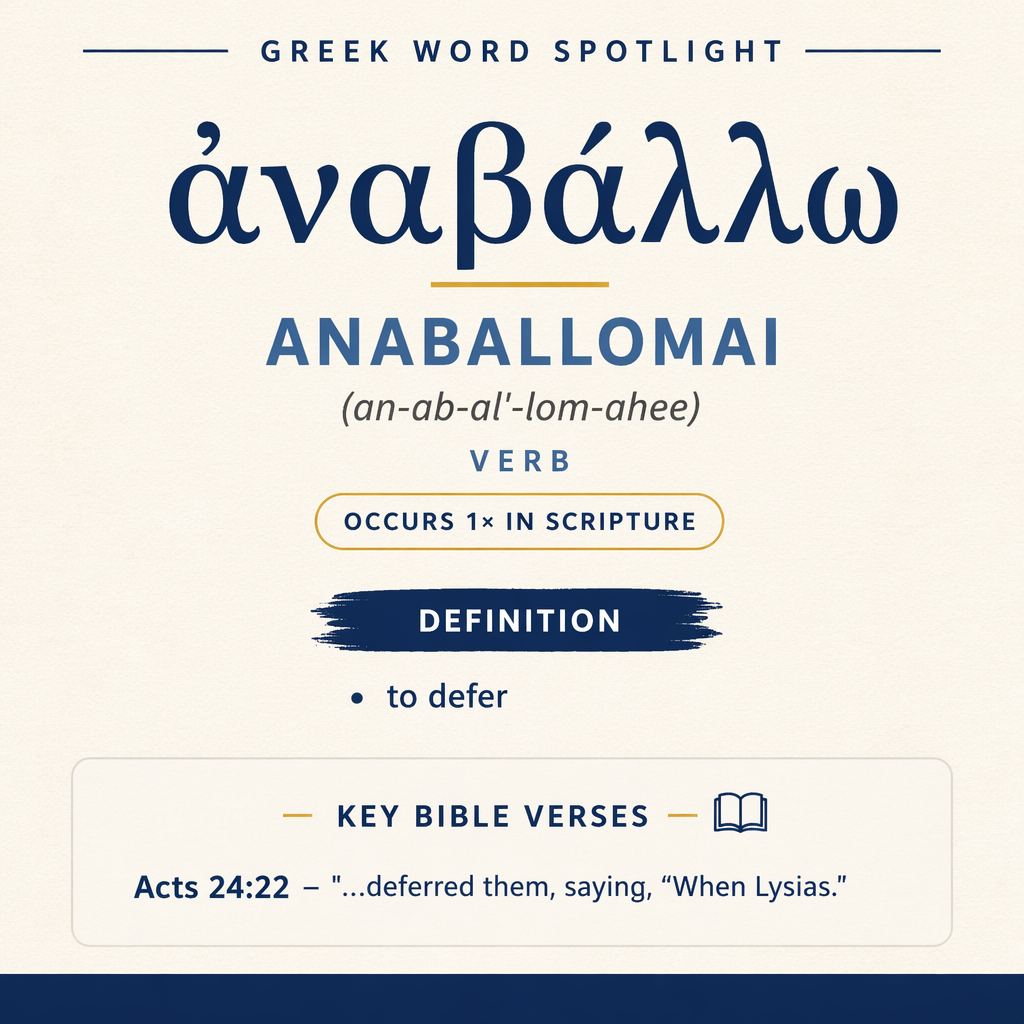
ἀναβάλλω means “to defer” and appears once in Scripture, in Acts 24:22.
Acts 24 Context
In Acts 24:22, Felix deferred them, mentioning Lysias the commanding officer.
Learn More →ἀναβάλλω means “to defer,” and it appears once in the New Testament, in the narrative of Paul’s hearing before the Roman governor Felix. In its single attested setting, it describes an official postponement of a decision while awaiting a key person.
Root and Related Words
ἀναβάλλω is connected with ἀνά (ana), “each” (Strong’s G303), and βάλλω (ballo), “to throw: throw” (Strong’s G906). These related elements frame the verb’s formation within Greek word-building, with the second component drawing on the verbal idea expressed by βάλλω.

Occurrences
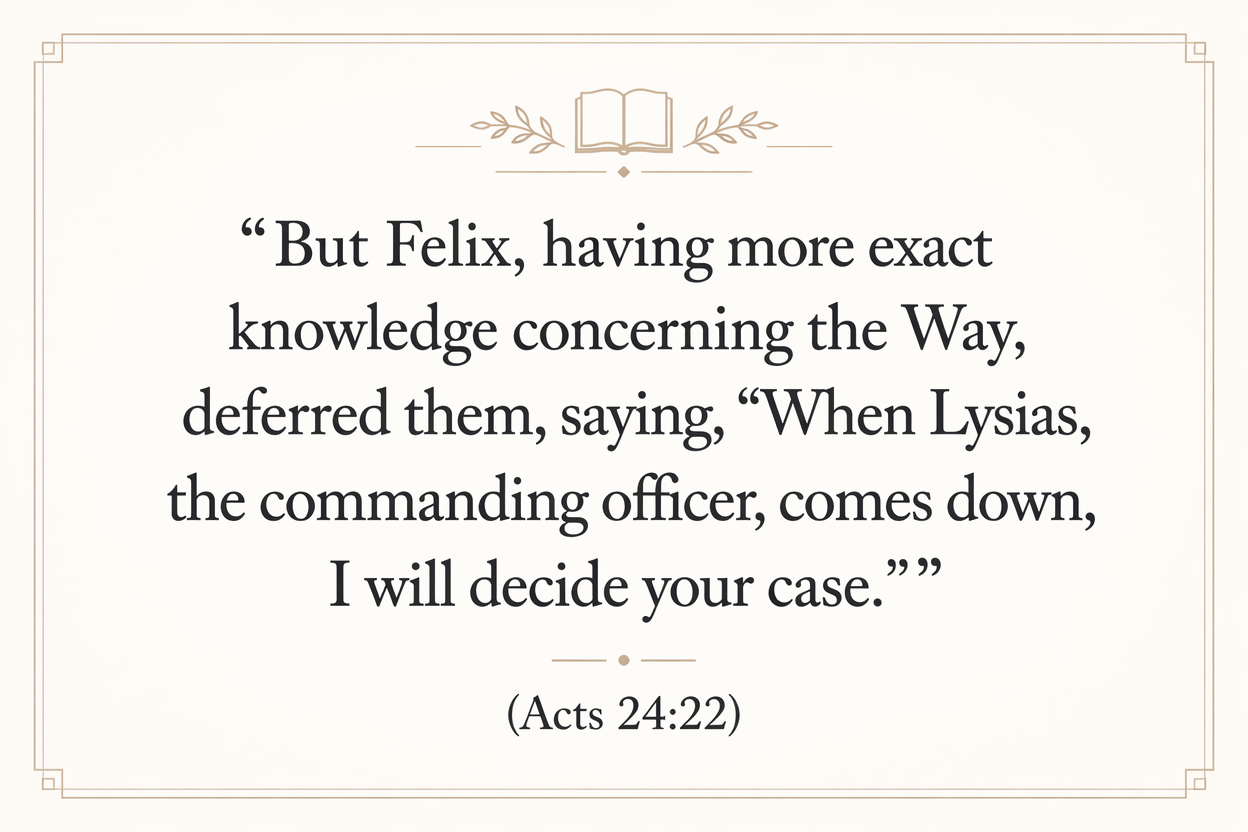
“But Felix, having more exact knowledge concerning the Way, deferred them, saying, “When Lysias, the commanding officer, comes down, I will decide your case.”” (Acts 24:22)
In Acts 24:22, ἀναβάλλω marks a procedural pause issued by Felix in the middle of a legal controversy. The verse sets the postponement within Felix’s posture as an informed authority: “having more exact knowledge concerning the Way,” he does not immediately render judgment. Instead, he “deferred them,” shifting the matter forward in time and tying the future decision to a condition he states explicitly—“When Lysias, the commanding officer, comes down, I will decide your case.”
The word therefore functions as more than a vague delay; it is a formal deferral of parties and proceedings. The speech that follows the verb explains the rationale and the endpoint Felix proposes: the case will be decided after Lysias arrives. In the narrative logic of the sentence, ἀναβάλλω links (1) Felix’s knowledge about “the Way,” (2) his present refusal to decide immediately, and (3) his announced plan to decide later in response to a particular event. The deferral is thus embedded in governance and adjudication, not in indecision without direction.
Sense and Usage
The sense “to defer” in this passage is expressed through an administrative act: Felix places the dispute on hold. The immediate context shows how deferral can operate as a controlled postponement rather than a simple inability to respond. Felix frames the delay with a stated future point of decision—“I will decide your case”—and a specified circumstance that will trigger that decision: “When Lysias, the commanding officer, comes down.” This makes the deferral intelligible as a time-bound procedural move, a way of holding a matter in reserve pending further input.
The object of the deferral is also significant in the wording: “deferred them.” The postponement affects people involved in the case, not merely an abstract “decision.” In the flow of the scene, the parties are made to wait while the governor retains control of the timetable. The verb therefore depicts deferral as an exercise of authority: the governor determines when and under what conditions a judgment will be issued.
Within Acts 24:22 itself, two features color the nuance of “defer.” First, the clause “having more exact knowledge concerning the Way” suggests a backdrop of awareness that could, in theory, support an immediate ruling; yet the action taken is to defer. Second, Felix’s spoken explanation places the delay within a narrative of information-gathering or confirmation. By tying the decision to the arrival of Lysias, Felix presents the deferral as oriented toward a fuller basis for judgment, even while it still functions as postponement.
Imagery
The imagery carried by ἀναβάλλω in Acts 24:22 is the image of a case set aside under an official’s hand. Felix’s words picture a hearing room where a governor pauses proceedings and points forward to a later session—“When Lysias… comes down”—so that the present moment becomes a waiting interval under authority, with the decision deliberately moved to a future time.
Sources: Lexical data from Strong’s Exhaustive Concordance and the Translators Brief Lexicon of Extended Strongs for Greek (STEPBible, CC BY). Occurrence data from the Translators Amalgamated Greek New Testament (STEPBible, CC BY). Scripture quotations from the World English Bible (public domain).




