Understanding the Meaning of Amoibe in Greek
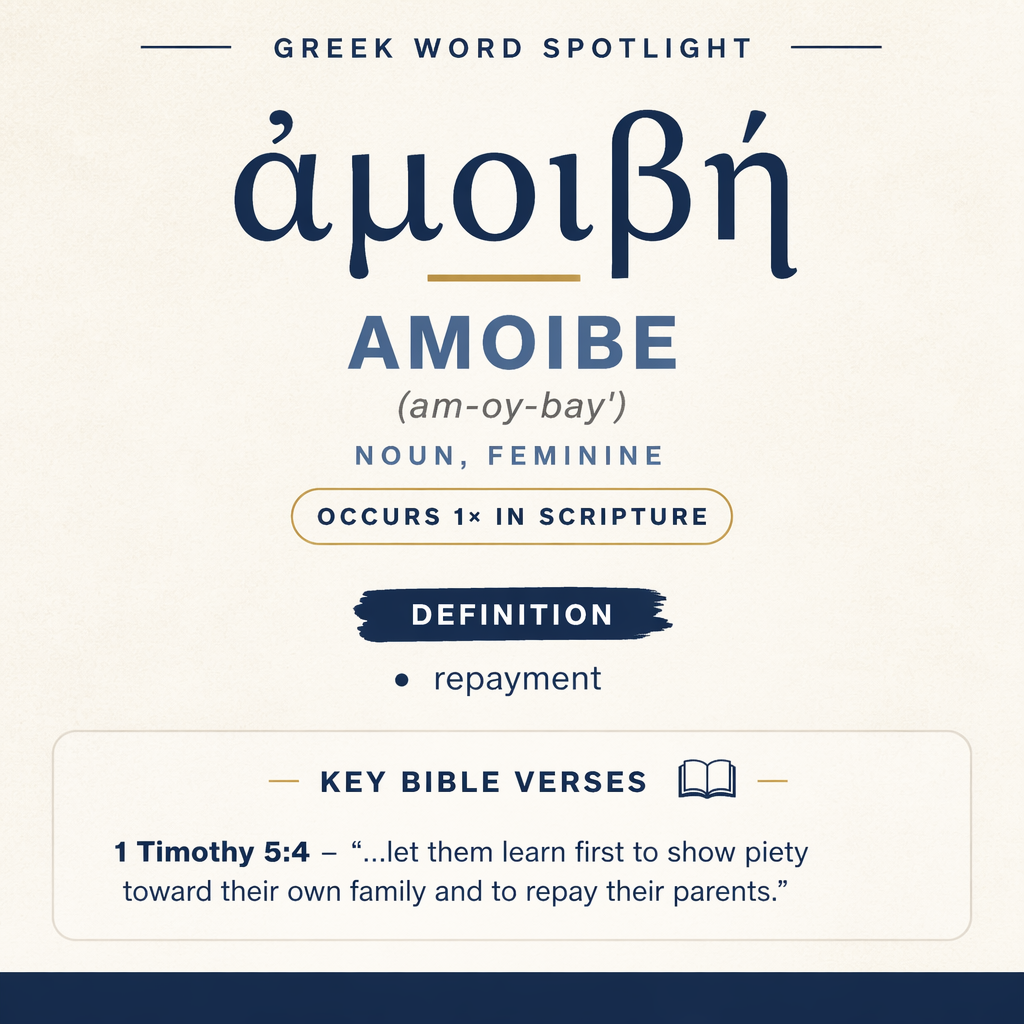
ἀμοιβή means “repayment” and appears once in Scripture, in 1 Timothy 5:4.
Scripture Occurrence
ἀμοιβή occurs 1 time in Scripture. Its single occurrence is in 1 Timothy 5:4.
Learn More →Verse Context
In 1 Timothy 5:4, it appears in the phrase “to repay” within instructions concerning a widow’s children or grandchildren.
Learn More →ἀμοιβή expresses the idea of repayment, and it appears once in the New Testament, in Paul’s instruction about widows and family responsibility. In its single setting it frames repayment as a learned, practiced response within the household.
Occurrences
1 Timothy 5:4
“But if any widow has children or grandchildren, let them learn first to show piety toward their own family and to repay their parents, for this is acceptable in the sight of God.” (1 Timothy 5:4)
Here ἀμοιβή is embedded in a chain of obligations described as something children or grandchildren must “learn first.” The verse begins with a concrete situation—“if any widow has children or grandchildren”—and then moves immediately to a household response: they are to “show piety toward their own family” and “to repay their parents.” Repayment is thus presented as an active duty toward parents, not an abstract ideal. The focus remains within “their own family,” giving repayment a clear, relational target: “their parents.”
The surrounding wording links repayment with two evaluative perspectives at once. On one hand, it is part of demonstrated “piety toward their own family,” an outward, visible posture expressed through actions. On the other hand, it carries explicit moral approval: “for this is acceptable in the sight of God.” In this setting, repayment is not merely a private exchange within the family; it is portrayed as conduct that stands under divine evaluation. The verse also casts repayment as forward-moving conduct (“let them learn… to repay”), implying a pattern of behavior that can be taught, adopted, and practiced as part of family life.

Sense and Usage
In 1 Timothy 5:4 repayment functions as a practical expression of family devotion. The verse does not treat repayment as an isolated transaction; it is paired with “show[ing] piety toward their own family,” so repayment is one way that piety becomes concrete within the home. The instruction aims first at the widow’s “children or grandchildren,” placing repayment within the responsibilities of the next generation. The relational direction of repayment is upward (“to repay their parents”), and the implied setting is the ordinary sphere of family care.
Because repayment is attached to learning (“let them learn first”), it belongs to the realm of formed character and habitual practice. The verse suggests that repayment is not accidental or sporadic; it is something people can be trained to do as part of what comes “first,” that is, as an initial or fundamental duty within family ethics. This learning language also makes repayment measurable: it can be performed in ways that show whether the obligation is being met.
The statement “for this is acceptable in the sight of God” gives repayment a moral weight beyond reciprocity. The verse ties repayment to what is “acceptable,” a term that places the action within the category of conduct approved by God. Repayment, then, is portrayed as fitting and proper within a religiously informed life, not merely socially expected behavior. In this single occurrence, repayment stands at the intersection of family responsibility and God-pleasing conduct, presenting a household act as a form of obedience that carries religious significance.
Within the verse’s logic, repayment also implies a sense of answering to prior care. The instruction is directed at those related to a widow—children or grandchildren—and it calls for repayment “to repay their parents.” The command does not spell out the form repayment must take, but it anchors the duty in the real structure of family relationships. The phrase “their own family” keeps the obligation close and specific: repayment begins at home, directed to one’s parents, as part of the immediate responsibilities created by kinship.
Finally, repayment in this context contributes to the passage’s concern for proper ordering: the family is to act first, and such action is judged “acceptable in the sight of God.” Repayment is therefore framed as an appropriate, prioritized response within the household that aligns with the moral vision of the letter. Even with only one attestation, the verse shows repayment operating as a concrete act of care that embodies piety and meets divine approval.
Imagery
The verse evokes the simple, tangible picture of generations within a household taking responsibility—children and grandchildren acting toward parents in a way described as repayment. The imagery is not ceremonial or distant; it is domestic and relational, with repayment portrayed as a learned practice carried out within “their own family” under the approving gaze of God.
Sources: Lexical data from Strong’s Exhaustive Concordance and the Translators Brief Lexicon of Extended Strongs for Greek (STEPBible, CC BY). Occurrence data from the Translators Amalgamated Greek New Testament (STEPBible, CC BY). Scripture quotations from the World English Bible (public domain).