
Exploring the Meaning of Alla in Greek
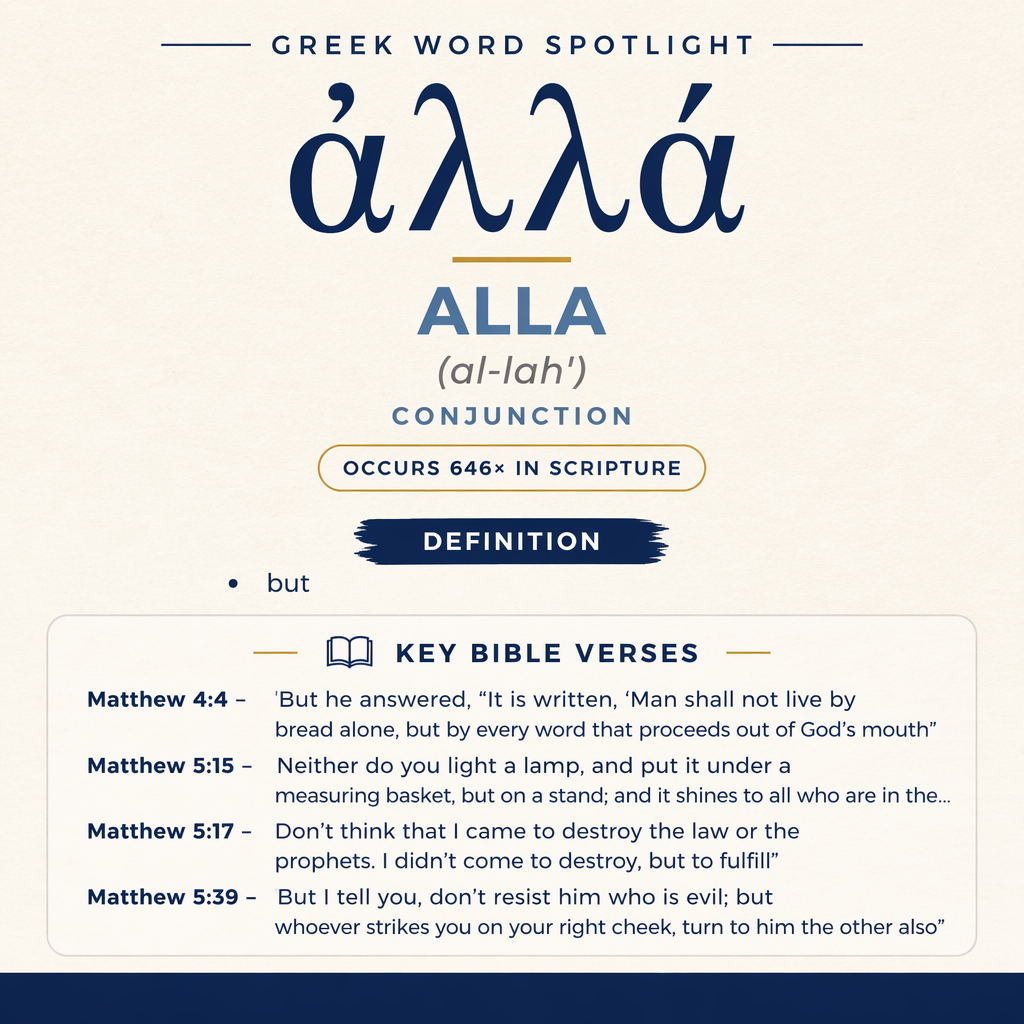
ἀλλά means “but” in Greek and occurs 646 times in Scripture, including Matthew 4:4; 5:15, 17, 39; 6:13, 18; 7:21; 8:4.
Core Meaning
ἀλλά is defined as “but.” It marks contrast in the statements where it appears.
Learn More →Scripture Frequency
This word occurs 646 times in Scripture. It appears repeatedly in Matthew, including 4:4 and 5:15.
Learn More →Matthew Examples
In Matthew 5:17 it contrasts “destroy” with “fulfill,” and in Matthew 6:13 it contrasts temptation with deliverance from the evil one.
Learn More →ἀλλά marks a contrast: it turns a sentence from one idea to an opposing or correcting one. In the passages quoted below it regularly redirects attention—away from a mistaken assumption, an inadequate alternative, or an incomplete picture—toward what the speaker presents as decisive.
Occurrences
Matthew 4:4 — “But he answered, “It is written, ‘Man shall not live by bread alone, but by every word that proceeds out of God’s mouth.’ ””
Here ἀλλά operates twice within one response. The first “But” sets Jesus’ answer over against whatever has just been proposed to him, signaling a rebuttal framed by Scripture. The second “but” sharpens the internal contrast: bread is not treated as life’s sufficient basis; life is located instead in “every word that proceeds out of God’s mouth.” The conjunction makes the saying hinge on a decisive replacement of what seems primary (bread) with what is presented as truly sustaining (God’s word).

Matthew 5:15 — “Neither do you light a lamp, and put it under a measuring basket, but on a stand; and it shines to all who are in the house.”
In this practical image, ἀλλά sets two placements side by side. One placement (under a basket) is dismissed as incongruent with the purpose of lighting a lamp; the other (on a stand) matches the expected result: “it shines to all.” The contrast is spatial and purposive—misplacement versus proper placement—so the conjunction helps the sentence move from an implausible action to the fitting one.
Matthew 5:17 — ““Don’t think that I came to destroy the law or the prophets. I didn’t come to destroy, but to fulfill.”
ἀλλά here carries a corrective force against a potential misunderstanding about Jesus’ mission. The statement is structured as a denial followed by a contrasted affirmation: not “to destroy,” but “to fulfill.” The conjunction draws a clear boundary between two interpretations of his coming and pushes the reader toward the second as the intended one.
Matthew 5:39 — “But I tell you, don’t resist him who is evil; but whoever strikes you on your right cheek, turn to him the other also.”
This verse uses ἀλλά to pivot from one line of teaching to another. The opening “But I tell you” signals a transition to Jesus’ instruction, and within the verse ἀλλά again sets an alternative response pattern: instead of resistance, the response described is non-retaliation—“turn to him the other also.” The conjunction highlights the move from what a listener might instinctively do to the concrete behavior Jesus commands.
Matthew 6:13 — “Bring us not into temptation, but deliver us from the evil one. For yours is the Kingdom, the power, and the glory forever. Amen.’”
In this petition, ἀλλά contrasts two requests that are closely linked: not being led “into temptation” is paired with the positive plea to be rescued—“deliver us from the evil one.” The conjunction does not merely add a second clause; it reorients the request from a negative formulation to a corresponding deliverance, so the prayer’s direction becomes protection through rescue.
Matthew 6:18 — “so that you are not seen by men to be fasting, but by your Father who is in secret, and your Father, who sees in secret, will reward you.”
Here ἀλλά contrasts audiences. The action of fasting is framed not as a performance aimed at “men,” but as something conducted before “your Father who is in secret.” The conjunction reinforces a shift in motive and visibility: the point is not public recognition but the Father’s hidden seeing and consequent reward.
Matthew 7:21 — “Not everyone who says to me, ‘Lord, Lord,’ will enter into the Kingdom of Heaven; but he who does the will of my Father who is in heaven.”
ἀλλά draws the line between verbal profession and obedient action. The first clause excludes a category defined by speech alone (“says to me”), and the second clause, introduced by “but,” identifies the one who enters as the one “who does the will of my Father.” The contrast turns the criterion from words to deeds, and the conjunction makes that criterion explicit and exclusive.
Matthew 8:4 — “Jesus said to him, “See that you tell nobody, but go, show yourself to the priest, and offer the gift that Moses commanded, as a testimony to them.””
In this instruction, ἀλλά contrasts two courses of action for the healed man. He is not to spread the news (“tell nobody”); instead, he is to take specific steps: “go,” “show yourself,” and “offer the gift.” The conjunction helps the command read as a redirection from public talk to prescribed action that functions “as a testimony to them.”
Matthew 8:8 — “The centurion answered, “Lord, I’m not worthy for you to come under my roof. Just say the word, and my servant will be healed.”
The centurion’s reply includes no instance of ἀλλά in the wording quoted, but the statement itself is shaped by a contrastive logic: unworthiness for Jesus’ physical entrance is set against confidence in the effectiveness of his spoken command. The movement from “not worthy” to “Just say the word” matches the kind of turn ἀλλά regularly marks in neighboring sayings—away from one possibility to the alternative that carries the speaker’s confidence.
Matthew 9:12 — “When Jesus heard it, he said to them, “Those who are healthy have no need for a physician, but those who are sick do.””
ἀλλά sets up a contrast in need. The “healthy” are described as lacking need of a physician, while “the sick” are the ones who do. The conjunction makes the proverb-like saying work: it is not a general claim about physicians but a pointed distinction between two groups, with need located in the second.
Matthew 9:13 — “But you go and learn what this means: ‘I desire mercy, and not sacrifice,’ for I came not to call the righteous, but sinners to repentance.”
This verse uses ἀλλά at the outset and again near the end. The opening “But” introduces a directive—“you go and learn”—which stands as a corrective response in the conversation. Later, ἀλλά frames Jesus’ purpose with a contrast: he came “not to call the righteous, but sinners to repentance.” The conjunction serves to relocate the target of his call, and the double contrast within the citation (“mercy, and not sacrifice”) reinforces the same kind of reorientation.
Matthew 9:17 — “Neither do people put new wine into old wine skins, or else the skins would burst, and the wine be spilled, and the skins ruined. No, they put new wine into fresh wine skins, and both are preserved.”
Although ἀλλά is not visible in the English quotation, the sentence functions as a strong contrast between an unfit practice and the fitting one. The negative scenario (new wine in old skins) leads to loss and ruin; the alternative (“No, they put new wine into fresh wine skins”) leads to preservation. The transition word “No,” in this rendering, plays the same role ἀλλά often does in these sayings: turning from a rejected option to the preferred alternative.

Sense and Usage
Across these passages ἀλλά serves as a hinge that swings discourse from one side to another. Sometimes the contrast is between two explanations of the same topic: bread versus God’s word (Matthew 4:4), destroy versus fulfill (Matthew 5:17), public display versus the Father’s secret seeing (Matthew 6:18), saying “Lord” versus doing the Father’s will (Matthew 7:21). In such lines, the conjunction gives the sentence its argumentative edge: the first element is denied, limited, or shown to be inadequate, and the second is installed as the proper focus.
At other times the contrast is between two actions or responses. The lamp image contrasts hiding light with elevating it so it “shines to all” (Matthew 5:15). Jesus’ instruction about an evil person contrasts resistance with the concrete act of offering the other cheek (Matthew 5:39). The healed man is turned away from public speech and toward obedience to priestly procedure (Matthew 8:4). In these, ἀλλά is not abstract; it guides behavior by placing one path over against another.
ἀλλά also regularly works in short, memorable formulations: the physician saying (Matthew 9:12) and the mission statement about calling sinners (Matthew 9:13). In such maxims, the conjunction creates a clean division between two groups or goals, so the hearer can grasp the point in a single turn of thought. Even in the prayer of Matthew 6:13, where both clauses are petitions rather than a denial and an affirmation, ἀλλά still steers the request: the prayer is not left as a vague wish to avoid trial; it becomes a plea for deliverance “from the evil one.”
Imagery and Rhetoric
The recurring effect of ἀλλά in these sayings is a tightening of focus. It sharpens images (lamp placement, wine skins) and clarifies purpose (fulfilling the law and prophets; calling sinners to repentance) by forcing a choice between alternatives. In narrative moments and in instruction alike, it draws the reader’s attention to what follows as the intended direction of thought and action.
Sources: Lexical data from Strong’s Exhaustive Concordance and the Translators Brief Lexicon of Extended Strongs for Greek (STEPBible, CC BY). Occurrence data from the Translators Amalgamated Greek New Testament (STEPBible, CC BY). Scripture quotations from the World English Bible (public domain).




