Exploring the Meaning of Alexandros in Greek
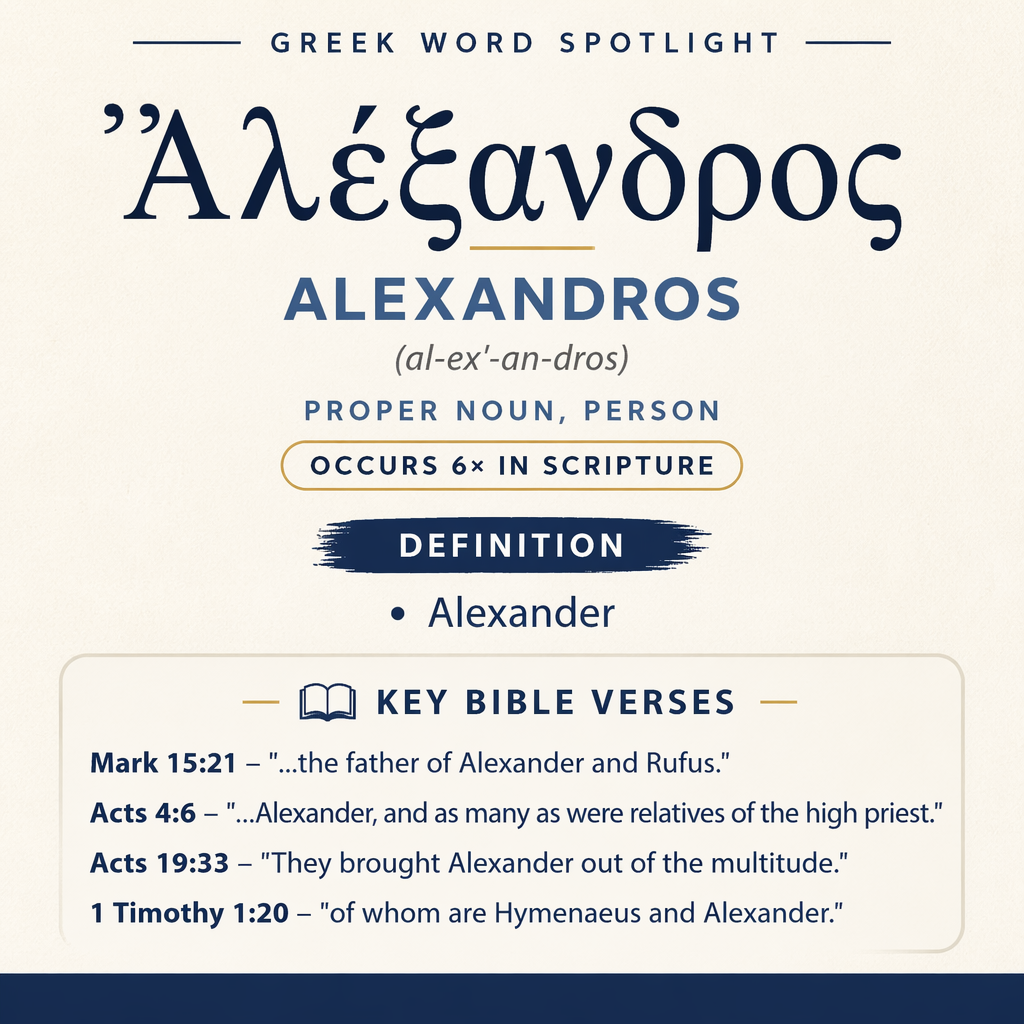
Ἀλέξανδρος (Alexandros) means “Alexander” and occurs in Mark 15:21; Acts 4:6; Acts 19:33; 1 Timothy 1:20; 2 Timothy 4:14.
Where It Appears
It occurs 6 times in Scripture, including Mark 15:21 and several passages in Acts and the Pastoral Epistles.
Learn More →Named Individuals
In Mark 15:21, Alexander is named as the son of Simon of Cyrene. In 2 Timothy 4:14, Alexander the coppersmith is said to have done much evil to Paul.
Learn More →Ἀλέξανδρος is the personal name “Alexander.” In the New Testament it appears across narrative and epistolary settings, identifying multiple individuals in scenes ranging from the crucifixion procession to public hearings and pastoral admonition.
Root and Related Words
Ἀλέξανδρος is connected (per Strong’s) with ἀλέκτωρ (alektor), “rooster” (Strong’s G220), and ἀνήρ (aner), “man” (Strong’s G435). These related words are cited to show the name’s traditional derivational associations.

Occurrences
Mark 15:21: “They compelled one passing by, coming from the country, Simon of Cyrene, the father of Alexander and Rufus, to go with them, that he might bear his cross.”
Here Ἀλέξανδρος functions inside a family identification: Simon is singled out not only by origin (“of Cyrene”) but by relationship (“the father of Alexander and Rufus”). The name’s role is anchoring Simon’s identity through his sons, giving the reader a concrete social location for the man compelled to carry the cross. Alexander himself is not acting in the scene; the name serves the narrative by marking Simon through recognizable ties.

Acts 4:6: “Annas the high priest was there, with Caiaphas, John, Alexander, and as many as were relatives of the high priest.”
In this hearing context, Ἀλέξανδρος appears in a list alongside leading figures (“Annas the high priest… Caiaphas”) and then expands to a wider circle (“as many as were relatives of the high priest”). The name contributes to the picture of an assembled authority group: Alexander is presented as part of a cluster associated with high-priestly power, reinforcing the formal, institutional setting in which decisions and interrogations are taking place.
Acts 19:33: “They brought Alexander out of the multitude, the Jews putting him forward. Alexander beckoned with his hand, and would have made a defense to the people.”
In the public disturbance at Ephesus, Ἀλέξανδρος is a figure extracted from the crowd and pushed into prominence (“They brought Alexander out of the multitude”). The text highlights two movements: he is advanced by others (“the Jews putting him forward”), and he attempts to take control of the moment (“beckoned with his hand”). The name marks the individual who is poised to speak as a representative voice, intending “to make a defense to the people.” This use shows Alexander as an on-scene participant whose gestures and intention to address the crowd are central to the moment.
1 Timothy 1:20: “of whom are Hymenaeus and Alexander, whom I delivered to Satan, that they might be taught not to blaspheme.”
In this pastoral warning, Ἀλέξανδρος identifies one of two named individuals paired together (“Hymenaeus and Alexander”). The name is used in a disciplinary context: the speaker reports decisive action (“I delivered to Satan”) with a stated moral aim (“that they might be taught not to blaspheme”). Alexander is thus fixed in the reader’s mind as an example within an internal community matter where correction and boundaries are being asserted.
2 Timothy 4:14: “Alexander, the coppersmith, did much evil to me. The Lord will repay him according to his deeds,”
Here Ἀλέξανδρος is sharpened by occupation and accusation. The phrase “Alexander, the coppersmith” distinguishes him from other bearers of the same name and places him in ordinary working life, while the following statement is personal and severe: “did much evil to me.” The verse then frames the response in terms of divine recompense: “The Lord will repay him according to his deeds.” In this occurrence the name is not merely identifying; it carries the weight of remembered harm, professional identification, and the expectation of just repayment.
Sense and Usage
Across these passages “Alexander” operates as a stable personal identifier, but it does different kinds of work depending on context. In Mark it functions indirectly: the name is embedded in a kinship label that helps specify Simon (“the father of Alexander and Rufus”), a narrative technique that identifies one person by connection to others. In Acts 4:6 the name appears as part of an authority roster, contributing to a sense of official presence and aligned power (“with Caiaphas, John, Alexander”). In Acts 19:33 it identifies a spokesperson figure, someone pushed to the front and signaling readiness to speak (“beckoned with his hand… would have made a defense”).
In the letters, the name becomes a tool for moral and communal boundary-setting. In 1 Timothy 1:20, Alexander is one of two named examples attached to a corrective action and a stated lesson (“taught not to blaspheme”). In 2 Timothy 4:14, the name is tied to a trade designation (“the coppersmith”) and a record of wrongdoing (“did much evil to me”), with a stated expectation of repayment “according to his deeds.” These uses show how a personal name can function both neutrally (as a relational or civic identifier) and pointedly (as an emblem of opposition, harm, or disciplinary concern) without changing what the word itself signifies: it remains the proper name marking a particular person in each scene.
Because the same name appears in varied settings—family reference, leadership assembly, crowd confrontation, and personal pastoral report—the reader is prompted to attend carefully to each passage’s immediate descriptors (fatherhood, association with the high priest, being put forward by others, being paired with Hymenaeus, being called “the coppersmith”). These local details are what distinguish the individuals and shape the force the name carries in each narrative or exhortation.
Imagery in Context
The name Alexander is attached to vivid public moments: a man compelled to carry a cross is located through his sons’ names (Mark 15:21), an elite council-like gathering is populated by named figures (Acts 4:6), and a tense crowd scene features a man pulled forward and motioning for silence to speak (Acts 19:33). In the epistles, the imagery turns inward and personal: a named person is linked to a severe corrective measure intended to teach restraint in speech (1 Timothy 1:20), and another is remembered as a craftsman whose deeds are met with an expectation of repayment (2 Timothy 4:14). In each case, Ἀλέξανδρος is a concise label that attaches these scenes to a specific individual and keeps the reader’s attention on concrete relationships, roles, and actions.
Sources: Lexical data from Strong’s Exhaustive Concordance and the Translators Brief Lexicon of Extended Strongs for Greek (STEPBible, CC BY). Occurrence data from the Translators Amalgamated Greek New Testament (STEPBible, CC BY). Scripture quotations from the World English Bible (public domain).