Understanding the Meaning of Alexandrinos in Greek
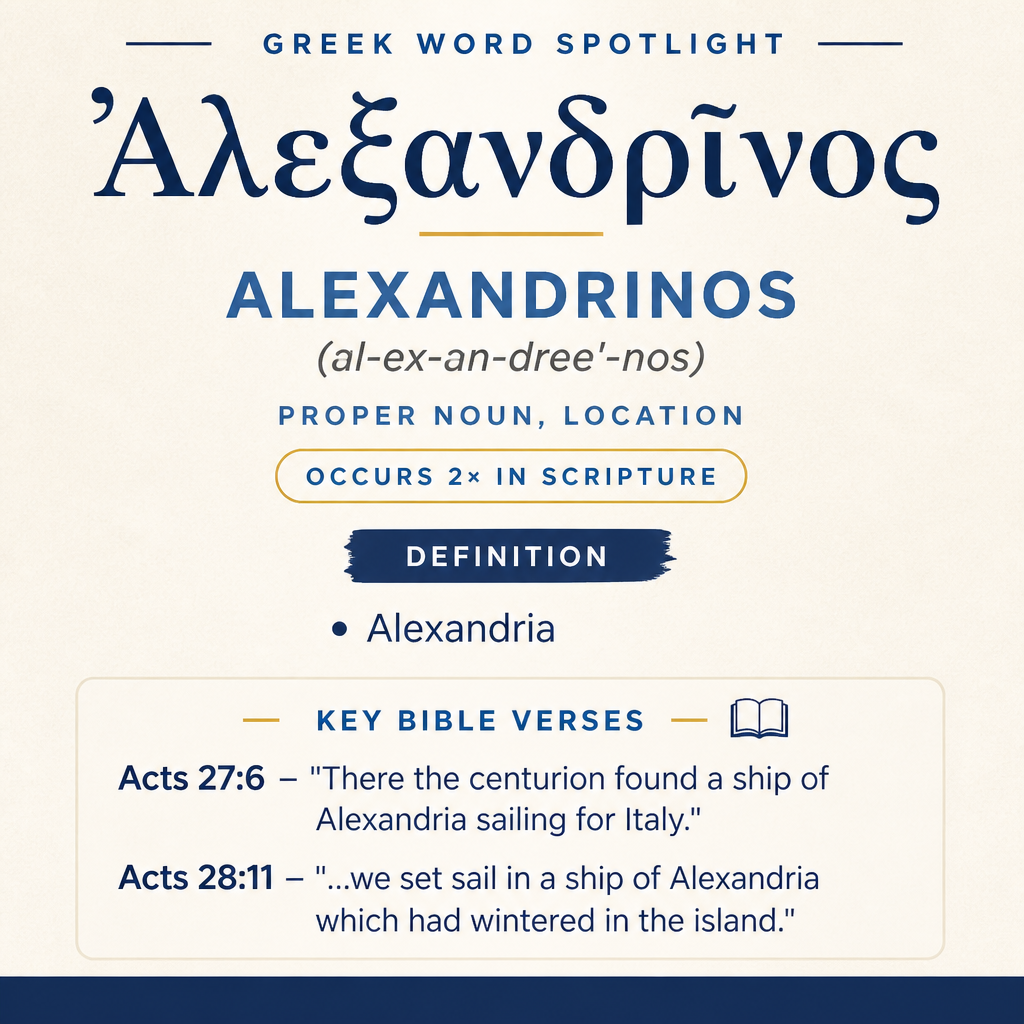
Ἀλεξανδρῖνος (Alexandrinos) means “Alexandria” and appears in Acts 27:6 and Acts 28:11.
Context in Acts
In both verses, it describes a ship of Alexandria involved in travel by sea.
Learn More →Ἀλεξανδρῖνος means “Alexandria” and appears in two travel notices in Acts, each identifying a ship by its Alexandrian origin. In both places the word functions as a geographic marker that helps locate the journey within real ports, routes, and shipping practices.
Root and Related Words
Ἀλεξανδρῖνος is derived from the related term Alexandreūs (Ἀλεξανδρεύς), “Alexandrian” (Strong’s G221).

Occurrences
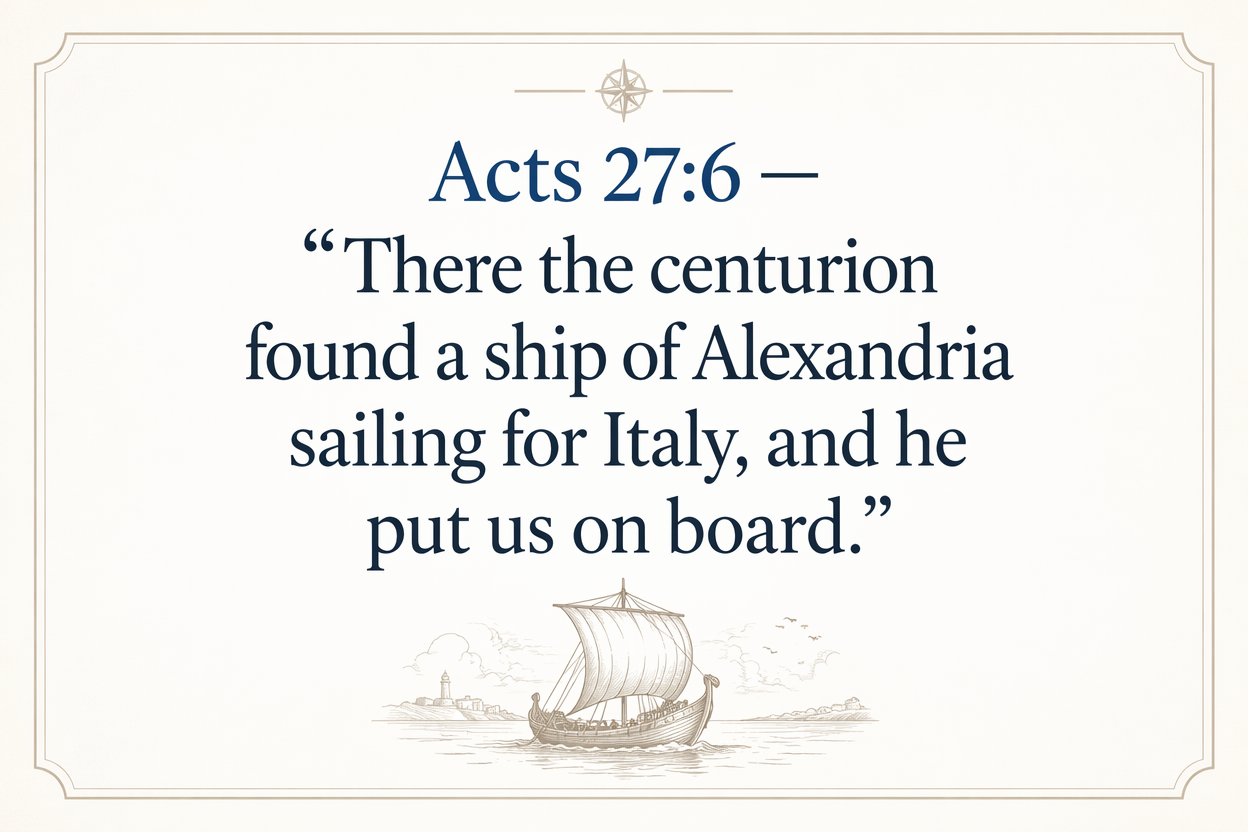
Acts 27:6 — “There the centurion found a ship of Alexandria sailing for Italy, and he put us on board.”
Here Ἀλεξανδρῖνος anchors the narrative in a specific point of departure: the centurion “found a ship of Alexandria.” The phrase presents the vessel as identifiable by its association with Alexandria, as one might recognize a ship by its home port or registry. That detail sits alongside two other concrete travel markers in the same sentence—its destination (“sailing for Italy”) and the transfer of passengers (“he put us on board”). By naming Alexandria as the ship’s origin, the word helps the reader picture a long-distance itinerary already underway and a deliberate choice of transportation that suits the group’s intended route.
The wording also highlights the centurion’s agency and discernment. He does not merely embark on any available craft; he “found” a particular one, and the Alexandrian identification becomes part of what makes it suitable for passage toward Italy. In the tight economy of the verse, “of Alexandria” supplies a compact, practical descriptor: the ship belongs to a recognizable stream of maritime movement connected with that port, now intersecting with the travelers’ needs.
Acts 28:11 — “After three months, we set sail in a ship of Alexandria which had wintered in the island, whose sign was “The Twin Brothers.””
In this second occurrence, the Alexandrian identification is again attached to a ship, but the narrative context is more developed. The group’s delay is emphasized: “After three months,” they resume travel by sea. Ἀλεξανδρῖνος ties the new stage of the journey to a vessel characterized first by origin (“a ship of Alexandria”) and then by local history (“which had wintered in the island”). The word thus sits at the intersection of two geographic points: a ship associated with Alexandria is now physically present at the island where the travelers have been staying, ready to depart when conditions permit.
The verse adds one more concrete identifier: “whose sign was ‘The Twin Brothers.’” Within the sentence, “of Alexandria” works as one element in a cluster of recognitions—origin, seasonal circumstance, and distinguishing mark. The effect is specificity: the ship is not an anonymous means of transport but a particular vessel with a known connection to Alexandria, a documented stay (“had wintered”), and a visible emblem (“sign”). The Alexandrian tag contributes to that realism by placing the ship within the world of named ports and recognizable ships.
Sense and Usage
Across both passages, Ἀλεξανδρῖνος operates as a concise geographic label that identifies a ship through its association with Alexandria. The word’s contribution is not to describe the ship’s build or cargo but to situate it in a network of travel: a ship is linked to a city, and that linkage matters to the unfolding itinerary. In Acts 27:6 the Alexandrian identification accompanies forward movement (“sailing for Italy”) and a decisive boarding. In Acts 28:11 it accompanies a restart after enforced waiting (“After three months”) and provides continuity with a vessel that has already been present in the setting (“had wintered in the island”).
The two uses also show how such a location term can function with different shades of narrative emphasis while keeping the same core reference. First, it supports the centurion’s logistical action: an Alexandrian ship is found and used as a means toward Italy. Second, it supports the narrator’s memory-like precision: the ship is recalled by origin and by a distinguishing sign. In both instances the word behaves like a practical tag in travel documentation—one of the small details that make the route traceable and the sequence of movements intelligible. The repeated pairing of the Alexandrian identification with verbs of movement (“sailing,” “set sail”) keeps the focus on travel as a chain of concrete transitions from one conveyance to another.
Because the word is attached to “ship” both times, its sense in these contexts is shaped by maritime association. It points to Alexandria as the relevant place by which the vessel is known; the narrative relies on that identification to distinguish this ship from other possibilities. The result is that Alexandria, though not itself described, becomes present in the story through the ship that bears its name: a distant city invoked in the immediate scene as a marker of origin, familiarity, and suitability for onward travel.
Imagery
In these verses Ἀλεξανδρῖνος carries the imagery of a ship connected to a major port, entering and leaving the story as a tangible link between places. The word evokes travel’s material realities: finding passage, waiting out seasons, and recognizing a vessel by origin and sign. Without pausing to describe the city itself, Acts lets “of Alexandria” function like a stamped provenance on a ship’s presence—first as it is located for a journey toward Italy, and then as it is boarded after months of wintering, ready to carry the travelers onward.
Sources: Lexical data from Strong’s Exhaustive Concordance and the Translators Brief Lexicon of Extended Strongs for Greek (STEPBible, CC BY). Occurrence data from the Translators Amalgamated Greek New Testament (STEPBible, CC BY). Scripture quotations from the World English Bible (public domain).