
Exploring the Meaning of Aletho in Greek
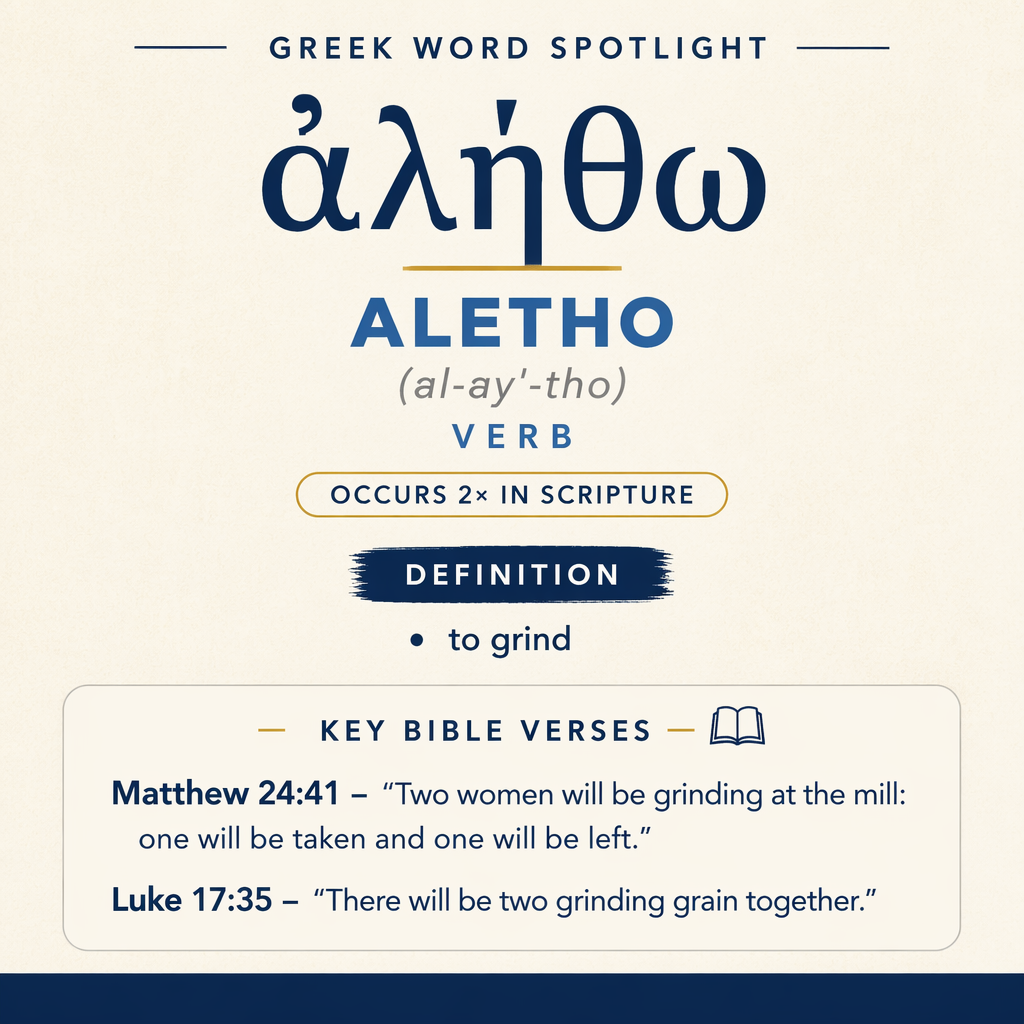
ἀλήθω means “to grind” and appears in Matthew 24:41 and Luke 17:35.
Scene Described
In both verses, it describes women grinding at the mill or grinding grain together, with one taken and one left.
Learn More →ἀλήθω means “to grind,” and it appears in two sayings about ordinary work continuing right up to a moment of separation. In both places it is set in a domestic scene where people are engaged in the repeated action of grinding grain.
Root and Related Words
ἀλήθω is associated with the noun aleuron (ἄλευρον), “flour” (Strong’s G224), presented as a related term from which it derives. The relationship links the verb’s action to the product that results from grinding.

Occurrences
“Two women will be grinding at the mill: one will be taken and one will be left.” (Matthew 24:41)
Here ἀλήθω depicts a familiar task performed at “the mill.” The wording places the action in a shared workspace: “Two women” are engaged in the same kind of labor, close enough to be described together and focused on one continuous activity. The verb presents the work as ongoing rather than completed; it frames the scene as daily routine in progress. Against that backdrop of ordinary motion and attention, the sentence turns sharply to an outcome that does not arise from the work itself: “one will be taken and one will be left.” In this setting, the verb’s contribution is to anchor the moment of separation in the middle of unremarkable, repetitive labor, so that the contrast is between steady, commonplace grinding and the sudden divergence of the two workers’ futures.
“There will be two grinding grain together. One will be taken and the other will be left.” (Luke 17:35)
Luke’s wording explicitly names the material: “grinding grain.” ἀλήθω is therefore tied directly to processing a staple food source, an activity that turns raw grain into something usable for preparing food. The adverbial “together” stresses shared participation: two people are occupied side by side in a synchronized or cooperative task. As in the other occurrence, the verb presents the action as something currently happening, with no signal that the work has reached its end. The second sentence again introduces the separation—“One will be taken and the other will be left”—as something that interrupts neither the normalcy nor the togetherness of the work at the moment it occurs. The verb thus supplies the mundane, physical texture of the scene: hands at work, grain being processed, time being filled with necessary labor, and yet an outcome comes that divides those who were acting in parallel.
Sense and Usage
Across these two occurrences, “to grind” functions as a concrete depiction of daily necessity: grain is worked so it can be used, and the action is repetitive, bodily, and time-bound. The verb is not used to describe a completed product but a present activity—people are caught in the middle of the process. That feature matters in both sayings, because the moment of being “taken” or “left” is not portrayed as arriving after a task is finished, nor as the result of the grinding itself, but as something that meets people during routine labor.
The settings also show how ἀλήθω can be expressed with different complements. In Matthew it is “grinding at the mill,” where the instrument or location is foregrounded; the mill signals a fixed point of work and the physical means by which grinding is done. In Luke it is “grinding grain,” where the object of the action is foregrounded; “grain” identifies what is being processed. Together these two phrasings keep the sense stable—grinding—while showing that the verb readily takes its context from either the place/tool of grinding or the material being ground. The related noun aleuron (ἄλευρον), “flour,” fits this same world of meaning: grinding is the action that leads toward flour, and the verb’s scenes assume that kind of household economy where grinding grain is a normal part of provision.
Both occurrences place ἀλήθω in plural scenes (“Two women…,” “two… together”), and both pair it with a balanced contrast (“one… and one…,” “One… and the other…”). The verb therefore serves as the shared baseline: two people participate in the same work in the same moment. The symmetry of the action heightens the asymmetry of the result. Because the grinding is identical and simultaneous, the difference between “taken” and “left” cannot be explained by outward activity in the scene; ἀλήθω helps establish that sameness of visible circumstance.
Imagery
The imagery carried by ἀλήθω in these sayings is tactile and ordinary: grain reduced by steady pressure, time marked by repeated motion, and companionship expressed through working “together.” The mill and the grain place the listener in a setting of provision and routine, so that the announced separation—“one will be taken and one will be left”—lands with the force of interruption within everyday life rather than in an extraordinary or ceremonial moment.
Sources: Lexical data from Strong’s Exhaustive Concordance and the Translators Brief Lexicon of Extended Strongs for Greek (STEPBible, CC BY). Occurrence data from the Translators Amalgamated Greek New Testament (STEPBible, CC BY). Scripture quotations from the World English Bible (public domain).





