
Exploring the Meaning of Aletheia in Greek
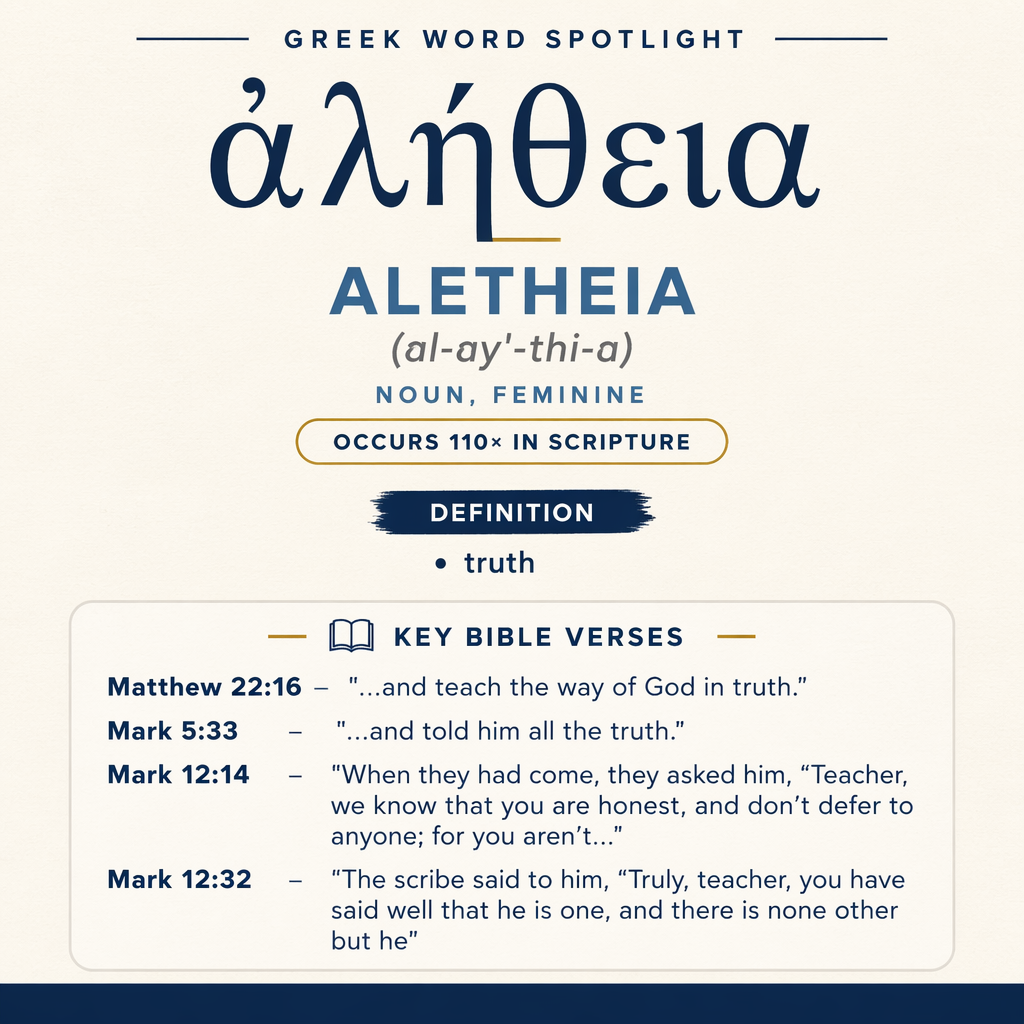
ἀλήθεια (Aletheia) means “truth” and occurs 110 times in Scripture, including Matthew 22:16; Mark 5:33; Luke 4:25; and John 1:14.
Sample Occurrences
It appears in passages such as Matthew 22:16, Mark 12:14, Luke 20:21, and John 1:14.
Learn More →ἀλήθεια expresses “truth,” a key term in Gospel scenes where speech, testimony, worship, and divine action are weighed for integrity. In the passages below it can describe frank disclosure, reliable teaching, and the kind of reality that belongs with God’s light and worship.
Occurrences
“They sent their disciples to him, along with the Herodians, saying, “Teacher, we know that you are honest, and teach the way of God in truth, no matter whom you teach, for you aren’t partial to anyone.”” (Matthew 22:16)
Here ἀλήθεια qualifies how “the way of God” is taught. The speakers frame truth as an impartial standard: teaching “in truth” is paired with being “honest” and “aren’t partial to anyone.” In this setting, truth is not merely a correct answer but a manner of instruction that refuses to bend to social pressure (“no matter whom you teach”).
“But the woman, fearing and trembling, knowing what had been done to her, came and fell down before him, and told him all the truth.” (Mark 5:33)
In this confession scene, ἀλήθεια is what the healed woman “told” in full (“all the truth”). The surrounding language—“fearing and trembling,” “fell down before him”—marks truth as a complete disclosure offered in vulnerability. Truth functions as candid testimony about “what had been done to her,” bringing hidden experience into the open.
“When they had come, they asked him, “Teacher, we know that you are honest, and don’t defer to anyone; for you aren’t partial to anyone, but truly teach the way of God. Is it lawful to pay taxes to Caesar, or not?”” (Mark 12:14)
This occurrence again connects truth with teaching, now with the adverbial idea “truly teach the way of God.” Truth is aligned with fearless instruction: “don’t defer to anyone” and “aren’t partial to anyone.” The question about taxes is set against a claim that true teaching is not controlled by either the powerful or the crowd.
“The scribe said to him, “Truly, teacher, you have said well that he is one, and there is none other but he,”” (Mark 12:32)
Here truth appears as an evaluative response—“Truly… you have said well.” The scribe uses truth language to affirm the reliability and correctness of what has been spoken: a statement about God (“he is one… there is none other but he”). In this scene, truth marks agreement that speech has accurately expressed what should be confessed.
“But truly I tell you, there were many widows in Israel in the days of Elijah, when the sky was shut up three years and six months, when a great famine came over all the land.” (Luke 4:25)
In this declaration, truth introduces a solemn, authoritative assertion (“truly I tell you”). The content that follows is presented as a dependable account about a hard period (“sky was shut up… a great famine”). ἀλήθεια here serves to strengthen the speaker’s claim, pressing the hearer to receive the statement as factual and weighty.
“They asked him, “Teacher, we know that you say and teach what is right, and aren’t partial to anyone, but truly teach the way of God.”” (Luke 20:21)
Truth again frames instruction: “say and teach what is right” is paired with teaching “truly.” The emphasis falls on integrity in public speech—truthful teaching is consistent with “what is right” and unmoved by favoritism (“aren’t partial to anyone”). This usage places truth in the realm of ethical and accurate communication about God’s way.
“After about one hour passed, another confidently affirmed, saying, “Truly this man also was with him, for he is a Galilean!”” (Luke 22:59)
In a moment of accusation, truth language is used to support a confident claim: “Truly this man also was with him.” The speaker offers a reason (“for he is a Galilean!”), treating truth as something that can be inferred and asserted in public. Here ἀλήθεια is tied to testimony about association and identity, not merely abstract principle.
“The Word became flesh, and lived among us. We saw his glory, such glory as of the one and only Son of the Father, full of grace and truth.” (John 1:14)
This statement joins truth with “grace” as a quality that characterizes the incarnate Word: “full of grace and truth.” Truth is portrayed as something abundant and present in a person’s revealed glory (“We saw his glory”). In this context, truth is not only spoken; it is embodied and encountered in the life that “lived among us.”
“For the law was given through Moses. Grace and truth were realized through Jesus Christ.” (John 1:17)
Truth is paired again with grace, but now described as “realized through Jesus Christ.” The contrast with “the law was given through Moses” highlights a transition in how truth is experienced: it is “realized,” made actual in history through a person. Truth here is something that comes to concrete expression, not remaining at the level of command or instruction alone.
“But he who does the truth comes to the light, that his works may be revealed, that they have been done in God.”” (John 3:21)
This usage places truth in the sphere of action: one may “do the truth.” Truth is not only a statement to believe but a lived alignment that moves toward exposure—“comes to the light.” The result is disclosure of “works,” shown as genuinely “done in God.” Truth therefore relates to openness, where deeds can bear scrutiny rather than hiding from illumination.
“But the hour comes, and now is, when the true worshipers will worship the Father in spirit and truth, for the Father seeks such to be his worshipers.” (John 4:23)
Truth defines the manner and quality of worship. The phrase “in spirit and truth” presents truth as integral to worship that the Father seeks. Here truth is not merely sincerity; it belongs with “spirit” as a defining feature of “true worshipers,” shaping worship into a response that fits God’s own desire.
“God is spirit, and those who worship him must worship in spirit and truth.”” (John 4:24)
This final occurrence grounds the previous claim in the nature of God: “God is spirit,” therefore worship “must” be “in spirit and truth.” Truth is treated as required for worship that corresponds to who God is. In this scene, ἀλήθεια becomes a criterion: worship is measured by whether it participates in truth alongside spirit.
Sense and Usage
Across these Gospel passages, ἀλήθεια moves through several closely related arenas without leaving its core domain. First, it is repeatedly attached to speech and instruction. In Matthew 22:16, Mark 12:14, and Luke 20:21, truth is the manner in which “the way of God” is taught; it is associated with honesty, courage, and impartiality. The repeated pairing with “aren’t partial to anyone” and “don’t defer to anyone” shows truth functioning as a public standard that resists manipulation—teaching that is true is consistent regardless of audience.
Second, truth appears as testimony and evaluation in interpersonal moments. Mark 5:33 presents truth as full disclosure—“told him all the truth”—where truth involves bringing a whole story forward rather than offering partial information. Luke 22:59 shows truth claimed in a charged social setting, where someone “confidently affirmed” an assertion about another person. Mark 12:32 illustrates truth as agreement with a spoken confession: “Truly… you have said well.” These uses place truth in the realm of witness and judgment—what is said, what is affirmed, and what is openly admitted.
Third, in John’s material, ἀλήθεια is closely tied to God’s self-disclosure and to the shape of life before God. John 1:14 and 1:17 speak of truth as something present in and realized through Jesus Christ, joined with grace and connected with visible “glory.” Truth there is not only a criterion for statements but an experienced reality that becomes accessible. John 3:21 extends truth into practice: one can “do the truth,” and the movement of such a life is toward “the light,” where works are revealed as “done in God.” Finally, John 4:23–24 places truth at the heart of worship: worship that corresponds to God is characterized by being “in spirit and truth,” and this is expressed both as what the Father seeks and what worshipers “must” offer.
Put together, these passages show ἀλήθεια operating as a unifying thread between honest teaching, candid testimony, embodied divine revelation, transparent deeds, and fitting worship. Truth is depicted as stable and non-negotiable (not adjusted for persons), but also relational and practical: it can be told, taught, done, realized, and used to shape worship.
Imagery
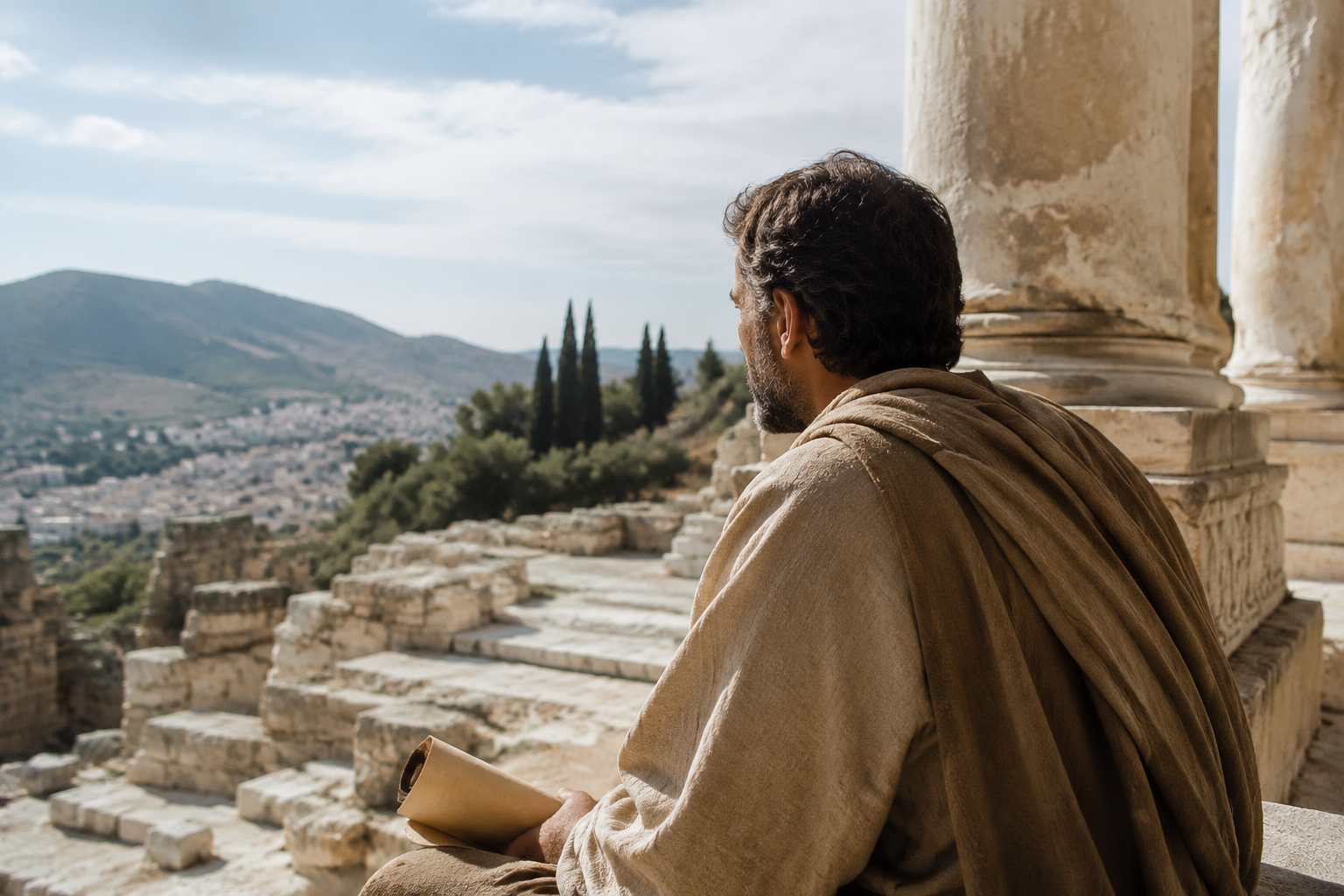
The quoted scenes give truth a set of concrete images: a teacher speaking without partiality, a trembling person kneeling in confession, a claim made “confidently” in public, and a life that “comes to the light” so that its works can be “revealed.” In John 4, truth is pictured not as a tool for argument but as the atmosphere of worship offered to the Father—worship carried out in a way that matches God’s spiritual nature.
Sources: Lexical data from Strong’s Exhaustive Concordance and the Translators Brief Lexicon of Extended Strongs for Greek (STEPBible, CC BY). Occurrence data from the Translators Amalgamated Greek New Testament (STEPBible, CC BY). Scripture quotations from the World English Bible (public domain).





