
Exploring the Meaning of Akulas in Greek
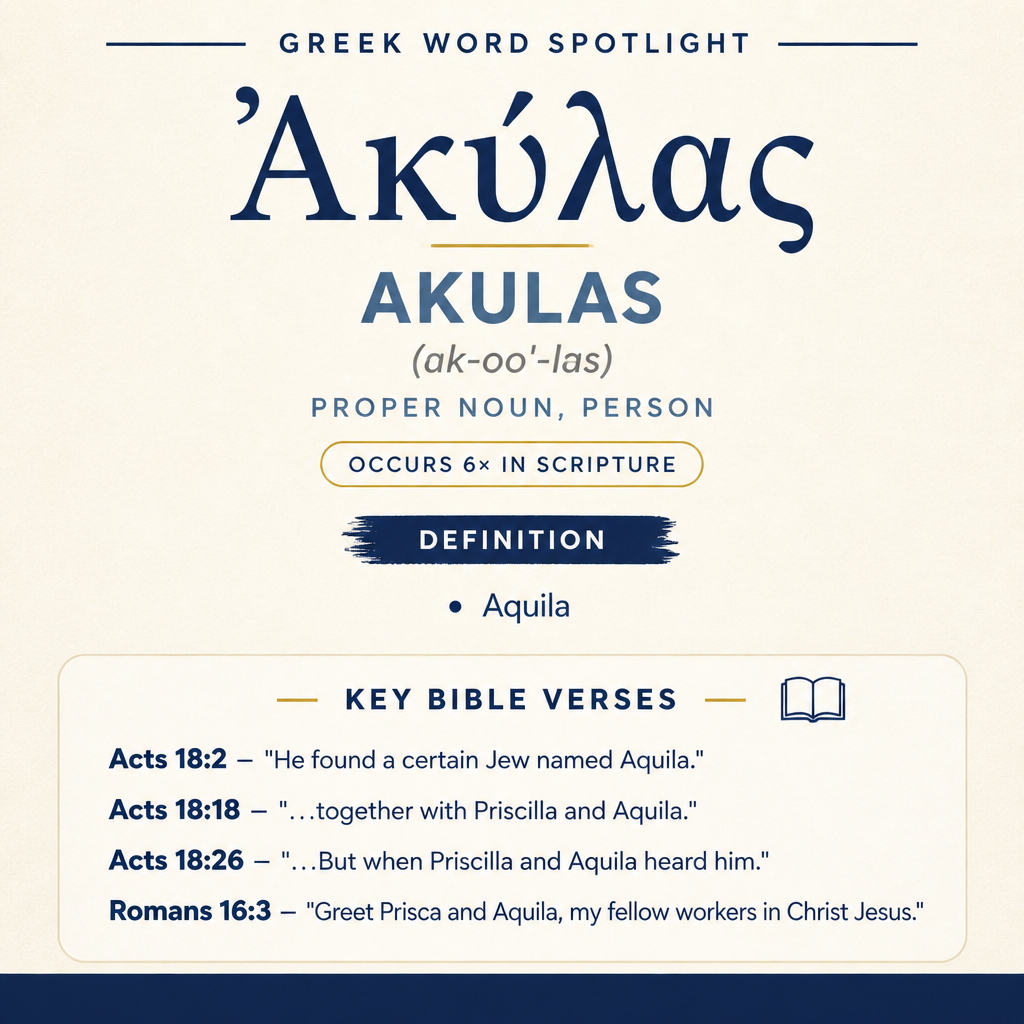
Ἀκύλας means Aquila and appears six times in Scripture: Acts 18:2, 18:18, 18:26; Romans 16:3; 1 Corinthians 16:19; 2 Timothy 4:19.
Name & Identity
Ἀκύλας is the Greek form of the personal name Aquila. In Acts 18:2 he is a Jew, a man of Pontus by race, recently come from Italy, with his wife Priscilla.
Learn More →Acts Narratives
In Acts 18:18 Aquila travels with Paul as Paul sails for Syria. In Acts 18:26 Priscilla and Aquila take a synagogue speaker aside and explain further.
Learn More →Pauline Greetings
Paul greets Prisca/Priscilla and Aquila in Romans 16:3, calling them his fellow workers in Christ Jesus. Aquila also appears in greetings in 1 Corinthians 16:19 and 2 Timothy 4:19.
Learn More →Ἀκύλας refers to Aquila, a named individual who appears in a cluster of New Testament passages centered on Paul’s ministry and the life of early assemblies. The occurrences present him in travel, hospitality, instruction, and greetings, usually alongside Priscilla/Prisca.
Occurrences
Acts 18:2: “He found a certain Jew named Aquila, a man of Pontus by race, who had recently come from Italy, with his wife Priscilla, because Claudius had commanded all the Jews to depart from Rome. He came to them,”
Here Ἀκύλας identifies the man Paul “found,” placing Aquila in a specific social and geographic setting. The verse ties Aquila to a Jewish identity, to Pontus “by race,” and to recent movement “from Italy” with Priscilla, with the move explained by an imperial command affecting Jews in Rome. Naming Aquila anchors the narrative in real relationships: Paul “came to them,” and the name marks the household that becomes a point of contact for Paul’s ministry in this scene.
Acts 18:18: “Paul, having stayed after this many more days, took his leave of the brothers, and sailed from there for Syria, together with Priscilla and Aquila. He shaved his head in Cenchreae, for he had a vow.”
In this travel notice, Ἀκύλας functions as part of a small company accompanying Paul: he sails “together with Priscilla and Aquila.” The name contributes to the picture of shared movement and partnership, not merely a passing acquaintance. By placing Aquila beside Priscilla in the same phrase, the verse presents them as a recognizable pair within the travel narrative, linked with Paul’s departure and onward journey.
Acts 18:26: “He began to speak boldly in the synagogue. But when Priscilla and Aquila heard him, they took him aside, and explained to him the way of God more accurately.”
In this episode, Ἀκύλας appears as one of the listeners who respond to public synagogue teaching. Aquila, together with Priscilla, acts decisively: they “heard him,” “took him aside,” and “explained to him the way of God more accurately.” The name therefore marks Aquila as an active participant in careful instruction—private, corrective, and aimed at greater accuracy—rather than as a silent bystander. The narrative role of Aquila is inseparable from this act of clarifying explanation.
Romans 16:3: “Greet Prisca and Aquila, my fellow workers in Christ Jesus,”
Here Ἀκύλας occurs in a direct imperative of greeting. Aquila is named with Prisca, and Paul characterizes them with the relational title “my fellow workers in Christ Jesus.” The name carries the weight of recognized service: Aquila is not introduced as new information, but addressed as someone whose identity and labor are already known to the recipients. The greeting frames Aquila as part of Paul’s working network, defined by shared labor “in Christ Jesus.”
1 Corinthians 16:19: “The assemblies of Asia greet you. Aquila and Priscilla greet you much in the Lord, together with the assembly that is in their house.”
In this closing section, Ἀκύλας again appears in greetings, but now as a sender rather than merely a recipient. Aquila and Priscilla convey greeting “much in the Lord,” and the verse links them to “the assembly that is in their house.” Aquila’s name therefore points to a household setting that hosts an assembly, placing him within the practical, domestic sphere where believers gather. The wording joins personal greeting with communal life: Aquila’s greeting comes together with that of the house-based assembly associated with them.
2 Timothy 4:19: “Greet Prisca and Aquila, and the house of Onesiphorus.”
In this final greeting list, Ἀκύλας appears once more paired with Prisca, alongside mention of “the house of Onesiphorus.” The name functions as part of a set of identifiable contacts to be greeted, again implying established relationships and known locations or households. By placing Aquila in parallel with a named “house,” the verse keeps Aquila in the same relational world seen elsewhere: persons and households connected by greeting and fellowship.
Sense and Usage
Across these passages, Ἀκύλας consistently serves its basic function as a personal name—Aquila—yet the narrative and epistolary contexts give the name a stable profile. In Acts, Aquila is introduced with ethnic and geographic descriptors and appears in motion (arrival from Italy; travel with Paul), then in ministry activity (explaining “the way of God more accurately”). The name is thus attached to recognizable actions: being found, traveling with others, listening, taking someone aside, and offering more accurate explanation. These are concrete narrative roles that make Aquila more than a label; the name becomes shorthand for a participant in the unfolding missionary story and instruction within synagogue settings.
In the letters, Aquila appears in greetings that presuppose ongoing connections among assemblies and workers. Romans 16:3 uses the name within the language of co-labor: Aquila stands within Paul’s circle of “fellow workers in Christ Jesus.” 1 Corinthians 16:19 adds a communal dimension by associating Aquila with “the assembly that is in their house,” so the name carries a household-and-assembly setting where greeting and fellowship originate. 2 Timothy 4:19 likewise places Aquila in the remembered network of people to be greeted, again paired with Prisca and set alongside another household. Through repeated pairing, the name regularly appears with Priscilla/Prisca, giving a consistent social frame: Aquila is typically encountered in the company of his wife, in shared travel, shared teaching, and shared greeting.
The shift between narrative introduction (Acts 18:2) and later greetings (Romans 16:3; 1 Corinthians 16:19; 2 Timothy 4:19) shows how a personal name can move from initial identification to established recognition. Once introduced, Aquila’s name functions in subsequent contexts without reintroducing his background; it can be used simply to locate him within a network of relationships and ministries that span regions (“Asia”), households (“the assembly that is in their house”), and correspondence between assemblies.
Imagery and Associations
The passages attach Ἀκύλας to a set of recurring, concrete scenes: a couple newly arrived due to a decree (Acts 18:2), companions on a sea journey (Acts 18:18), careful private instruction following synagogue speech (Acts 18:26), and the warmth of greetings exchanged between assemblies and households (Romans 16:3; 1 Corinthians 16:19; 2 Timothy 4:19). Taken together, Aquila’s name is repeatedly heard in contexts where faith is lived through movement, shared work, and home-based gathering—ordinary settings where relationships and teaching sustain the life of the assemblies.
Sources: Lexical data from Strong’s Exhaustive Concordance and the Translators Brief Lexicon of Extended Strongs for Greek (STEPBible, CC BY). Occurrence data from the Translators Amalgamated Greek New Testament (STEPBible, CC BY). Scripture quotations from the World English Bible (public domain).




