
Understanding the Meaning of ‘Akoloutheo’ in Greek
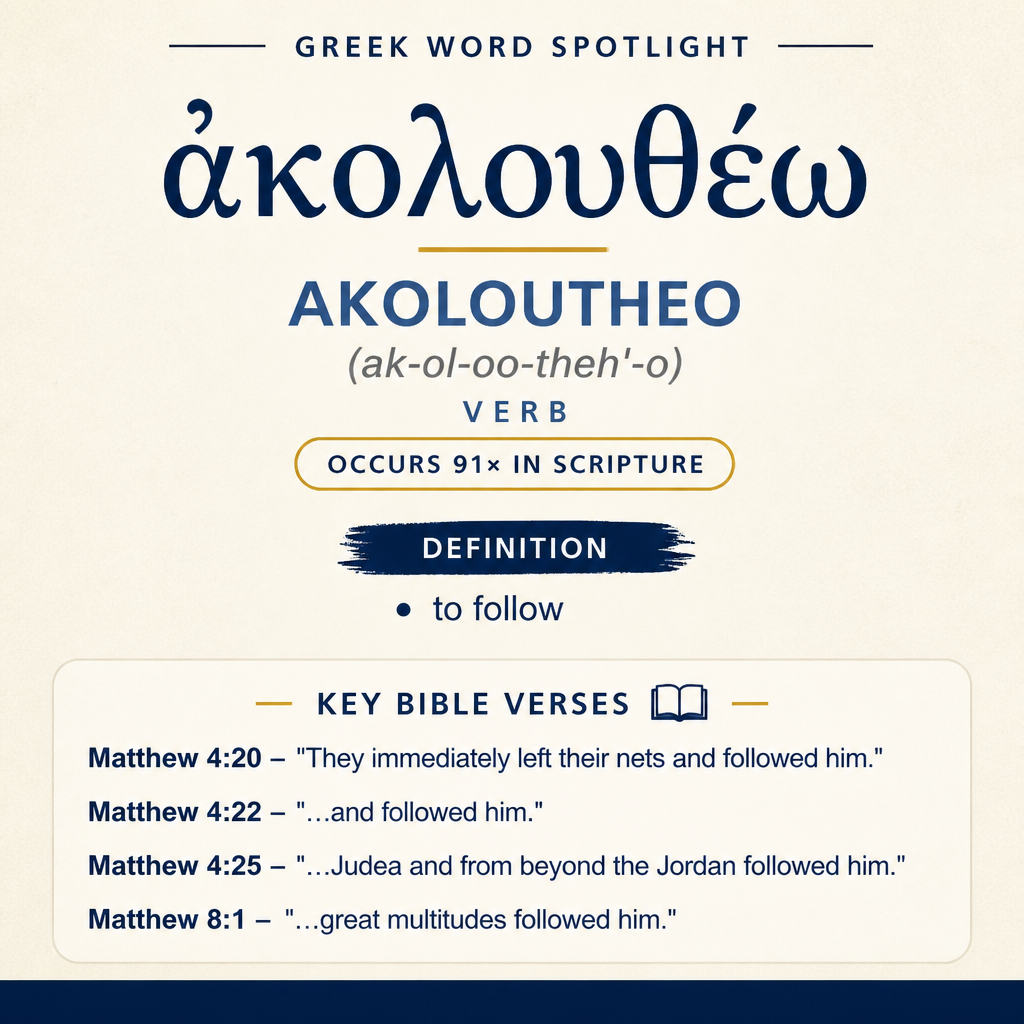
ἀκολουθέω means “to follow” and occurs 91 times in Scripture, including Matthew 4:20–25 and 8:1–23.
Core Meaning
ἀκολουθέω means “to follow.” In Matthew, it describes people and disciples following Jesus.
Learn More →Matthew Examples
In Matthew 4:20–22, men immediately left nets, boat, and father and followed him. In Matthew 8:23, his disciples followed him into a boat.
Learn More →Calls to Follow
In Matthew 8:19, a scribe promises, “I will follow you wherever you go.” In Matthew 8:22, Jesus commands, “Follow me.”
Learn More →ἀκολουθέω expresses the action of following. In these Gospel scenes, it marks bodily movement after Jesus as well as the committed attachment implied when people leave former ties to go with him.
Occurrences
Matthew 4:20 — “They immediately left their nets and followed him.”
Here ἀκολουθέω is set beside an abrupt break with work: leaving “nets” and then taking up movement after Jesus. The wording links following with a decisive, time-sensitive response (“immediately”), so the verb carries the force of an enacted choice rather than a delayed intention.
Matthew 4:22 — “They immediately left the boat and their father, and followed him.”
This instance sharpens what following costs in ordinary life. The objects left behind are both livelihood (“the boat”) and family connection (“their father”). ἀκολουθέω names the new direction of life that comes after that double release, again with the same immediacy.
Matthew 4:25 — “Great multitudes from Galilee, Decapolis, Jerusalem, Judea and from beyond the Jordan followed him.”
ἀκολουθέω now describes mass movement rather than the response of a few. The geographic sweep (“from Galilee, Decapolis, Jerusalem, Judea and from beyond the Jordan”) frames following as something that gathers people across regions; the verb holds together the picture of many traveling after one figure.
Matthew 8:1 — “When he came down from the mountain, great multitudes followed him.”
The scene is physical and directional: Jesus descends, and the crowd trails behind. ἀκολουθέω supplies the continuity of movement—his descent is matched by their pursuit—showing the crowd’s nearness and persistence as he transitions from one place to another.
Matthew 8:10 — “When Jesus heard it, he marveled, and said to those who followed, “Most certainly I tell you, I haven’t found so great a faith, not even in Israel.”
Here ἀκολουθέω identifies an audience: “those who followed” are the ones close enough to hear his reaction and his public statement. The verb functions almost like a social marker—these are the companions-on-the-road who accompany him and receive his spoken assessment.
Matthew 8:19 — “A scribe came, and said to him, “Teacher, I will follow you wherever you go.””
In this pledge, ἀκολουθέω is projected into the future (“I will follow”) and expanded without limits (“wherever you go”). The verb therefore takes on the force of a stated commitment, not merely a step taken at the moment; it is a promise to remain in his wake regardless of destination.
Matthew 8:22 — “But Jesus said to him, “Follow me, and leave the dead to bury their own dead.””
ἀκολουθέω appears as a direct command: “Follow me.” The command is paired with a stark leaving behind—“leave the dead to bury their own dead”—so the verb stands in contrast to other claims on a person’s time and duty. Following is presented as an urgent priority that reorders what one attends to first.
Matthew 8:23 — “When he got into a boat, his disciples followed him.”
Here ἀκολουθέω is almost tactile: Jesus enters a boat, and his disciples go after him into that same confined space. The verb conveys close accompaniment and shared travel; they do not simply watch from shore but take the same passage with him.
Matthew 9:9 — “As Jesus passed by from there, he saw a man called Matthew sitting at the tax collection office. He said to him, “Follow me.” He got up and followed him.”
This narrative sets ἀκολουθέω within a call-and-response pattern. The imperative “Follow me” is immediately met by action: “He got up and followed him.” The verb thus marks the transition from a stationary, defined role (“sitting at the tax collection office”) to active movement with Jesus, with the “got up” highlighting the decisive shift.
Matthew 9:19 — “Jesus got up and followed him, as did his disciples.”
Here Jesus himself is the subject of ἀκολουθέω: he “followed him,” and the disciples mirror that movement. The verb becomes a chain of following—someone leads, Jesus follows, and the disciples follow alongside—so it depicts coordinated travel and responsiveness within a group.
Matthew 9:27 — “As Jesus passed by from there, two blind men followed him, calling out and saying, “Have mercy on us, son of David!””
ἀκολουθέω is paired with loud petition. The two men “followed him” while “calling out,” so the verb describes pursuit that is not silent or passive; it is active pressing-in as Jesus moves on. Their following keeps them within hearing range and keeps their request in front of him as he passes.
Matthew 10:38 — “He who doesn’t take his cross and follow after me, isn’t worthy of me.”
This saying frames ἀκολουθέω as a defining mark of allegiance. The verb is joined to “take his cross,” making following the kind of action that involves acceptance of a heavy, costly association. It also becomes a criterion (“isn’t worthy of me”), so following is more than proximity; it functions as a test of whether a person truly aligns with him.
Sense and Usage
Across these passages, ἀκολουθέω consistently names movement in the wake of another—going after Jesus as he travels. Yet the scenes show that this “following” is rarely bare locomotion. In Matthew 4:20 and 4:22, it is anchored in abandonment of former securities (nets, boat, even family presence). The repeated “immediately” pushes the verb toward the sphere of decisive response: following is not treated as a gradual drift but as a punctual turning that can be seen in what is left behind.
Other contexts broaden the scale and texture of the same action. Matthew 4:25 and 8:1 use ἀκολουθέω for crowds, emphasizing numbers and geographic reach; following becomes a public phenomenon with momentum. Matthew 8:10 shows another angle: “those who followed” are a recognizable circle, close enough to hear and be addressed. The verb can therefore imply a relationship of access—being near enough to receive teaching and to be counted among companions.
The verb also appears in speech as a commitment or command. The scribe’s “I will follow you wherever you go” (Matthew 8:19) stretches following across unknown routes; it is a stated readiness to keep pace with Jesus’ movements without specifying terms. Jesus’ “Follow me” (Matthew 8:22; 9:9) makes the verb performative: the word itself initiates a new pattern of life, and the surrounding clauses show that answering it reshapes priorities. In Matthew 8:22, following is placed against obligations associated with death and burial; in Matthew 9:9, it contrasts with remaining seated at a work station. In both, ἀκολουθέω signals an immediate reorientation of one’s next steps—literally getting up and going.
Finally, Matthew 10:38 presents following as an emblem of worthiness. The concrete image of “take his cross” supplies weight and seriousness to the action of following “after me.” In that setting, ἀκολουθέω functions as a summary of the kind of attachment that defines a disciple: it is not simply to walk behind Jesus when convenient, but to accept the implications of being identified with him as one goes after him.
Imagery
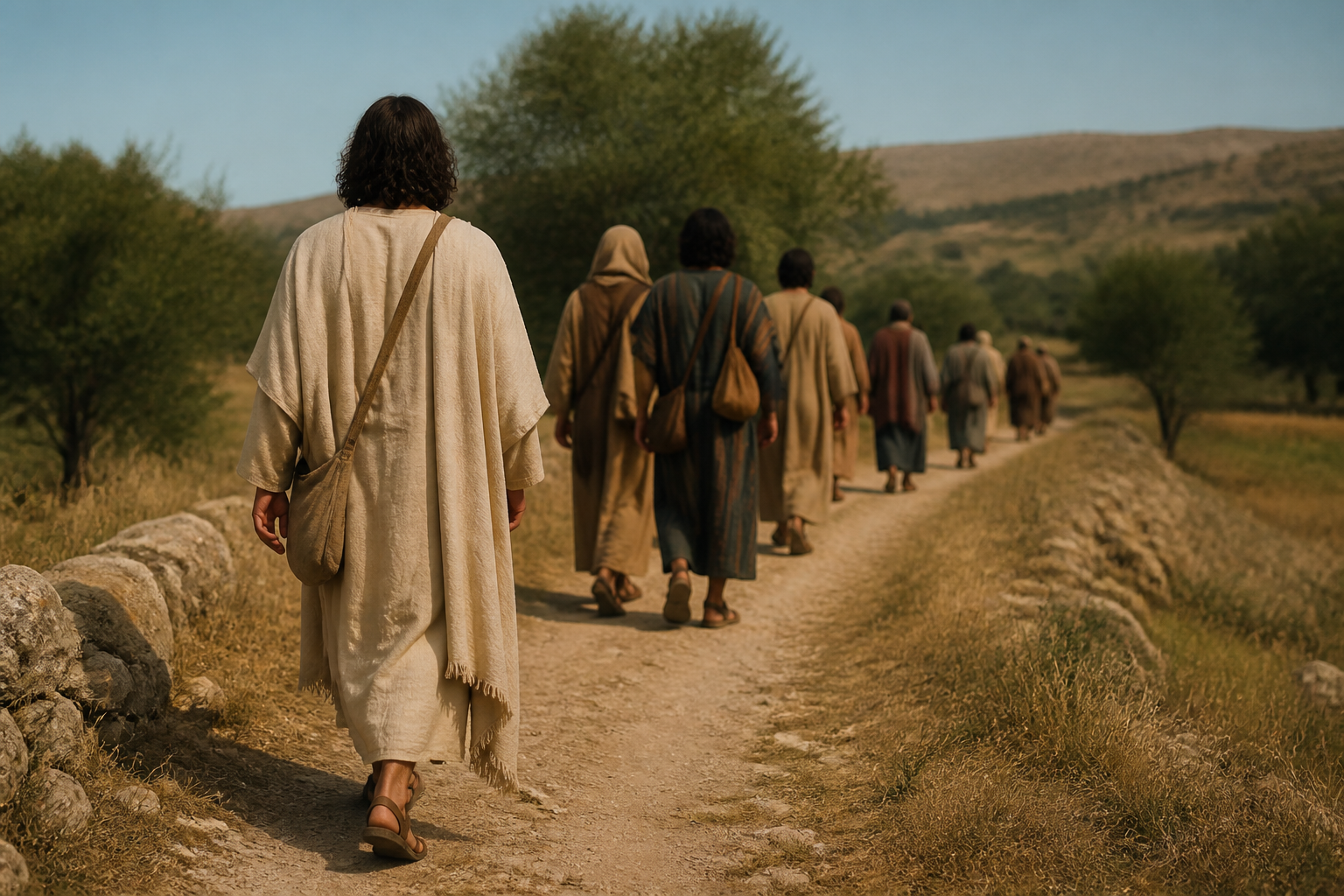
In these scenes, ἀκολουθέω repeatedly paints a road-bound picture: nets dropped, boats boarded, crowds streaming from many places, disciples stepping into the same vessel, and voices calling out while pursuing. The verb ties discipleship language to visible, embodied motion—people actually moving behind Jesus—and the repeated acts of leaving and rising reinforce that following is seen as a concrete trajectory rather than a private sentiment.
Sources: Lexical data from Strong’s Exhaustive Concordance and the Translators Brief Lexicon of Extended Strongs for Greek (STEPBible, CC BY). Occurrence data from the Translators Amalgamated Greek New Testament (STEPBible, CC BY). Scripture quotations from the World English Bible (public domain).





