
Exploring the Meaning of Akathartos in Greek
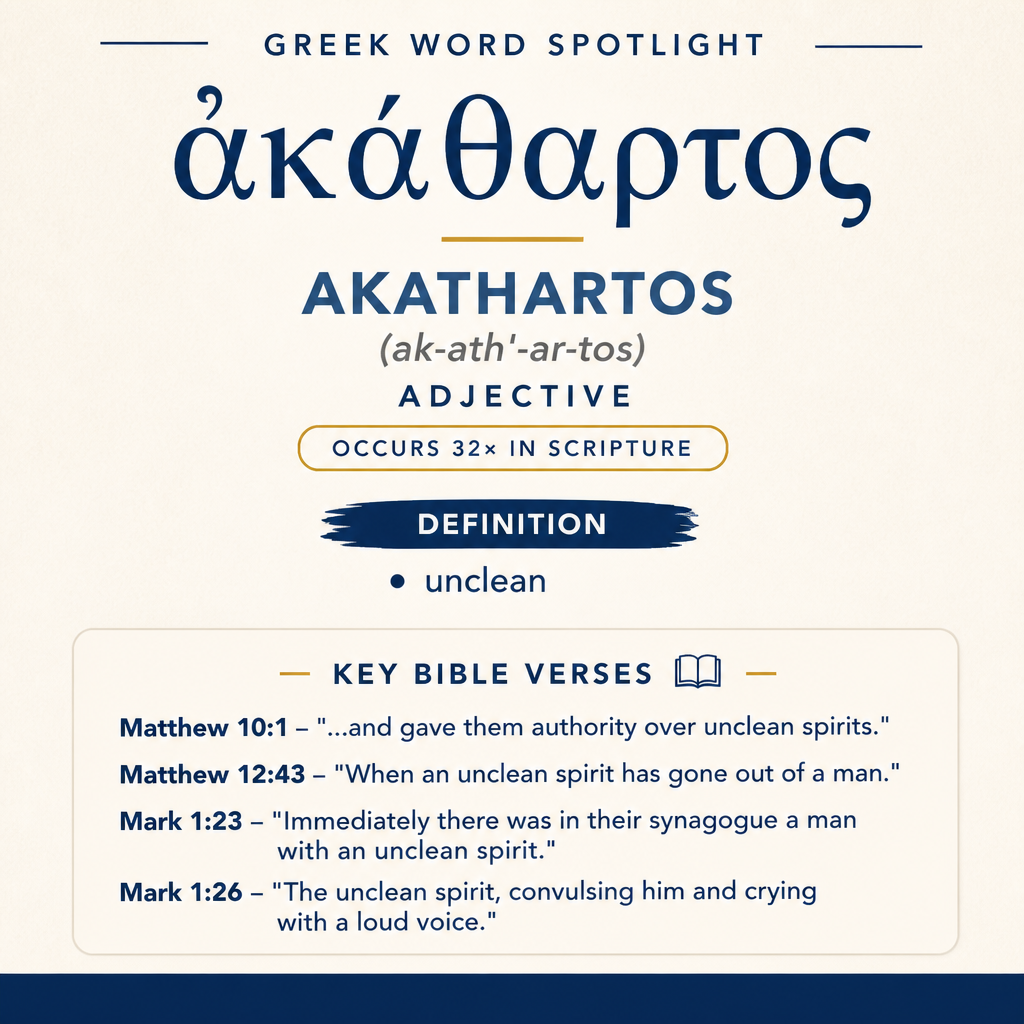
ἀκάθαρτος means “unclean” and appears 32 times in Scripture, including Matthew 10:1; 12:43 and Mark 1:23–27; 3:11, 30; 5:2.
Gospel Occurrences
It occurs in Matthew 10:1 and 12:43, and in Mark 1:23, 1:26–27, 3:11, 3:30, and 5:2.
Learn More →Akathartos means “unclean.” In the passages cited here it appears chiefly in the phrase “unclean spirit(s),” describing the spirits over which Jesus and his disciples exercise authority and which are shown to oppress, speak, and depart at command.
Occurrences
He called to himself his twelve disciples, and gave them authority over unclean spirits, to cast them out, and to heal every disease and every sickness. (Matthew 10:1)
Here “unclean” qualifies “spirits” in a setting of delegated authority: the disciples are given power “over unclean spirits” with the stated purpose “to cast them out.” The same grant of authority is paired with healing “every disease and every sickness,” so “unclean spirits” belong to the complex of afflictions that Jesus commissions his disciples to confront.

When an unclean spirit has gone out of a man, he passes through waterless places, seeking rest, and doesn’t find it. (Matthew 12:43)
In this saying, “unclean” marks a spirit whose departure from “a man” is envisioned and whose subsequent movement is described: it “passes through waterless places, seeking rest.” The adjective helps frame the spirit as an unwelcome occupant that can leave and roam, and the scene stresses its restless, searching character after it has “gone out.”
Immediately there was in their synagogue a man with an unclean spirit, and he cried out, (Mark 1:23)
“Unclean” identifies the spirit associated with a man in a public worship setting (“their synagogue”). The narrative places the man’s distress and disruption (“he cried out”) alongside the presence of the “unclean spirit,” so the word contributes to the portrayal of the man’s condition as involving a personal, vocal spiritual presence.
The unclean spirit, convulsing him and crying with a loud voice, came out of him. (Mark 1:26)
Here “unclean” labels the spirit as it departs. The verse links the spirit’s exit with physical and audible effects on the man: “convulsing him and crying with a loud voice.” The word thus participates in a depiction where the spirit is an active agent whose leaving is dramatic and observable.
They were all amazed, so that they questioned among themselves, saying, “What is this? A new teaching? For with authority he commands even the unclean spirits, and they obey him!” (Mark 1:27)
“Unclean spirits” appear as the object of Jesus’ authoritative command, and their response is emphasized: “they obey him!” The adjective underscores the remarkable scope of his authority; it reaches to spirits characterized as “unclean,” and the crowd’s amazement is tied to that obedience.
The unclean spirits, whenever they saw him, fell down before him, and cried, “You are the Son of God!” (Mark 3:11)
“Unclean spirits” are presented collectively and react repeatedly (“whenever they saw him”). Their behavior—“fell down before him”—and their cry identify Jesus’ status in their own speech. The adjective continues to distinguish these spirits while the scene highlights their compelled recognition and submissive posture in his presence.
—because they said, “He has an unclean spirit.” (Mark 3:30)
This occurrence is an accusation directed at Jesus: “He has an unclean spirit.” The adjective shapes the charge by portraying the alleged spirit as “unclean,” and the statement functions as an explanatory note (“because they said”) for what precedes in the narrative context. The word here participates not in a deliverance scene but in contested interpretation of Jesus himself.
When he had come out of the boat, immediately a man with an unclean spirit met him out of the tombs. (Mark 5:2)
“Unclean” again qualifies the spirit associated with a man, but the setting is stark: the man comes “out of the tombs” to meet Jesus as soon as Jesus disembarks (“Immediately”). The adjective contributes to a scene of confrontation at the boundary of normal habitation, where the man’s encounter is framed by the presence of the “unclean spirit.”
For he said to him, “Come out of the man, you unclean spirit!” (Mark 5:8)
The phrase “you unclean spirit” is direct address, used in the command for departure: “Come out of the man.” The adjective functions as part of the vocative identification of the spirit being commanded, spotlighting that the command is aimed at a distinct personal agent rather than merely at symptoms.
At once Jesus gave them permission. The unclean spirits came out and entered into the pigs. The herd of about two thousand rushed down the steep bank into the sea, and they were drowned in the sea. (Mark 5:13)
“Unclean spirits” here are plural and mobile: they “came out and entered into the pigs.” Their transfer is narrated as the trigger for a large-scale, visible result: a herd “of about two thousand” rushes “down the steep bank into the sea,” ending in drowning. The adjective continues to mark the spirits’ identity while the narrative stresses their movement and the destructive chain of events that follows their entry.
He called to himself the twelve, and began to send them out two by two; and he gave them authority over the unclean spirits. (Mark 6:7)
This commissioning parallels Matthew’s: the twelve are sent “two by two” with “authority over the unclean spirits.” The word anchors one element of their mission as they go out, defining a sphere over which delegated authority operates.
For a woman, whose little daughter had an unclean spirit, having heard of him, came and fell down at his feet. (Mark 7:25)
“Unclean” qualifies the spirit affecting “a woman”’s “little daughter,” and it supplies the urgent reason for the woman’s approach. The mother’s action—she “came and fell down at his feet”—is motivated by having “heard of him,” and the adjective contributes to the portrayal of the daughter’s need as involving a troubling spiritual presence.

Sense and Usage
Across these texts, akathartos functions as a consistent descriptor of “spirit(s)” in situations of affliction, confrontation, and command. The adjective marks the spirits as a kind that ought not to be present with the people they inhabit or trouble: a man “with an unclean spirit” cries out in a synagogue (Mark 1:23), convulses as the spirit departs (Mark 1:26), and a little girl “had an unclean spirit” that drives a mother to seek help (Mark 7:25). In each of these, the word helps characterize the spirits as an invasive, disordered presence in human lives—something that can be present “in” or “with” a person and that needs removal.
The same adjective also sharpens the portrayal of authority. Jesus “commands even the unclean spirits, and they obey him” (Mark 1:27), and the twelve receive “authority over unclean spirits” (Matthew 10:1; Mark 6:7). The repeated coupling of “unclean spirits” with “authority” and with the act of “cast[ing] them out” establishes a pattern: the spirits are depicted as powerful enough to convulse and cry out (Mark 1:26), yet they are not sovereign; they respond to command. Even when the narrative reports large-scale consequences of their movement—entering pigs and precipitating the herd’s rush into the sea (Mark 5:13)—the episode is framed by Jesus’ control, since “Jesus gave them permission” (Mark 5:13).
Akathartos also appears in a reflective teaching scene where the focus is not on an exorcism but on the spirit’s behavior after leaving a person: it “passes through waterless places, seeking rest, and doesn’t find it” (Matthew 12:43). In that setting the adjective belongs to a portrayal of the spirit as restless and unsettled, moving through inhospitable spaces. The word’s contribution is to keep the subject clearly within the same category as the spirits cast out elsewhere, linking removal with what may follow afterward.
Finally, the adjective can function in polemical speech. “He has an unclean spirit” (Mark 3:30) is not a description of someone seeking help but an accusation aimed at Jesus. In that single line, akathartos helps show how talk about spirits can become a contested interpretation of Jesus’ activity. Mark’s narrative notes the statement as the reason for a prior charge (“because they said”), so the adjective sits at the center of a dispute over how to explain Jesus’ power.
Imagery in Context
The passages attach vivid, bodily and spatial imagery to “unclean spirits”: a man crying out in a synagogue (Mark 1:23), convulsions and a loud voice at the moment of departure (Mark 1:26), spirits falling down and shouting recognition (Mark 3:11), wandering through “waterless places” in search of “rest” (Matthew 12:43), and a transfer into animals that ends in a herd plunging into the sea (Mark 5:13). Through these scenes, “unclean” is not an abstract label; it is a descriptor tied to dramatic encounters where spirits are confronted, expelled, and shown to be subject to command.
Sources: Lexical data from Strong’s Exhaustive Concordance and the Translators Brief Lexicon of Extended Strongs for Greek (STEPBible, CC BY). Occurrence data from the Translators Amalgamated Greek New Testament (STEPBible, CC BY). Scripture quotations from the World English Bible (public domain).




