Exploring the Meaning of Aiteo in Greek
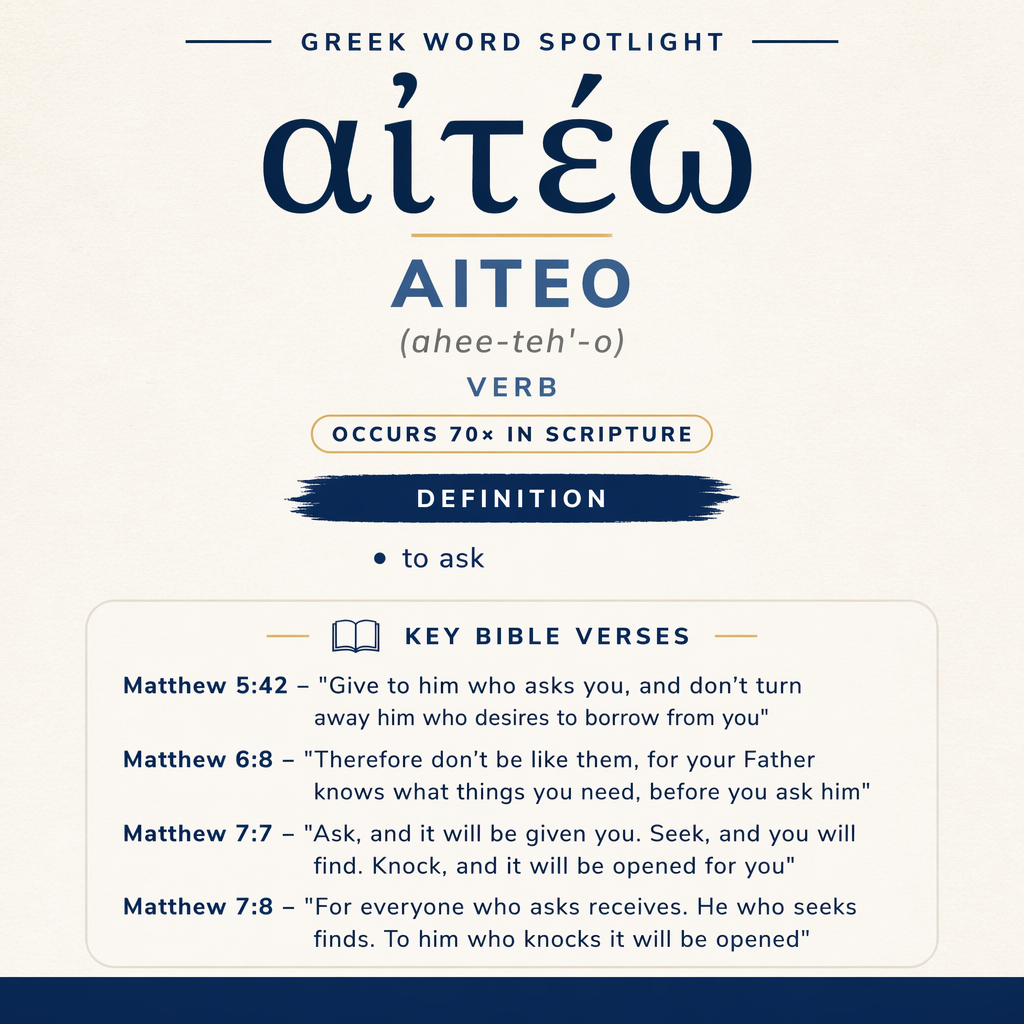
αἰτέω means “to ask” and occurs 70 times in Scripture, including multiple uses in Matthew’s Gospel.
Core Meaning
αἰτέω is defined as “to ask.” In Matthew it appears in contexts of requesting, such as asking for bread or fish.
Learn More →Teaching Context
Jesus uses αἰτέω in Matthew 7:7–8: “Ask, and it will be given you… For everyone who asks receives.” Matthew 6:8 links asking with the Father’s knowledge of needs.
Learn More →Narrative Example
In Matthew 5:42, it describes someone who asks and receives a gift or help. In Matthew 14:7, it refers to a request made under an oath to give “whatever she should ask.”
Learn More →αἰτέω expresses the act of asking, appearing in a range of settings that include ordinary human requests, moral instruction, and prayer addressed to God. In the passages below it marks both the requester and the one appealed to, shaping scenes of giving, dependence, and expectation.
Occurrences
Matthew 5:42 — “Give to him who asks you, and don’t turn away him who desires to borrow from you.”
Here αἰτέω stands at the point where a request meets a response. The saying assumes an asker approaching “you,” and the imperative “Give” treats the request as a concrete occasion for generosity. Asking is paired with “desires to borrow,” setting requesting within everyday material need and the social power dynamic of one person having the ability to grant or refuse.

Matthew 6:8 — “Therefore don’t be like them, for your Father knows what things you need, before you ask him.”
Asking is framed against divine knowledge: the Father already knows “what things you need” prior to the request. The line does not cancel the act of asking; it places it within a relationship where the one addressed is already aware. αἰτέω thus marks prayerful petition as something offered to a knowing Father, not as a way of informing him.
Matthew 7:7 — ““Ask, and it will be given you. Seek, and you will find. Knock, and it will be opened for you.”
αἰτέω appears as a direct command, parallel to “Seek” and “Knock.” The pairing “Ask … and it will be given you” treats asking as an initiating act that anticipates an answering gift. The verse situates asking in a sequence of active approaches, where the petitioner is not passive but engaged in coming toward what is desired.
Matthew 7:8 — “For everyone who asks receives. He who seeks finds. To him who knocks it will be opened.”
This sentence generalizes the preceding command into a maxim: “everyone who asks receives.” Asking is presented as a recognizable human action with a corresponding outcome. By coordinating ask/receive with seek/find and knock/open, the verse portrays asking as one kind of approach to another party who can respond, and it emphasizes the expectation of response rather than the content of the request.
Matthew 7:9 — “Or who is there among you, who, if his son asks him for bread, will give him a stone?”
αἰτέω is embedded in a household illustration: a son makes a request to a father for “bread.” Asking here is specific and ordinary, and it highlights the moral absurdity of a mismatched answer (“a stone”). The verb frames the relational appropriateness of granting what is requested, and it stresses the father’s responsibility to respond fittingly to the child’s request.
Matthew 7:10 — “Or if he asks for a fish, who will give him a serpent?”
The second analogy repeats the same structure with a different object: “fish” versus “serpent.” αἰτέω again marks a child’s request, and the rhetorical question depends on shared moral sense that a request for nourishment should not be met with something harmful. Asking functions as the trigger that reveals character in the one with power to give.
Matthew 7:11 — “If you then, being evil, know how to give good gifts to your children, how much more will your Father who is in heaven give good things to those who ask him!”
Asking is now directed explicitly toward “your Father who is in heaven.” The verse links human parental giving (“good gifts”) to divine giving (“good things”), with asking as the point of contact: the recipients are “those who ask him.” αἰτέω thus marks petition as a normal and fitting way creatures approach God, and it underscores the generosity of the giver more than the skill of the asker.
Matthew 14:7 — “Whereupon he promised with an oath to give her whatever she should ask.”
In this narrative moment, asking is set within a vow: he promises “to give her whatever she should ask.” αἰτέω highlights the breadth of what the speaker puts at the disposal of the requester—an open-ended commitment shaped by the future request. The verb therefore carries a weight of consequence: the asked-for item is not yet specified, but it will define what is given because a promise has been attached to the act of asking.
Matthew 18:19 — “Again, assuredly I tell you, that if two of you will agree on earth concerning anything that they will ask, it will be done for them by my Father who is in heaven.”
Asking here occurs in a communal setting: “if two of you will agree on earth concerning anything that they will ask.” αἰτέω is tied to agreement, suggesting a shared petition rather than an isolated request. The outcome is described as the Father’s action—“it will be done for them”—so the asking is not merely addressed to God but is also situated within the unity of the petitioners.
Matthew 20:20 — “Then the mother of the sons of Zebedee came to him with her sons, kneeling and asking a certain thing of him.”
This scene shows asking through posture and approach: she “came,” she was “kneeling,” and she was “asking a certain thing of him.” αἰτέω thus functions as a social act performed with deference, directed toward one recognized as able to grant the request. The phrase “a certain thing” keeps the focus on the act of petition itself before any details are voiced, stressing the intentionality of coming to request.
Matthew 20:22 — “But Jesus answered, “You don’t know what you are asking. Are you able to drink the cup that I am about to drink, and be baptized with the baptism that I am baptized with?” They said to him, “We are able.”
Here αἰτέω is evaluated: “You don’t know what you are asking.” Asking is portrayed as an action that can be misguided or uninformed; the request may have implications beyond what the petitioner grasps. Jesus’ response connects the act of asking with readiness for suffering (“drink the cup”) and identification (“baptized with the baptism”), showing that requests can be bound up with outcomes that test the asker.
Matthew 21:22 — “All things, whatever you ask in prayer, believing, you will receive.”
Asking is explicitly located “in prayer,” and it is joined to “believing.” αἰτέω here is not casual requesting but petition offered within a faith posture. The promise “you will receive” echoes the earlier ask/receive pattern, but this verse tightens the setting: the asking is framed as prayer and is characterized by trust, presenting receiving as the fitting counterpart to such asking.

Sense and Usage
Across these passages, αἰτέω consistently marks a directed request: someone asks someone for something, whether the recipient is a neighbor with goods to share (Matthew 5:42), a parent in a household (Matthew 7:9–10), a ruler making an oath-bound offer (Matthew 14:7), Jesus as the approached authority (Matthew 20:20), or “your Father who is in heaven” in prayer (Matthew 6:8; 7:11; 18:19; 21:22). The verb’s force is relational: asking presupposes a party able to grant, and it places the asker in a position of dependence, need, or appeal.
The scenes also show that asking can be framed by expectations and conditions. In Matthew 7:7–8 and 21:22, asking is connected to receiving, presenting a strong linkage between petition and provision. In Matthew 18:19, the asking is paired with agreement between two people, indicating that the act of requesting may be set within shared purpose. In Matthew 6:8, asking is set alongside the Father’s prior knowledge, which situates the request within intimacy rather than uncertainty. And in Matthew 20:22, asking is open to critique: the action of requesting is not automatically wise simply because it is earnest; the content and implications of the request matter, as shown by the corrective, “You don’t know what you are asking.”
Finally, the verb participates in the moral logic of giving. Matthew 5:42 attaches asking to the demanded response of generosity. Matthew 7:9–11 uses asking to draw out what appropriate giving looks like, moving from human parents who give “good gifts” to the heavenly Father who gives “good things.” Asking, in these sayings, becomes the moment where the giver’s character is revealed: either by refusing to turn away, by not substituting harm for help, or by giving in a way consistent with goodness.
Imagery
The imagery tied to αἰτέω in these verses is concrete and bodily. A needy person asks and another is told, “Give” (Matthew 5:42); a child asks for “bread” or “a fish” (Matthew 7:9–10); a woman kneels while asking (Matthew 20:20). Even when the setting is prayer, asking is pictured as an active approach—“Ask … Seek … Knock” (Matthew 7:7)—so the verb carries the feel of reaching out toward one who can open, give, and do “good things” for those who ask (Matthew 7:11; 18:19; 21:22).
Sources: Lexical data from Strong’s Exhaustive Concordance and the Translators Brief Lexicon of Extended Strongs for Greek (STEPBible, CC BY). Occurrence data from the Translators Amalgamated Greek New Testament (STEPBible, CC BY). Scripture quotations from the World English Bible (public domain).