Exploring the Meaning of Aitema in Greek
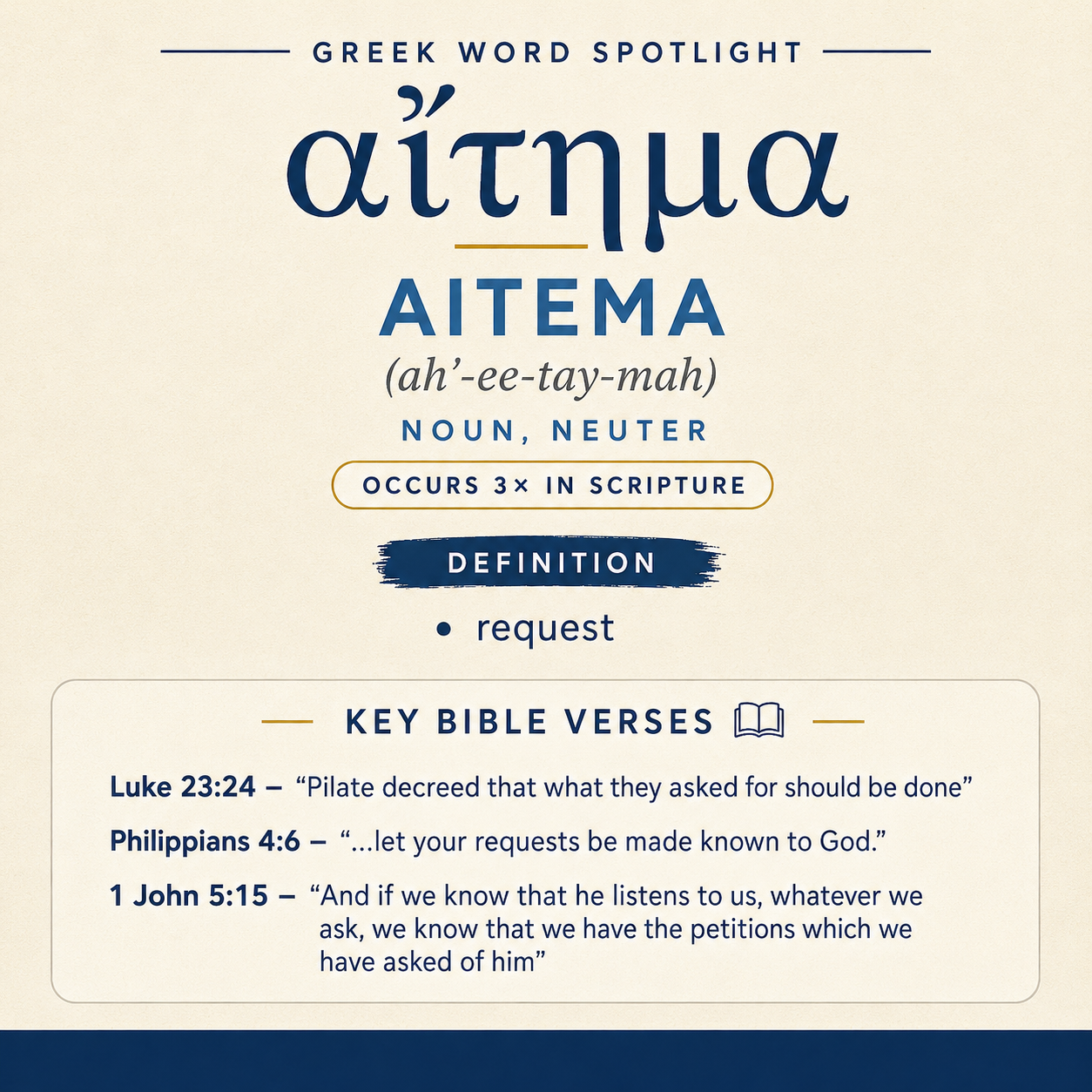
αἴτημα (Aitema) means “request” and occurs three times in Scripture: Luke 23:24, Philippians 4:6, and 1 John 5:15.
Core Meaning
αἴτημα is defined as “request.” It appears in contexts where something is asked for.
Learn More →Luke Context
In Luke 23:24, Pilate decreed that what they asked for should be done. The term refers to what was requested of him.
Learn More →Prayer Contexts
In Philippians 4:6, believers are told to make their requests known to God. In 1 John 5:15, petitions asked of God are affirmed as heard.
Learn More →αἴτημα refers to a “request,” the thing asked for. It appears in scenes of public decision and of prayer, where what is sought is brought before an authority—human or divine.
Root and Related Words
αἴτημα is related to the verb aiteo (αἰτέω), “to ask” (Strong’s G154). The noun expresses the outcome of asking: the request itself as a distinct item that can be voiced, known, granted, or possessed.

Occurrences
“Pilate decreed that what they asked for should be done.” (Luke 23:24)
Here αἴτημα belongs to a legal and political moment. The focus is not on the act of asking but on the content of the demand—“what they asked for”—and on the fact that it is treated as something that can be executed by decree. The verse pairs a request with an authoritative response: Pilate’s decision gives the request tangible effect (“should be done”). The word therefore carries the weight of a petition that has moved from the crowd’s desire into the sphere of an official ruling.

“In nothing be anxious, but in everything, by prayer and petition with thanksgiving, let your requests be made known to God.” (Philippians 4:6)
In this exhortation αἴτημα stands within a cluster of prayer language: “prayer and petition with thanksgiving.” The requests are not left vague or private; they are to be “made known to God.” The wording portrays αἴτημα as something that can be expressed and presented—brought into the open before God rather than held inside as anxiety. “In everything” sets a wide field for these requests, while “with thanksgiving” frames how they are offered. The term thus functions as the concrete content carried by prayer and petition: specific requests, articulated and entrusted to God’s attention.
“And if we know that he listens to us, whatever we ask, we know that we have the petitions which we have asked of him.” (1 John 5:15)
In this statement αἴτημα is tied to confidence grounded in God’s hearing: “he listens to us.” The verse moves in two steps: asking (“whatever we ask”) and possessing (“we know that we have the petitions”). αἴτημα names what is possessed—the petitions themselves—once they have been asked “of him.” The repetition of “ask/asked” keeps the scene anchored in requesting, yet the noun highlights the requests as identifiable items that can be counted as “the petitions.” The emphasis is certainty: if God listens, the petitions asked are truly held, not merely hoped for.
Sense and Usage
Across these passages αἴτημα consistently denotes a request as a definite object, something that can be singled out as “what they asked for,” gathered into “your requests,” or recognized as “the petitions.” This object-like character allows the word to operate naturally in different settings: judicial action, spiritual practice, and assurance of answered prayer.
In Luke 23:24, the request is collective and public, coming from a group and meeting the machinery of governance. The request is powerful enough to be the content of a decree, and the result is immediate: it “should be done.” In Philippians 4:6, the requests are personal and comprehensive (“in everything”), and the key action is disclosure: they are to be made known to God. The sentence does not merely recommend asking; it sets the requests inside a posture (“with thanksgiving”) and a larger purpose (replacing anxiety). In 1 John 5:15, the requests are again personal (“to us”) and are framed by relationship and trust: God listens, therefore the petitions asked can be spoken of as already possessed.
These uses also show how αἴτημα relates to agency and authority. A request implies someone with the ability to grant or enact it. Pilate’s authority turns the request into an order carried out. In Philippians and 1 John, God is the one before whom requests are placed; the verbs around the noun (“made known,” “listens,” “have”) describe a movement from expression to reception to confident possession. The word thereby serves as a bridge between the asker and the one addressed, marking the specific matters that pass between them.
Finally, the three contexts highlight different outcomes for a request. Luke presents fulfillment by decree. Philippians focuses on the act of presenting requests rather than the immediate result. 1 John speaks of having the petitions, describing a settled confidence that the requests asked of God are truly secured because he listens. In each case, αἴτημα names the same kind of thing—a request—while the surrounding sentences supply distinct angles: public enforcement, prayerful disclosure, and assured possession.
Imagery
The word carries the imagery of a matter placed before a higher hand for decision. In Luke 23:24, the request stands at the edge of a governor’s judgment seat, waiting for a decree. In Philippians 4:6, requests are gathered with prayer and thanksgiving and brought into God’s presence as known and spoken matters. In 1 John 5:15, the petitions rest in the confidence that the One who listens also holds the outcome, so that what is asked can be spoken of as already had.
Sources: Lexical data from Strong’s Exhaustive Concordance and the Translators Brief Lexicon of Extended Strongs for Greek (STEPBible, CC BY). Occurrence data from the Translators Amalgamated Greek New Testament (STEPBible, CC BY). Scripture quotations from the World English Bible (public domain).