Understanding the Significance of Aionios in Greek
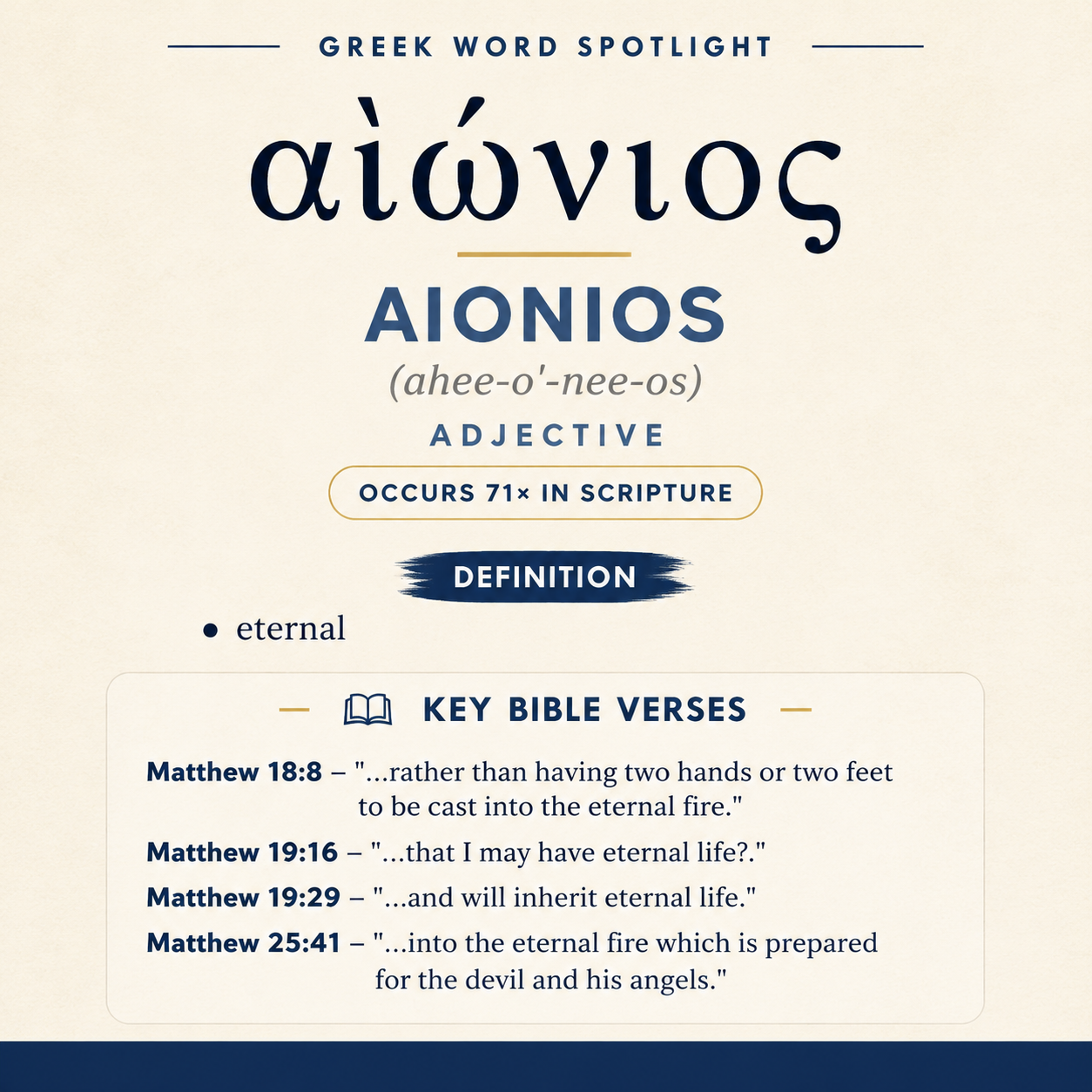
αἰώνιος means “eternal” and appears 71 times in Scripture, including Matthew 19:16; Matthew 25:46; and Mark 3:29.
Scripture Occurrences
This word occurs 71 times in Scripture. Listed examples include Matthew 18:8, Matthew 19:16, Matthew 25:41, and Mark 10:17.
Learn More →Biblical Contexts
It describes “eternal life” (Matthew 19:16; Matthew 25:46), “eternal fire” (Matthew 25:41), and “eternal condemnation” (Mark 3:29).
Learn More →Aionios means “eternal.” In the passages here, it qualifies realities Jesus and others speak about—fire, life, punishment, condemnation, and even “tents”—marking them out as belonging to an unending horizon.
Occurrences
Matthew 18:8 — “If your hand or your foot causes you to stumble, cut it off, and cast it from you. It is better for you to enter into life maimed or crippled, rather than having two hands or two feet to be cast into the eternal fire.”
Here aionios intensifies the warning by attaching “eternal” to “fire.” The contrast is not between different kinds of fire but between entering “into life” even at great cost versus being “cast into the eternal fire.” The adjective gives the threatened outcome a weight that matches the radical action described (“cut it off, and cast it from you”).
Matthew 19:16 — “Behold, one came to him and said, “Good teacher, what good thing shall I do, that I may have eternal life?””
Aionios frames the questioner’s goal: not merely “life” in general, but “eternal life.” Within the verse, the adjective belongs to the man’s moral calculus (“what good thing shall I do”), signaling that the life he seeks is understood as a lasting state worth pursuing through deliberate action.
Matthew 19:29 — “Everyone who has left houses, or brothers, or sisters, or father, or mother, or wife, or children, or lands, for my name’s sake, will receive one hundred times, and will inherit eternal life.”
In this promise, aionios modifies what is “inherited.” The verse stacks present losses (“left houses… lands”) against a twofold future: abundant recompense (“one hundred times”) and a lasting inheritance (“eternal life”). The adjective anchors the promise beyond temporary reward by portraying the inheritance as enduring.
Matthew 25:41 — “Then he will say also to those on the left hand, ‘Depart from me, you cursed, into the eternal fire which is prepared for the devil and his angels;”
Aionios again qualifies “fire,” but now within a judicial scene that divides people (“those on the left hand”) and issues a sentence (“Depart from me”). The fire is described not only as “eternal” but also as “prepared for the devil and his angels,” and the adjective underscores the severity of being sent into a destiny associated with that prepared judgment.
Matthew 25:46 — “These will go away into eternal punishment, but the righteous into eternal life.”
This verse places aionios on both sides of a stark parallel: “eternal punishment” and “eternal life.” The adjective functions as the shared measure of duration for each outcome, while the nouns (“punishment” versus “life”) supply the qualitative contrast. The symmetry gives the sentence a balanced finality: both destinations are portrayed as enduring.
Mark 3:29 — “but whoever may blaspheme against the Holy Spirit never has forgiveness, but is subject to eternal condemnation.”
Here aionios attaches to “condemnation” in a statement framed by absolutes: “never has forgiveness” and “is subject to eternal condemnation.” The adjective strengthens the consequence described; the issue is not merely that condemnation occurs, but that it is characterized as enduring, set against the total lack of forgiveness in the saying.
Mark 10:17 — “As he was going out into the way, one ran to him, knelt before him, and asked him, “Good Teacher, what shall I do that I may inherit eternal life?””
Aionios appears in a scene of urgency and reverence (“ran,” “knelt”), attached to the object of the man’s concern: “inherit eternal life.” The adjective indicates that what is sought is not a passing benefit but a permanent inheritance, and it helps explain the intensity of the approach and the directness of the question.
Mark 10:30 — “but he will receive one hundred times more now in this time: houses, brothers, sisters, mothers, children, and land, with persecutions; and in the age to come eternal life.”
This occurrence sets “now in this time” against “in the age to come,” and aionios qualifies the future gift: “eternal life.” The adjective is placed specifically in the later horizon (“the age to come”), distinguishing the enduring life promised there from the mixed present experience (“one hundred times more… with persecutions”).
Mark 16:8 — “They went out, and fled from the tomb, for trembling and astonishment had come on them. They said nothing to anyone; for they were afraid.”
This verse narrates fear and silence at the tomb. Its effect alongside the other contexts is to keep attention on the narrative setting of Jesus’ ministry and its aftermath, within which talk of “eternal” destinies (life, condemnation, punishment) belongs; the scene is marked by human trembling rather than by aionios-language in the spoken lines.
Luke 10:25 — “Behold, a certain lawyer stood up and tested him, saying, “Teacher, what shall I do to inherit eternal life?””
Aionios appears in a testing question. The lawyer’s concern with “inherit[ing] eternal life” gives the test a high seriousness: the subject is an enduring inheritance, not a minor point of debate. The adjective raises the stakes of the exchange by situating the question within ultimate, lasting concerns.
Luke 16:9 — “I tell you, make for yourselves friends by means of unrighteous mammon, so that when you fail, they may receive you into the eternal tents.”
This is the most concrete and unusual pairing here: aionios modifies “tents.” In the verse, “unrighteous mammon” is treated as a means to an end, and the end is described as being “receive[d]… into the eternal tents” when “you fail.” The adjective marks the “tents” as enduring lodging, set over against the instability implied by “mammon” and the certainty of “when you fail.”
Luke 18:18 — “A certain ruler asked him, saying, “Good Teacher, what shall I do to inherit eternal life?””
Again aionios qualifies “life” in the form “inherit eternal life.” The repetition of this phrasing across questioners (a ruler here) shows the adjective functioning as a standard descriptor for the life sought from Jesus: a lasting inheritance that prompts direct personal inquiry.

Sense and Usage
Across these passages, aionios consistently serves to stretch the horizon of what is being discussed. When it modifies “life,” the word directs attention to a lasting inheritance that motivates repeated questions: “what shall I do…?” (Matthew 19:16; Mark 10:17; Luke 10:25; Luke 18:18). In two places the verb “inherit” sits right beside the adjective (Mark 10:17; Luke 10:25; Luke 18:18), linking the enduring character of the life to the idea of receiving what is not merely earned but granted as a possession.
When it modifies realities of judgment—“fire,” “punishment,” and “condemnation”—aionios gives a corresponding permanence to the negative outcome (Matthew 18:8; Matthew 25:41; Matthew 25:46; Mark 3:29). These sayings are framed with decisive language (“Depart from me,” “never has forgiveness,” “will go away”), and the adjective ensures that the consequences are not pictured as temporary corrections but as enduring states. Matthew 25:46 is particularly pointed because the same adjective governs both “punishment” and “life,” presenting duration as a shared feature while leaving the contrast to the nouns themselves.
Luke 16:9 shows that aionios is not limited to explicitly judicial or biological terms. By describing “tents” as eternal, the verse expresses enduring security with everyday imagery. The setting of “unrighteous mammon” and the moment “when you fail” imply fragility and transience, and the adjective shifts the reader’s imagination toward a lasting welcome (“they may receive you”) that outlasts the moment of failure.
The occurrences also show that “eternal” can appear in direct moral exhortation (Matthew 18:8), in promises that reframe sacrifice (Matthew 19:29; Mark 10:30), in solemn judicial pronouncements (Matthew 25:41, 25:46), and in terse warnings about unforgiveness and culpability (Mark 3:29). In each case, the adjective functions less as an ornament and more as the key descriptor that makes the scene’s logic press toward ultimate outcomes.
Imagery
The word’s imagery ranges from stark to homely. “Eternal fire” and “eternal punishment” portray an unending judgment that matches the gravity of the sentences spoken (Matthew 18:8; Matthew 25:41; Matthew 25:46). “Eternal life” stands as the desired inheritance repeatedly placed before Jesus (Matthew 19:16; Matthew 19:29; Mark 10:17; Mark 10:30; Luke 10:25; Luke 18:18). “Eternal tents” casts that endurance as lasting shelter and reception, an image of being taken in beyond the point of human failure (Luke 16:9).
Sources: Lexical data from Strong’s Exhaustive Concordance and the Translators Brief Lexicon of Extended Strongs for Greek (STEPBible, CC BY). Occurrence data from the Translators Amalgamated Greek New Testament (STEPBible, CC BY). Scripture quotations from the World English Bible (public domain).