Understanding the Meaning of Aichmaloteuo in Greek
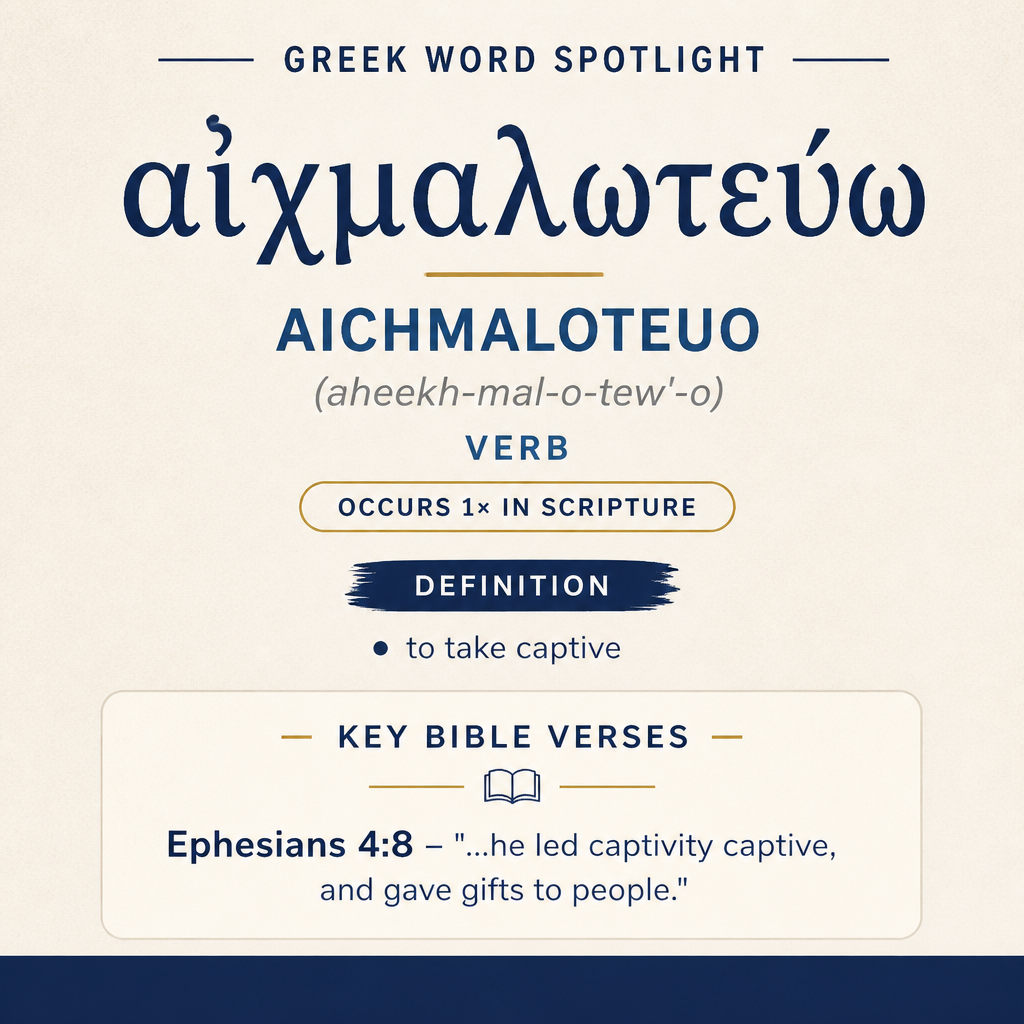
αἰχμαλωτεύω means “to take captive” and appears once in Scripture, in Ephesians 4:8.
Scripture Occurrence
This verb occurs one time in Scripture. Its single occurrence is in Ephesians 4:8.
Learn More →Verse Context
In Ephesians 4:8 it appears in the line, “he led captivity captive.” The verse also says, “and gave gifts to people.”
Learn More →αἰχμαλωτεύω means “to take captive,” and it appears in the New Testament in Paul’s quotation-like declaration in Ephesians 4:8. There it serves a striking role in describing what happens when the ascended one “led captivity captive.”
Root and Related Words
αἰχμαλωτεύω is related to aichmalotos (αἰχμάλωτος), “captive” (Strong’s G164). The verbal form expresses the action associated with that noun: the handling of captives in a victorious context.

Occurrences
Ephesians 4:8: Therefore he says, “When he ascended on high, he led captivity captive, and gave gifts to people.”
In Ephesians 4:8, αἰχμαλωτεύω (rendered in the line “he led captivity captive”) is set inside a compact sequence of exaltation and benefaction: ascent, the leading of captivity, and the giving of gifts. The immediate scene is not a battlefield described in detail, but a triumphal movement “on high,” framed as an ascent that results in captives being led and gifts being distributed.
The wording pairs the act of leading with “captivity” itself as the object—“he led captivity captive”—which compresses the idea of taking captives into a vivid phrase. The verb supplies the dynamic element: it presents captivity not as a static condition but as something acted upon and carried along in the wake of the ascent. In this sentence, the “leading” of captivity stands alongside “gave gifts to people,” so the taking of captives functions as part of a larger picture of a victorious ascent that produces tangible outcomes for others.
Because the verse begins, “Therefore he says,” the line is presented as a cited saying within Paul’s argument. Within the quoted wording itself, αἰχμαλωτεύω contributes a public, processional feel: captives are not merely subdued; they are led in the context of being “on high.” The clause makes the taking of captives the counterpart to the giving of gifts, placing conquest and generosity side by side within a single, ordered declaration.
Sense and Usage
The definition “to take captive” is expressed in Ephesians 4:8 with an emphatic construction: the action is portrayed as the leading of “captivity” in a way that highlights the completeness of the capture. The verse does not linger on who the captives are or how the capture occurred; instead, it spotlights the result of victory—captivity is now something that can be led.
This usage frames taking captive as an act bound to exaltation (“he ascended on high”) and to distribution (“and gave gifts to people”). In other words, the taking of captives is not presented as an isolated act of force but as one element in a sequence that culminates in benefit for “people.” Within the single attested context, αἰχμαλωτεύω therefore carries an aura of decisive triumph: it conveys capture as something accomplished and then displayed or escorted as part of the victor’s ascent.
The relationship to aichmalotos (αἰχμάλωτος), “captive,” also clarifies how the verb functions conceptually in this line. The noun names the state or identity of one who is captive; the verb depicts the action that produces and manages that state. Ephesians 4:8 uses the verbal idea to advance the scene from status (“captivity”) to movement (“he led”), emphasizing that captivity is under control and being directed.
Imagery
The imagery attached to αἰχμαλωτεύω in Ephesians 4:8 is triumphal and vertical: an ascent “on high” accompanied by the leading of captives and followed by the giving of gifts. The verse paints a single, concentrated tableau of victory and generosity, with the taking of captives serving as the forceful middle movement between ascent and gift-giving.
Sources: Lexical data from Strong’s Exhaustive Concordance and the Translators Brief Lexicon of Extended Strongs for Greek (STEPBible, CC BY). Occurrence data from the Translators Amalgamated Greek New Testament (STEPBible, CC BY). Scripture quotations from the World English Bible (public domain).