Discovering the Meaning of ‘Ahab in Hebrew
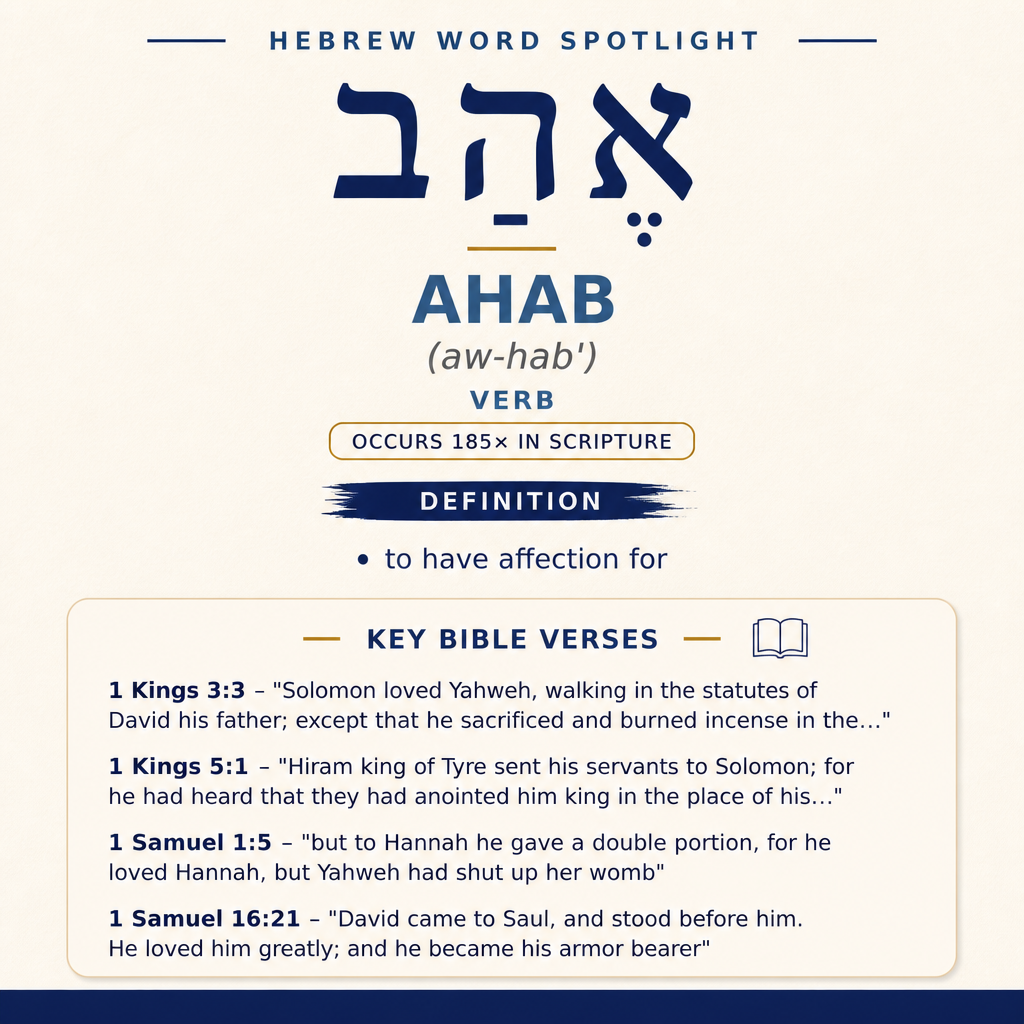
אָהַב means “to have affection for” and appears 185 times in Scripture, including 1 Kings 3:3 and 1 Samuel 18:20.
Core Sense
אָהַב means “to have affection for.” In 1 Samuel 1:5 it describes Elkanah’s affection for Hannah.
Learn More →People & Kings
It expresses affection toward leaders, as when David was loved by Saul (1 Samuel 16:21) and by all Israel and Judah (1 Samuel 18:16).
Learn More →Toward Yahweh
It can describe affection directed to Yahweh, as in “Solomon loved Yahweh” (1 Kings 3:3).
Learn More →אָהַב (ahab) expresses having affection for another. In the passages listed here it appears in narratives about royal relationships, family life, covenant loyalty, and the moral problem of directing affection toward what opposes Yahweh.

Occurrences
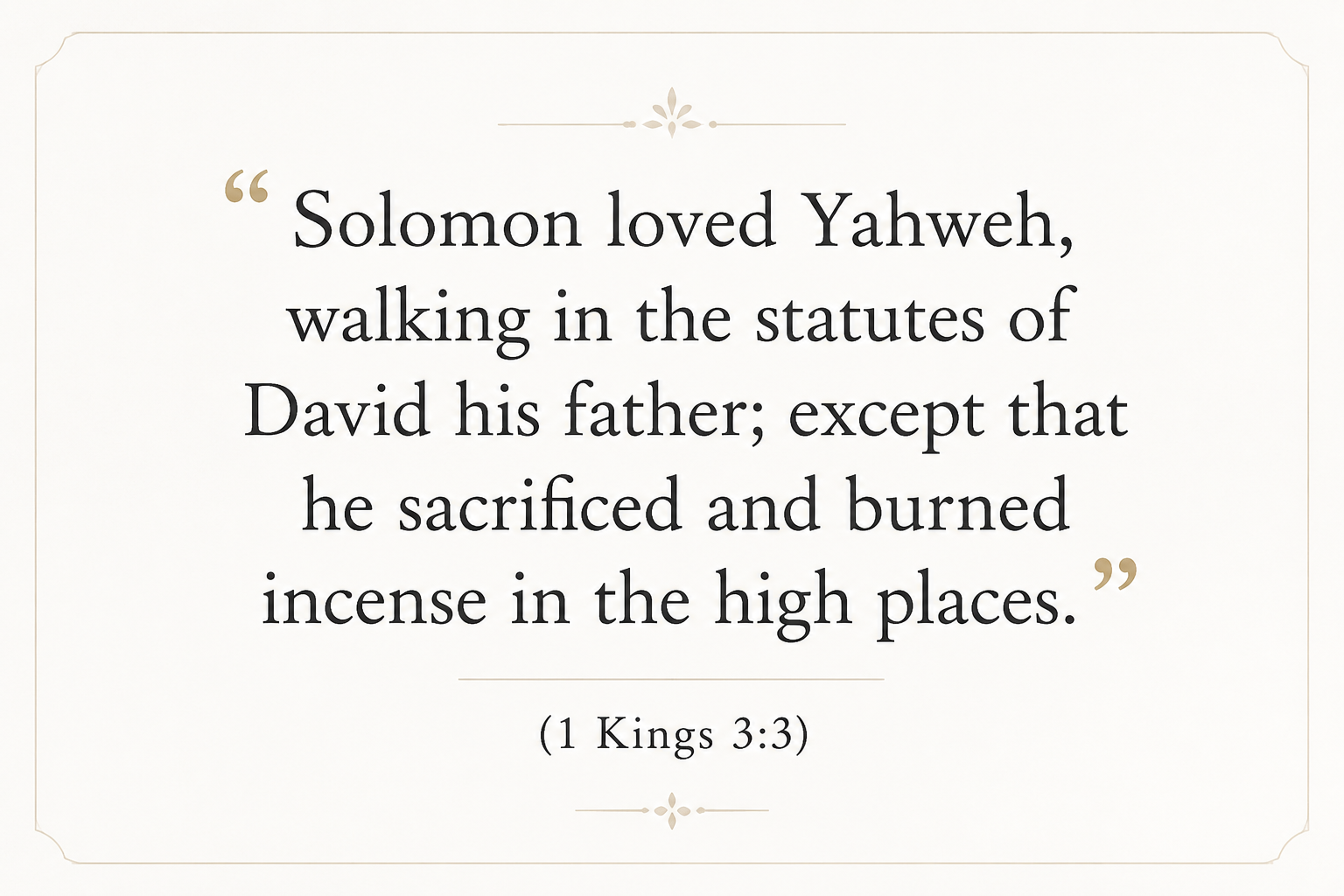
“Solomon loved Yahweh, walking in the statutes of David his father; except that he sacrificed and burned incense in the high places.” (1 Kings 3:3)
Here אָהַב ties affection to a pattern of life: Solomon’s love for Yahweh is immediately framed as “walking in the statutes of David his father.” The verse also places that affection alongside a stated exception—continued sacrifice and incense “in the high places”—so the word sits within a mixed portrayal: real attachment expressed in obedience, yet not without inconsistency in worship practice.
“Hiram king of Tyre sent his servants to Solomon; for he had heard that they had anointed him king in the place of his father, and Hiram had always loved David.” (1 Kings 5:1)
אָהַב describes enduring goodwill across political lines. Hiram’s continuing affection for David helps explain his initiative toward Solomon: the action of sending servants is grounded in a long-standing relationship that outlives the earlier king and shapes diplomatic behavior toward the new one.
“but to Hannah he gave a double portion, for he loved Hannah, but Yahweh had shut up her womb.” (1 Samuel 1:5)
In a household scene, affection is shown through material preference: Hannah receives “a double portion” because she is loved. The same sentence places that affection next to Hannah’s suffering—“Yahweh had shut up her womb”—so the word carries emotional weight in a context where love does not remove distress but does alter how she is treated within the family.
“David came to Saul, and stood before him. He loved him greatly; and he became his armor bearer.” (1 Samuel 16:21)
אָהַב is attached to Saul’s response to David’s presence and service. The affection is marked as intense (“greatly”) and it results in a role and proximity: David “became his armor bearer.” The verb therefore functions as a bridge between personal attachment and official appointment in the court.
“But all Israel and Judah loved David; for he went out and came in before them.” (1 Samuel 18:16)
This occurrence expands the object of affection from an individual relationship to a national one: “all Israel and Judah” love David. The reason given—“for he went out and came in before them”—locates the affection in public leadership and visible activity on behalf of the people, suggesting that love here includes communal approval expressed toward a leader’s ongoing conduct.
“Michal, Saul’s daughter, loved David; and they told Saul, and the thing pleased him.” (1 Samuel 18:20)
In this verse, affection becomes a reported fact that others can use. Michal’s love is communicated to Saul, and it “pleased him,” indicating that the emotion is not only personal but politically exploitable within the narrative’s court dynamics.
“Saul commanded his servants, “Talk with David secretly, and say, ‘Behold, the king has delight in you, and all his servants love you. Now therefore be the king’s son-in-law.’ ”” (1 Samuel 18:22)
Here אָהַב appears inside a crafted message meant to persuade. Saul wants David to believe he is surrounded by favor: “the king has delight in you” and “all his servants love you.” The verb is thus used rhetorically, as part of a secret strategy; affection (whether genuine, exaggerated, or staged) is presented as social pressure toward becoming “the king’s son-in-law.”
“Saul saw and knew that Yahweh was with David; and Michal, Saul’s daughter, loved him.” (1 Samuel 18:28)
This verse juxtaposes Saul’s recognition—“Yahweh was with David”—with Michal’s affection for David. The love is restated in a context of heightened tension, suggesting it persists and remains relevant even as Saul’s perception of David’s divine support becomes clearer. The verb helps hold together two strands of the scene: theological realization and relational attachment within Saul’s household.
“Jonathan caused David to swear again, for the love that he had to him; for he loved him as he loved his own soul.” (1 Samuel 20:17)
אָהַב is used twice to intensify the bond between Jonathan and David. The first mention grounds the oath: Jonathan’s insistence that David swear “again” arises “for the love that he had to him.” The second specifies the measure of that affection—“as he loved his own soul”—making the verb carry an idea of self-paralleling attachment and deep personal commitment expressed through covenantal speech and obligation.
“Rehoboam loved Maacah the daughter of Absalom above all his wives and his concubines; for he took eighteen wives and sixty concubines, and became the father of twenty-eight sons and sixty daughters.” (2 Chronicles 11:21)
In a royal household with many relationships, אָהַב marks preference within plurality: Rehoboam’s affection is set “above all” others. The verse underscores the scale of his family life—many wives, concubines, sons, and daughters—so the verb highlights selective attachment amid abundance, identifying one relationship as preeminent within a complex domestic setting.
“Jehu the son of Hanani the seer went out to meet him, and said to king Jehoshaphat, “Should you help the wicked, and love those who hate Yahweh? Because of this, wrath is on you from before Yahweh.” (2 Chronicles 19:2)
Here אָהַב is placed under moral evaluation. The seer’s question joins two actions: “help the wicked” and “love those who hate Yahweh.” Affection is treated as a consequential alignment, not a neutral feeling; directing love toward people characterized as hating Yahweh is presented as a culpable choice linked to the announced outcome: “wrath is on you from before Yahweh.”
“Didn’t you, our God, drive out the inhabitants of this land before your people Israel, and give it to the offspring of Abraham your friend forever?” (2 Chronicles 20:7)
The scene is a prayer that appeals to God’s past action—driving out inhabitants and giving land—and it speaks of “Abraham your friend forever,” setting a relational category in the context of covenant history and divine gift. Within that relational framing, the occurrence contributes to the broader cluster of passages where attachment and loyalty between parties is foregrounded in speech about God and his people.
Sense and Usage
Across these contexts, אָהַב functions as a relational verb that can describe affection toward Yahweh, toward family members, toward a leader, or toward political allies. In 1 Kings 3:3, affection for Yahweh is shown as compatible with “walking in the statutes,” making love visible in behavior; yet the same line can hold a stated inconsistency (“except that… in the high places”), demonstrating that affection may be affirmed even while practice is criticized.
In the narratives about Saul, David, Jonathan, and Michal (1 Samuel 16–20), אָהַב regularly affects decisions and social positioning: David becomes an “armor bearer,” the tribes’ love is connected to David’s public comings and goings, and love becomes a reported fact that influences Saul’s plans. The verb also supports covenantal seriousness when Jonathan’s love is described as paralleling love of one’s own soul, forming the emotional rationale for binding speech (“caused David to swear again”).
In royal and political settings (1 Kings 5:1; 2 Chronicles 11:21), affection is not merely private; it explains diplomatic initiative and it marks preference within a large household. In prophetic rebuke (2 Chronicles 19:2), the verb becomes a category of ethical alignment: loving those who hate Yahweh is treated as incompatible with faithful kingship, and it is linked to divine displeasure. Taken together, these uses show that having affection for someone in biblical narrative is repeatedly portrayed as an active force—expressed through gifts, appointments, public endorsement, persuasive speech, oaths, alliances, and choices that draw moral evaluation.
Implied Imagery
Within these passages, love is pictured indirectly through concrete actions: a double portion given at a meal (1 Samuel 1:5), a servant mission initiated between kings (1 Kings 5:1), an attendant standing before a king and entering close service (1 Samuel 16:21), a leader moving among the people (“went out and came in before them,” 1 Samuel 18:16), and secret counsel crafted to shape another man’s response (1 Samuel 18:22). Even when the word appears in rebuke (2 Chronicles 19:2), it remains practical and directional—affection shown as a choice of whom one stands with.
Sources: Lexical data from Strong’s Exhaustive Concordance and the Open Scriptures Hebrew Lexicon. Occurrence data from the Westminster Leningrad Codex with STEPBible reference data (CC BY). Scripture quotations from the World English Bible (public domain).