Exploring the Meaning of Agrupneo in Greek
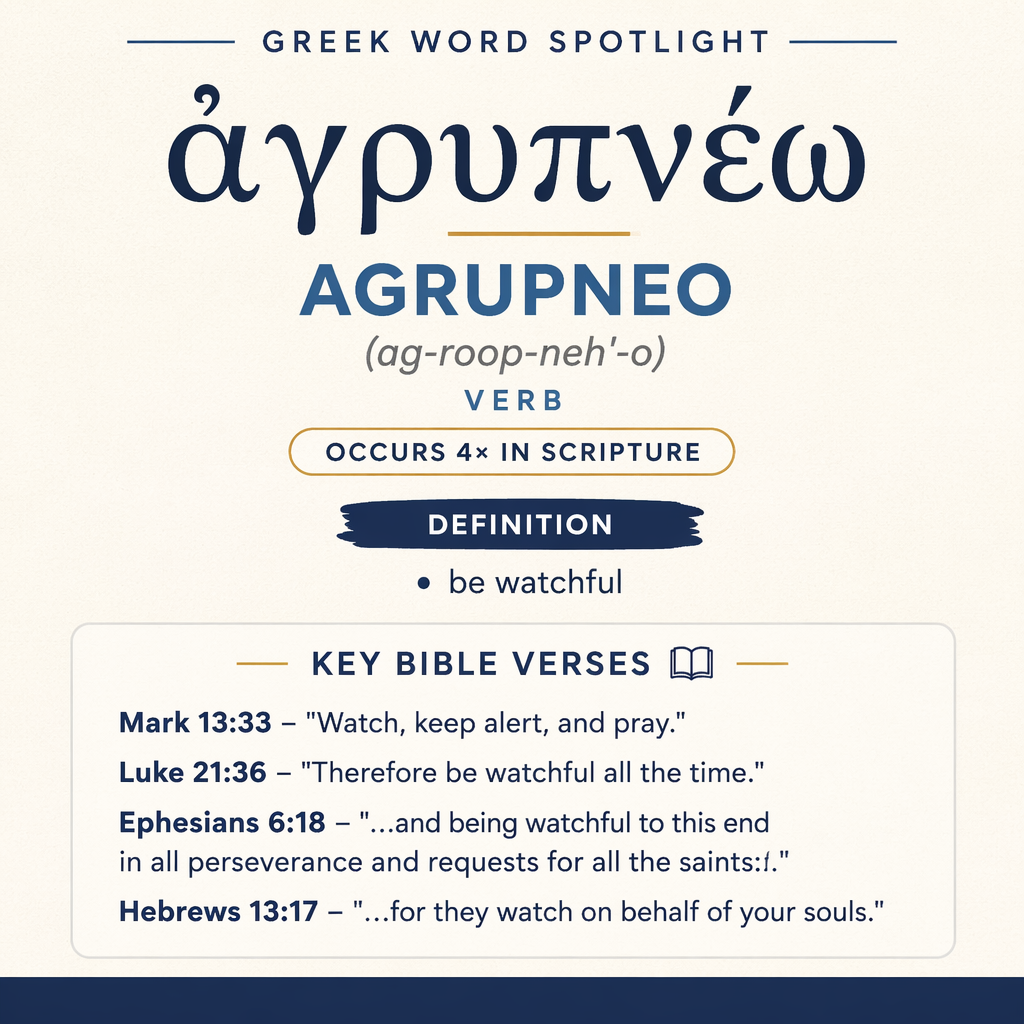
ἀγρυπνέω means “be watchful” and appears 4 times in Scripture: Mark 13:33; Luke 21:36; Ephesians 6:18; Hebrews 13:17.
Core Meaning
ἀγρυπνέω means “be watchful.” In the cited passages it describes staying alert.
Learn More →Prayer Context
In Mark 13:33 and Luke 21:36, it is paired with prayer alongside watchfulness. Ephesians 6:18 also connects being watchful with prayer and perseverance.
Learn More →Watching for Souls
Hebrews 13:17 uses ἀγρυπνέω for leaders who watch on behalf of souls. The verse adds that they will give account.
Learn More →ἀγρυπνέω means “be watchful.” It appears in Jesus’ end-times warnings, in instruction about prayer, and in a description of leaders’ vigilant care for others.
Root and Related Words
ἀγρυπνέω (Agrupneo) is connected with hypnos (ὕπνος), “sleep” (Strong’s G5258). It is also linked, in Strong’s, with A (α, Ἀλφα), “Alpha” (Strong’s G1).

Occurrences
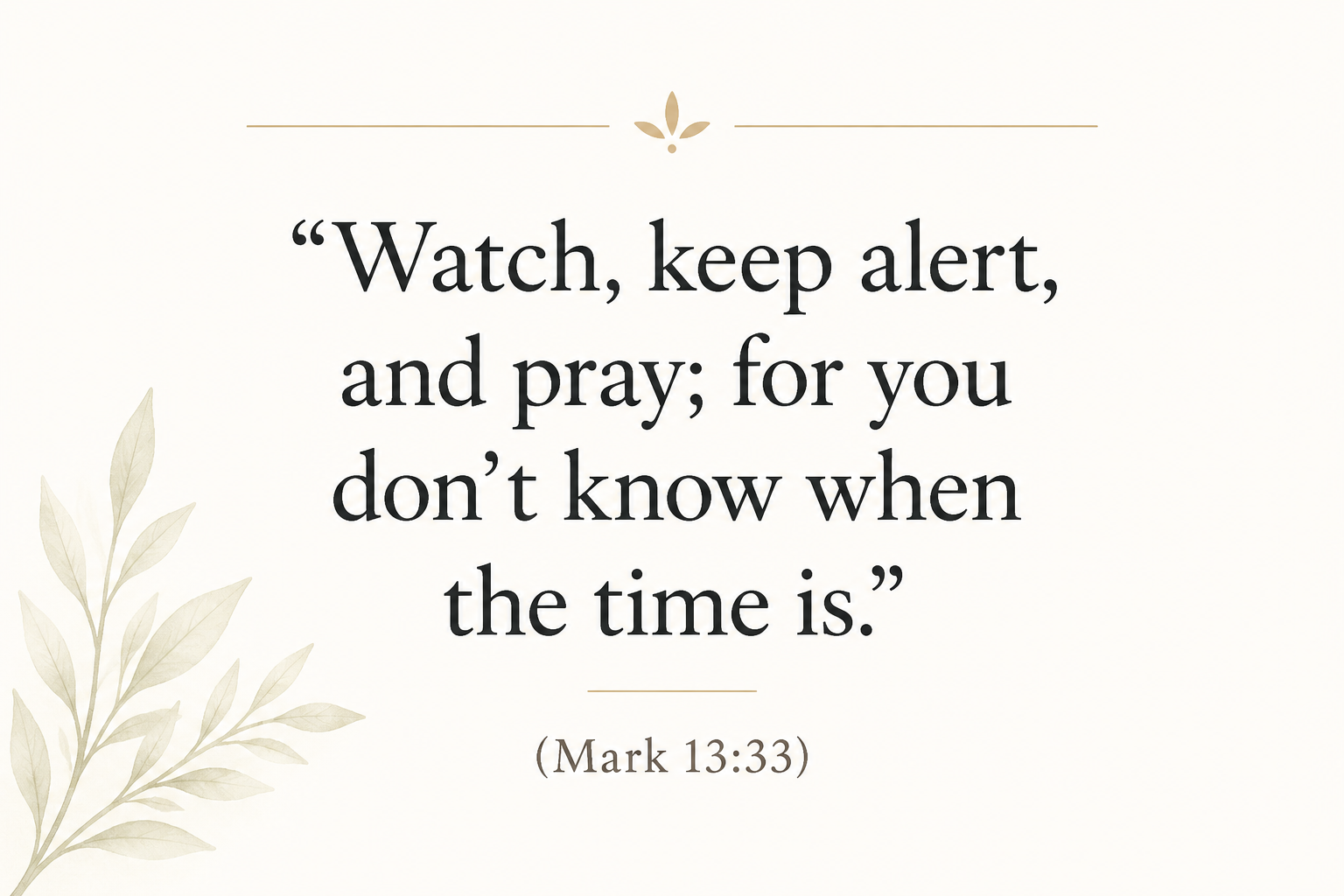
“Watch, keep alert, and pray; for you don’t know when the time is.” (Mark 13:33)
Here ἀγρυπνέω stands alongside two other imperatives—“keep alert” and “pray”—so watchfulness is presented as an active stance rather than a passing feeling. The reason given is practical and urgent: “you don’t know when the time is.” In this setting, being watchful is framed as the fitting response to uncertainty about timing; it is the posture that refuses complacency when the moment cannot be scheduled. The line binds watchfulness to prayer, not as a substitute for prayer but as a companion discipline: the person who prays is also to remain awake to what may come.
“Therefore be watchful all the time, praying that you may be counted worthy to escape all these things that will happen, and to stand before the Son of Man.” (Luke 21:36)
This occurrence expands watchfulness with a clear time frame: “all the time.” Watchfulness is sustained, not occasional, and it is again tied directly to prayer—“praying that you may be counted worthy.” The verse supplies two forward-looking aims shaped by that watchful praying: “to escape all these things that will happen,” and “to stand before the Son of Man.” Within the sentence, ἀγρυπνέω contributes the alert readiness appropriate to approaching events; it is not merely noticing, but maintaining a steady wakefulness that supports petition and endurance. The pairing of escape and standing underscores how watchfulness faces both danger (“these things that will happen”) and accountability (“before the Son of Man”).
“with all prayer and requests, praying at all times in the Spirit, and being watchful to this end in all perseverance and requests for all the saints:” (Ephesians 6:18)
In this instruction, watchfulness is folded into a sweeping description of prayer: “all prayer and requests,” “at all times,” “in the Spirit.” The phrase “being watchful to this end” gives watchfulness a purpose within prayer’s ongoing practice; it guards the continuity of praying rather than treating prayer as a single moment. The words that follow sharpen what that watchfulness looks like in action: “in all perseverance and requests for all the saints.” ἀγρυπνέω here helps describe a prayerful attentiveness that does not fade when praying becomes repetitive or costly; it is the wakeful resolve that keeps requests alive “in all perseverance.” It also leans outward toward others—“for all the saints”—so watchfulness includes staying attentive to the needs and welfare of the community, not only one’s own concerns.
“Obey your leaders and submit to them, for they watch on behalf of your souls, as those who will give account, that they may do this with joy, and not with groaning, for that would be unprofitable for you.” (Hebrews 13:17)
Here ἀγρυπνέω is applied to “your leaders,” describing their ongoing role: “they watch on behalf of your souls.” The watchfulness is portrayed as protective and responsible; it is not casual oversight but a form of wakeful care carried out “as those who will give account.” The sentence places this vigilance within a relationship marked by response—“Obey… and submit”—and by emotional consequence—“with joy, and not with groaning.” In this scene, ἀγρυπνέω conveys the demanding attentiveness of leadership that remains awake to spiritual welfare (“your souls”) and conscious of accountability (“will give account”). The verse also shows watchfulness as labor that can be either gladly borne or burdensomely endured, and it urges a community posture that supports leaders in fulfilling that vigilant task.
Sense and Usage
Across these four passages, ἀγρυπνέω consistently describes an alert, wakeful posture suited to situations where inattentiveness would be dangerous or negligent. In Mark 13:33 and Luke 21:36 it functions as readiness in the face of unknown timing and coming events; the watchful person does not assume tomorrow will mirror today. In both sayings of Jesus, watchfulness is inseparable from prayer: the alert stance is maintained by praying, and prayer is carried out with open-eyed awareness rather than drifting into spiritual drowsiness.
Ephesians 6:18 places watchfulness inside the practice of continual, varied prayer. The verse’s repeated “all” language (“all prayer,” “at all times,” “all perseverance,” “all the saints”) sets a horizon of breadth and duration; within that horizon, ἀγρυπνέω contributes the staying power that keeps prayer from collapsing under weariness or distraction. Watchfulness here is not portrayed as passive vigilance but as an attentive persistence that helps prayer remain deliberate, targeted, and sustained.
Hebrews 13:17 shows that ἀγρυπνέω can describe someone watching for others rather than for oneself. Leaders are pictured as keeping wakeful guard “on behalf of your souls,” with the added weight of giving account. This use frames watchfulness as moral responsibility: a readiness to act, to answer, and to carry burdens with a view to another’s good. The verse also implies that watchfulness can be emotionally taxing; the difference between “joy” and “groaning” highlights that such vigilance is real work, and that the community’s response affects how that work is carried.
Taken together, these uses sketch a coherent profile: ἀγρυπνέω is the kind of wakefulness that resists spiritual sleep, expresses itself in prayer, persists over time, and can be exercised both personally (staying ready) and relationally (watching on behalf of others). It is a stance shaped by the awareness that crucial moments arrive without warning and that care for souls is accountable labor.
Imagery
The passages attach watchfulness to the felt experience of staying awake: eyes open when the timing is unknown (Mark 13:33), alertness maintained “all the time” as events approach and one anticipates standing before the Son of Man (Luke 21:36), perseverance that continues making requests without letting attention drift (Ephesians 6:18), and a leader’s vigilant oversight that keeps guard for the good of others while carrying the weight of giving account (Hebrews 13:17). In each setting, ἀγρυπνέω evokes the steadiness of someone who refuses to doze off at a post that matters.
Sources: Lexical data from Strong’s Exhaustive Concordance and the Translators Brief Lexicon of Extended Strongs for Greek (STEPBible, CC BY). Occurrence data from the Translators Amalgamated Greek New Testament (STEPBible, CC BY). Scripture quotations from the World English Bible (public domain).