Understanding the Significance of Agreuo in Greek
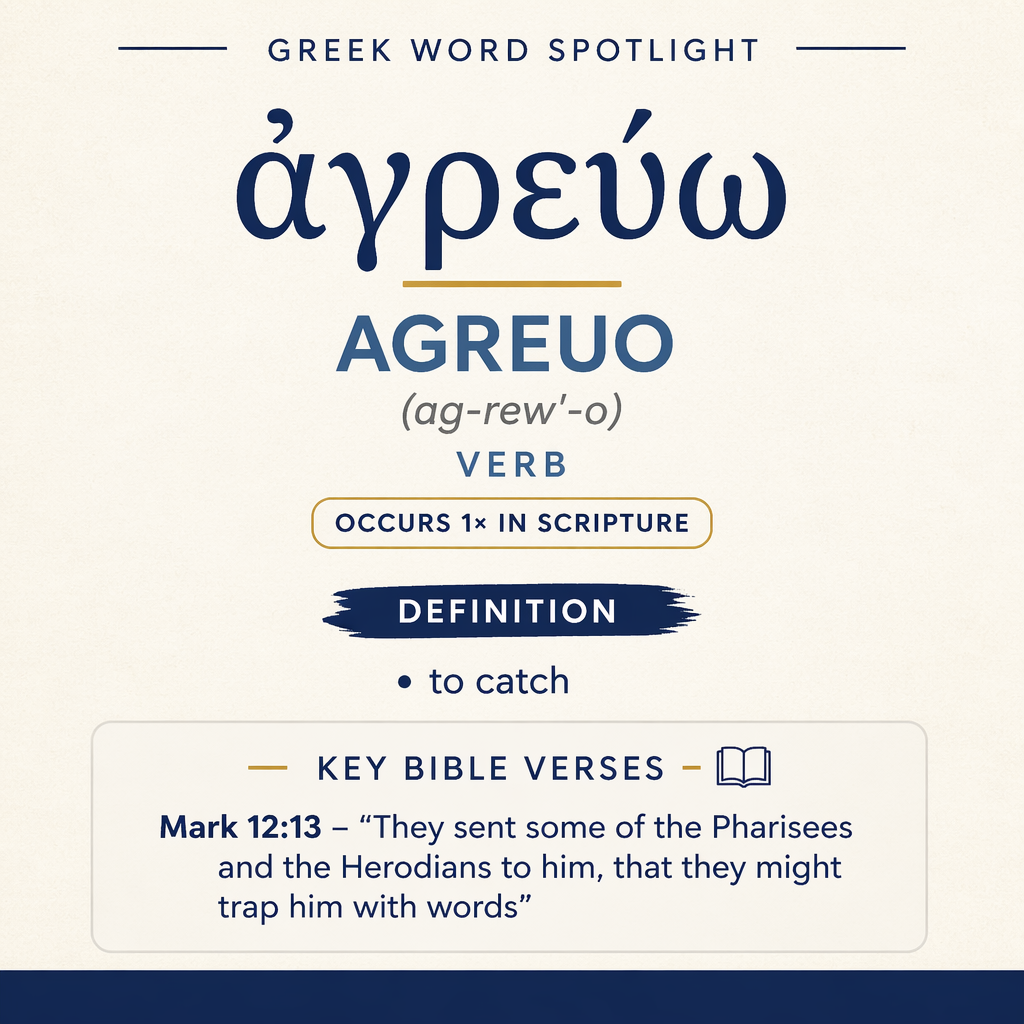
ἀγρεύω means “to catch” and appears once in Scripture in Mark 12:13.
Biblical Occurrence
This verb occurs 1 time in Scripture. Its sole reference is Mark 12:13.
Learn More →Context in Mark
In Mark 12:13, Pharisees and Herodians are sent to trap him with words. The verse frames ἀγρεύω in an attempt to catch him verbally.
Learn More →ἀγρεύω means “to catch,” and it appears once in the New Testament in a setting of hostile questioning directed at Jesus. In its single occurrence, the verb is applied not to animals or objects but to a person, highlighting a calculated attempt to seize him through speech.
Root and Related Words
ἀγρεύω is related to agra (ἄγρα), “catch” (Strong’s G61). The connection places the verb within the same word-family of “catching,” allowing the action to be pictured as the taking of something as a catch rather than as a mere verbal exchange.

Occurrences
“They sent some of the Pharisees and the Herodians to him, that they might trap him with words.” (Mark 12:13)
Here ἀγρεύω frames the purpose behind a deliberate delegation: “They sent” representatives “to him,” and the sending is strategic, not conversational. The groups named—“the Pharisees and the Herodians”—are presented as acting together toward a single end, and the verb identifies that end as a kind of catching. The means is specified: “with words.” This makes the action distinctively verbal, yet the verb imports the imagery of capture: words are treated as the instrument by which a person may be caught.

The verse also signals that the intended catch is not an incidental slip but something planned. The agents are selected and dispatched, and their aim is expressed in purpose language (“that they might…”). In this setting, ἀγρεύω portrays speech as something that can be arranged like a snare: questions and replies become the terrain in which an opponent is meant to be taken. The verb therefore functions to characterize the entire encounter in advance, defining it as an attempt at capture rather than an honest inquiry.
Because the object of the attempt is “him,” the word’s force in this scene falls on the target—Jesus himself—rather than on the content of the “words.” The focus is personal: the speakers want not simply to win a point but to secure a decisive hold over him by what he says. The verb thus casts the coming conversation as adversarial, with one side hunting for an opening that will close like a trap.
Sense and Usage
In Mark 12:13, “to catch” is applied metaphorically within a public, contentious setting. The verb’s sense is expressed through an explicitly linguistic tool (“words”), but it still communicates the basic idea of taking hold of a target. The effect is to portray verbal interaction as an environment in which capture is possible—where a carefully shaped question, a forced dilemma, or a quoted statement could function like a mechanism that closes on a person.
This use also shows how the verb can describe intention rather than outcome. The verse states the purpose for which the messengers are sent; it does not narrate the success of the attempt within the quoted line itself. As a result, ἀγρεύω here marks the posture and strategy of the senders: they approach speech as a means of securing control over another. “Catching” becomes the governing metaphor for their plan, and it colors the reader’s understanding of what follows—questions are not neutral, and answers are dangerous, because the exchange is designed to seize.
The wording “trap him with words” links the verb to the realm of testimony and public speech. What is being sought is something that can be taken from him—an utterance that can be grasped, held up, and used. Thus ἀγρεύω suggests a kind of capture that depends on the target’s own participation: the catch requires him to speak. Even though the action is initiated by the senders, the mechanism involves eliciting words that can close around him.
Imagery
The imagery carried by ἀγρεύω in Mark 12:13 is that of a hunter’s success transposed into a verbal arena: the “catch” is imagined not as prey in the field but as a person ensnared through speech. The verse’s brief phrasing compresses a whole picture—agents sent out, a target approached, and carefully chosen words set to spring—so that the confrontation is seen as an attempt to seize rather than to understand.
Sources: Lexical data from Strong’s Exhaustive Concordance and the Translators Brief Lexicon of Extended Strongs for Greek (STEPBible, CC BY). Occurrence data from the Translators Amalgamated Greek New Testament (STEPBible, CC BY). Scripture quotations from the World English Bible (public domain).