Exploring the Meaning of Agora in Greek
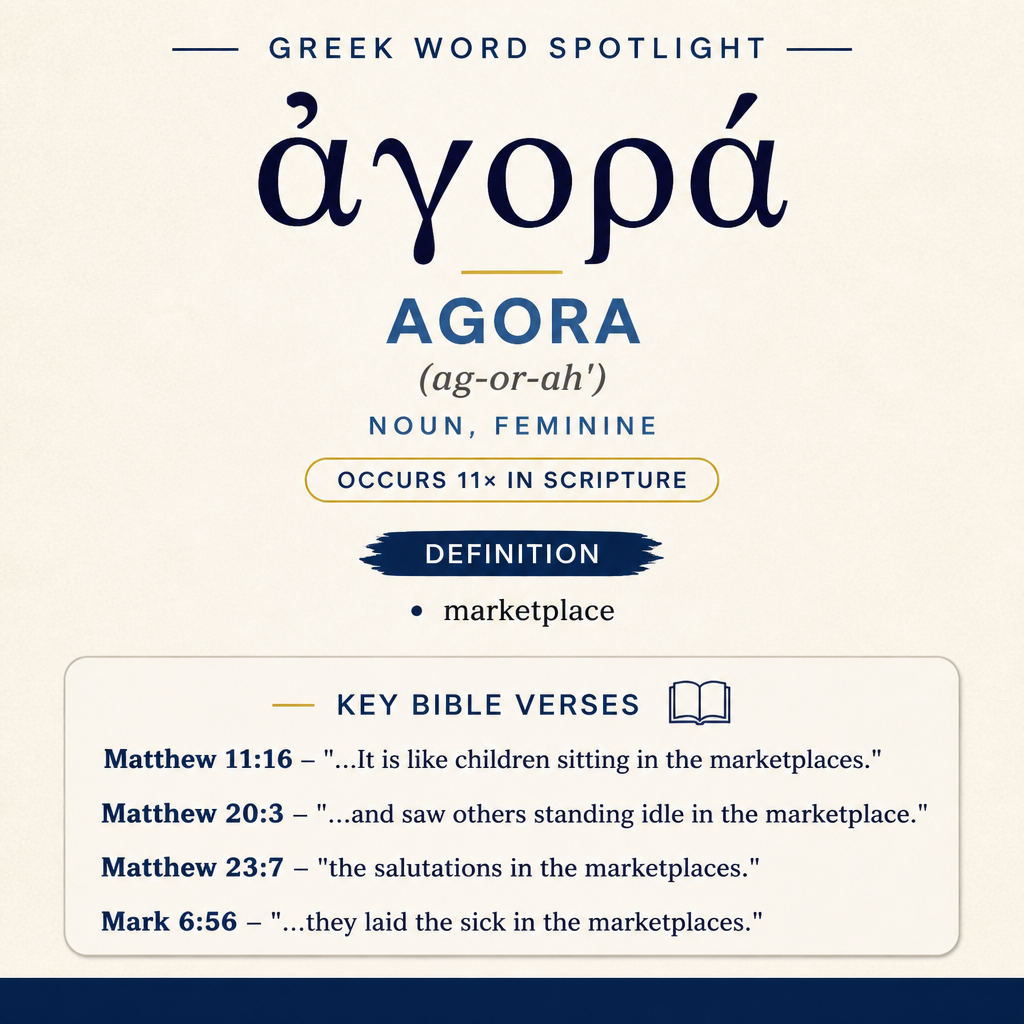
ἀγορά means “marketplace” and appears 11 times in Scripture, including Matthew, Mark, and Luke.
Gospel Occurrences
ἀγορά occurs in Matthew 11:16; 20:3; 23:7, Mark 6:56; 7:4; 12:38, and Luke 7:32; 11:43.
Learn More →Scene of Action
In these passages, the ἀγορά is where people sit, stand, receive greetings, bathe after coming from it, and where the sick are laid.
Learn More →ἀγορά names the “marketplace,” a public setting repeatedly used in the Gospels for everyday social display and in Acts for civic confrontation and daily conversation. In the passages where it appears, the marketplace functions as a shared, visible space where people gather, speak, watch, and act.
Occurrences
“But to what shall I compare this generation? It is like children sitting in the marketplaces, who call to their companions” (Matthew 11:16)
Here ἀγορά supplies the ordinary, open-air setting for a public comparison: children “sitting” and “call[ing]” in a place designed for coming and going. The image depends on the marketplace as a place where voices carry, where one group can address another, and where the behavior of “this generation” can be pictured in plain, daily life.
“He went out about the third hour, and saw others standing idle in the marketplace.” (Matthew 20:3)
In this scene the marketplace is a place where people “stand” and wait, available to be noticed and engaged. ἀγορά marks a public location where those without work can be found, observed, and summoned, emphasizing visibility and accessibility rather than privacy.
“the salutations in the marketplaces, and to be called ‘Rabbi, Rabbi’ by men.” (Matthew 23:7)
ἀγορά is the social stage for public recognition. The desire “for… salutations” belongs to a place where greetings are exchanged openly and status can be reinforced by what others say “by men” in front of observers.
“Wherever he entered, into villages, or into cities, or into the country, they laid the sick in the marketplaces, and begged him that they might just touch the fringe of his garment; and as many as touched him were made well.” (Mark 6:56)
The marketplace becomes a place of urgent access: the sick are “laid… in the marketplaces” as a practical way to meet Jesus “wherever he entered.” ἀγορά contributes the sense of a central, frequented area suitable for bringing many sufferers and for repeated public encounters, with the result that “as many as touched him were made well.”
“They don’t eat when they come from the marketplace unless they bathe themselves, and there are many other things, which they have received to hold to: washings of cups, pitchers, bronze vessels, and couches.)” (Mark 7:4)
Here ἀγορά is the place from which one “come[s]” into the home sphere, triggering concern about contact and the need to “bathe.” The marketplace is treated as a setting of broad interaction—where one might encounter many people and objects—so that returning from it becomes a meaningful boundary crossing that calls for ritualized washing.
“In his teaching he said to them, “Beware of the scribes, who like to walk in long robes, and to get greetings in the marketplaces,” (Mark 12:38)
Again ἀγορά functions as a public arena for performance and recognition. The scribes “like to walk” conspicuously and “to get greetings” where many can see, so the marketplace highlights the public-facing character of the conduct being warned against.
“They are like children who sit in the marketplace, and call to one another, saying, ‘We piped to you, and you didn’t dance. We mourned, and you didn’t weep.’” (Luke 7:32)
As in Matthew’s comparison, ἀγορά frames a scene of social interaction: children “sit” and “call to one another,” expecting responses. The marketplace provides the shared communal space where one group’s actions (“We piped… We mourned”) can be displayed and where the lack of response (“you didn’t”) becomes a pointed picture.
“Woe to you Pharisees! For you love the best seats in the synagogues, and the greetings in the marketplaces.” (Luke 11:43)
In this woe, ἀγορά stands alongside the synagogue as a place where honor is publicly conferred. The “greetings in the marketplaces” are valued precisely because they are visible signs of respect granted in a communal setting, where such acknowledgment can be observed by others.
““Beware of those scribes who like to walk in long robes, and love greetings in the marketplaces, the best seats in the synagogues, and the best places at feasts;” (Luke 20:46)
Here ἀγορά appears within a trio of honor-spaces: marketplace, synagogue, and feast. The marketplace is the everyday public sphere—less formal than a synagogue gathering or banquet seating, yet still capable of broadcasting status through “greetings,” which these scribes “love.”
“But when her masters saw that the hope of their gain was gone, they seized Paul and Silas, and dragged them into the marketplace before the rulers.” (Acts 16:19)
In Acts, ἀγορά becomes the setting for public accusation and legal pressure. Paul and Silas are “dragged… into the marketplace before the rulers,” so the marketplace functions as a civic public space where authorities can be engaged and where a dispute over “gain” is pressed into an official confrontation.
“So he reasoned in the synagogue with the Jews and the devout persons, and in the marketplace every day with those who met him.” (Acts 17:17)
Here ἀγορά is a daily venue for discussion with whoever is present: Paul reasons there “every day with those who met him.” The marketplace is depicted as a reliable place of encounter, not limited to one group, and suited to ongoing conversation with a changing set of people.
Sense and Usage
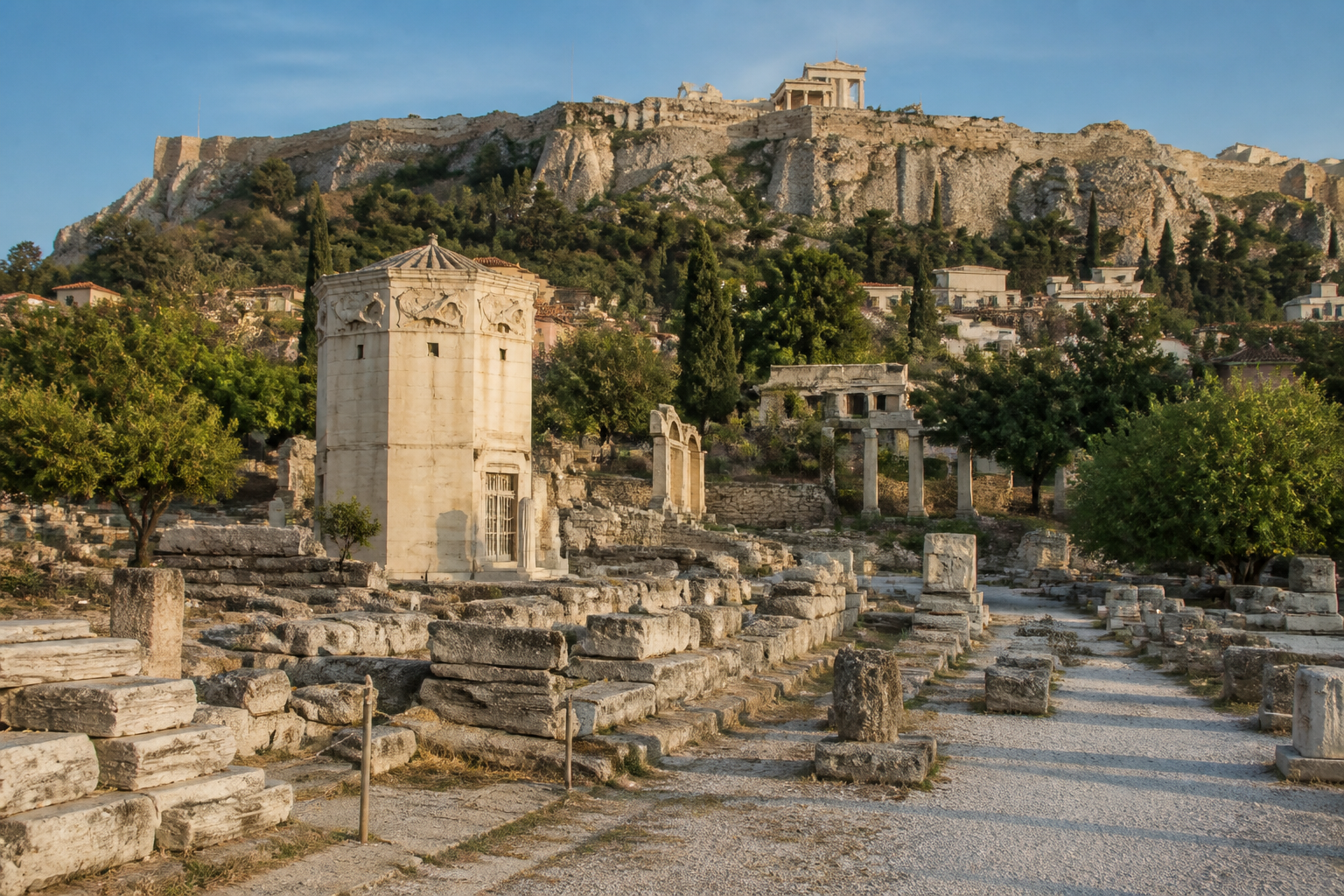
Across these passages, ἀγορά consistently denotes a recognizable public gathering place, but each context draws on a different aspect of what a marketplace is for. In the sayings of Jesus (Matthew 11:16; Luke 7:32), it supplies a vivid, everyday setting where children can sit and address others in public, making their calls and the community’s response (or lack of response) easy to picture. The comparison depends on the marketplace’s openness: it is a place where social signals are given and evaluated in plain view.
In Matthew 20:3, the marketplace is where one can find people “standing idle,” which highlights its function as a place of availability and visibility. The scene assumes that a person seeking workers can go there and observe those who are present. The marketplace is therefore not merely a location but a social node—people are there to be seen, to wait, and to be recruited.
Several Gospel occurrences use ἀγορά as the setting where honor is performed and desired (Matthew 23:7; Mark 12:38; Luke 11:43; Luke 20:46). The repeated mention of “greetings” and “salutations” makes the marketplace an arena of public acknowledgment. It is a place where the way others address someone becomes a kind of public endorsement, and therefore a place where the pursuit of recognition can be displayed. By placing these greetings “in the marketplaces,” the texts highlight the outward, community-facing nature of such honor.
Mark 6:56 brings out a different feature: the marketplace as a central, frequented space suitable for laying the sick where they will be encountered. The crowd’s action assumes that Jesus’ movement “into villages, or into cities, or into the country” will intersect with the marketplace, making it a practical site for bringing need into contact with him. The marketplace becomes the intersection of ordinary life and urgent hope.
Mark 7:4 shows the marketplace as a sphere whose contacts matter even after one leaves it. Coming “from the marketplace” is treated as a meaningful source of exposure that prompts bathing before eating. In this usage, ἀγορά stands for a place of broad, mixed interaction—enough so that it becomes a reference point for behavior upon return.
Acts uses ἀγορά with a civic and public edge. In Acts 16:19, the marketplace is where a dispute is thrust into a public forum “before the rulers,” underscoring that what happens there can be made to involve authority and public judgment. In Acts 17:17, it is a place for daily reasoning “with those who met him,” presenting the marketplace as a steady point of contact with a wide range of passersby. Together these uses show the marketplace as both a public court of opinion and a practical meeting ground for repeated engagement.
Imagery
The passages build a consistent picture of the marketplace as a shared public space where words and actions are exposed to notice: children calling, leaders receiving greetings, the sick laid out in hope, and messengers reasoning day by day. Whether the scene involves ordinary waiting, social honor, healing encounters, or civic confrontation, ἀγορά carries the imagery of public life unfolding where many people cross paths.
Sources: Lexical data from Strong’s Exhaustive Concordance and the Translators Brief Lexicon of Extended Strongs for Greek (STEPBible, CC BY). Occurrence data from the Translators Amalgamated Greek New Testament (STEPBible, CC BY). Scripture quotations from the World English Bible (public domain).