Exploring the Meaning of Agon in Greek
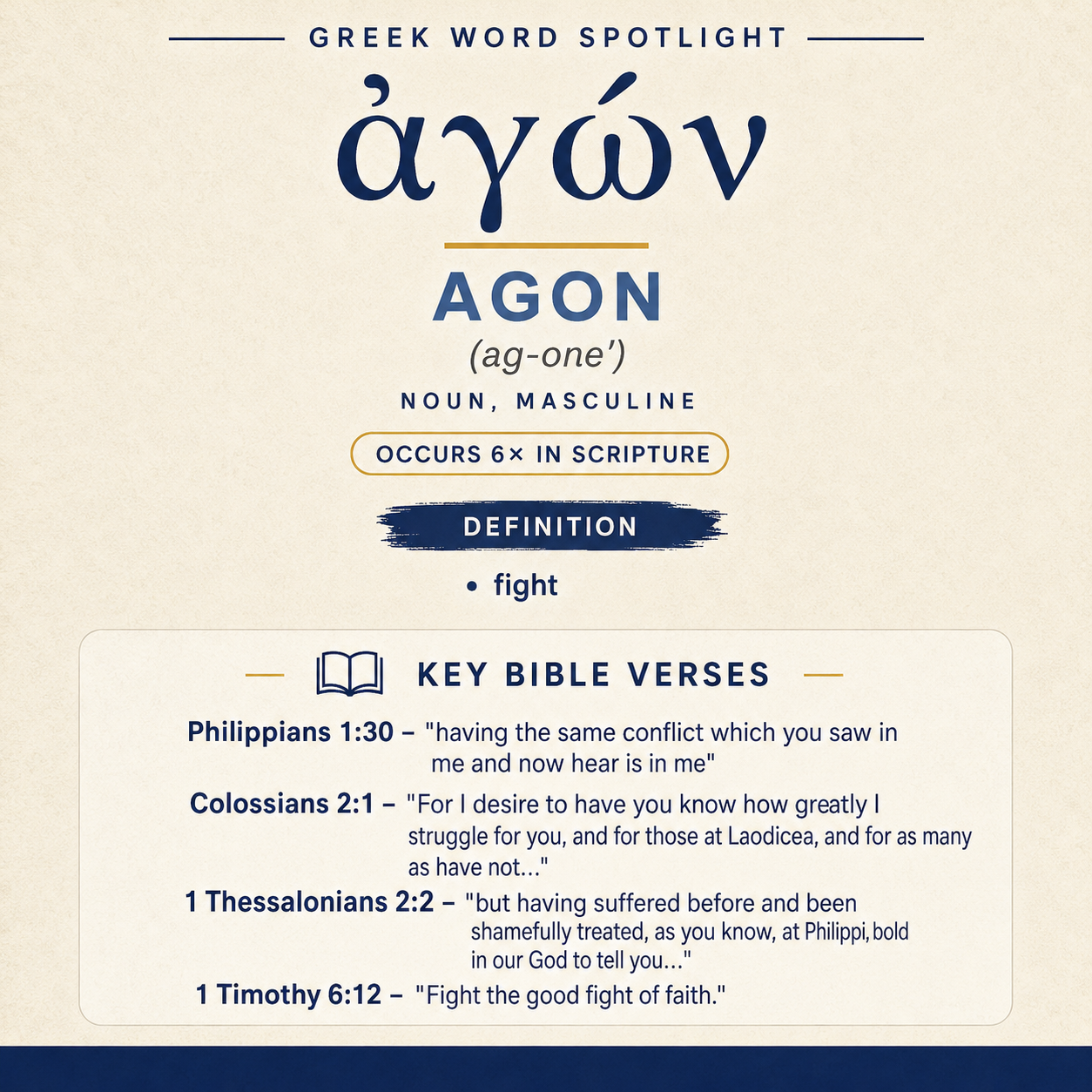
ἀγών means “fight” and occurs six times in Scripture: Philippians 1:30; Colossians 2:1; 1 Thessalonians 2:2; 1 Timothy 6:12; 2 Timothy 4:7; Hebrews 12:1.
Core Meaning
ἀγών is defined as “fight.” In these passages it marks conflict and struggle.
Learn More →Where It Appears
The word occurs 6 times in Scripture. It appears in Philippians 1:30; Colossians 2:1; 1 Thessalonians 2:2; 1 Timothy 6:12; 2 Timothy 4:7; Hebrews 12:1.
Learn More →Text Examples
It is used of “the same conflict” (Philippians 1:30) and “how greatly I struggle” (Colossians 2:1). It also appears in “Fight the good fight of faith” (1 Timothy 6:12) and “I have fought the good fight” (2 Timothy 4:7).
Learn More →ἀγών refers to a “fight,” a word used in the New Testament to describe strenuous conflict experienced in ministry and steadfastness in faith. It appears in Paul’s letters and in an exhortation in Hebrews, where it frames both hardship and perseverance in vivid, active terms.
Root and Related Words
ἀγών is connected with the verb ago (ἄγω, Strong’s G71), “to bring.”

Occurrences
“having the same conflict which you saw in me and now hear is in me.” (Philippians 1:30)
Here ἀγών names a shared “conflict” between Paul and the Philippian believers. The sentence ties the fight to what they “saw” in Paul and now “hear” is still present in him, so the word carries continuity: the struggle is not a momentary burst but an ongoing fight that can be witnessed, remembered, and recognized as continuing. It also binds the community to Paul’s experience—his fight is presented as a pattern they are experiencing as well (“the same conflict”).
“For I desire to have you know how greatly I struggle for you, and for those at Laodicea, and for as many as have not seen my face in the flesh;” (Colossians 2:1)
In Colossians 2:1 the fight is expressed as intense effort on behalf of others: “how greatly I struggle for you.” The wording makes the conflict relational and pastoral—Paul’s fight is for named groups (“you,” “those at Laodicea”) and even for people unknown to him personally (“as many as have not seen my face in the flesh”). ἀγών therefore frames ministry as costly exertion directed toward the good of believers, extending beyond immediate personal connection.
“but having suffered before and been shamefully treated, as you know, at Philippi, we grew bold in our God to tell you the Good News of God in much conflict.” (1 Thessalonians 2:2)
This occurrence places ἀγών alongside suffering and public mistreatment. The fight is not merely inner resolve; it is the environment in which proclamation happens: they “grew bold in our God to tell you the Good News of God in much conflict.” The word highlights that announcing the gospel can be accompanied by pressure strong enough to be called a fight, yet that setting becomes the stage for boldness rather than silence.
“Fight the good fight of faith. Take hold of the eternal life to which you were called, and you confessed the good confession in the sight of many witnesses.” (1 Timothy 6:12)
Here ἀγών is an imperative and a metaphor for faithfulness: “Fight the good fight of faith.” The fight is qualified as “good,” and it is closely tied to a concrete response—“Take hold of the eternal life to which you were called.” The verse further anchors the fight in public allegiance: Timothy has “confessed the good confession in the sight of many witnesses.” ἀγών thus depicts faith as something actively contended for, consistent with a calling and a witnessed confession.
“I have fought the good fight. I have finished the course. I have kept the faith.” (2 Timothy 4:7)
In 2 Timothy 4:7 Paul speaks of the fight as something completed: “I have fought the good fight.” The line sits beside two other completed images—finishing a course and keeping faith—so the fight belongs to a whole life of sustained perseverance. The pairing with “finished the course” places the fight in the realm of endurance rather than a single confrontation; the fight is something one can look back on as a settled reality.
“Therefore let’s also, seeing we are surrounded by so great a cloud of witnesses, lay aside every weight and the sin which so easily entangles us, and let’s run with perseverance the race that is set before us,” (Hebrews 12:1)
Although Hebrews 12:1 speaks in the imagery of running, ἀγών contributes the sense of a demanding contest-like struggle by framing the life of faith as a “race” requiring “perseverance.” The surrounding context emphasizes resistance to hindrances: “lay aside every weight and the sin which so easily entangles us.” The word’s force is felt in the strenuousness implied—progress requires deliberate renunciation of what burdens and trips, and steadfast continuation on a course “set before us,” under the gaze of “so great a cloud of witnesses.”
Sense and Usage
Across these passages ἀγών consistently portrays faithfulness and gospel work as strenuous conflict rather than effortless drift. In Philippians and 1 Thessalonians, the fight is linked to the visible and audible realities of opposition: believers have “seen” it in Paul, “hear” it remains in him, and proclamation happens “in much conflict” after having “suffered” and been “shamefully treated.” In Colossians the fight becomes inwardly directed effort for others, broad enough to include those Paul has never met, showing that ἀγών can describe costly labor undertaken for the sake of the church’s well-being.
In the Pastoral Epistles, the word moves into direct exhortation and retrospective testimony. “Fight the good fight of faith” pairs conflict with a positive moral evaluation (“good”) and connects it to an onward grasping of one’s calling and confession. When Paul later says, “I have fought the good fight,” the fight is set alongside finishing and keeping—images of completion and fidelity—so that the word conveys not only intensity but also a kind of lifelong steadiness. Hebrews places the struggle within a communal, witnessed setting (“so great a cloud of witnesses”) and depicts the demands of perseverance through the concrete actions of laying aside weight and resisting entangling sin; the fight is experienced as sustained exertion on a defined course.
Imagery
The passages that use ἀγών paint conflict as something seen, heard, and lived: suffering, bold speech under pressure, strenuous labor for others, a public confession before witnesses, and the long persistence of a runner who refuses what weighs down and entangles. Whether described as “conflict,” “struggle,” “fight,” or a persevering race, the word gathers these scenes into a single portrayal of life and ministry as active, demanding engagement that must be carried through to the end.
Sources: Lexical data from Strong’s Exhaustive Concordance and the Translators Brief Lexicon of Extended Strongs for Greek (STEPBible, CC BY). Occurrence data from the Translators Amalgamated Greek New Testament (STEPBible, CC BY). Scripture quotations from the World English Bible (public domain).