
Understanding the Significance of Agamos in Greek
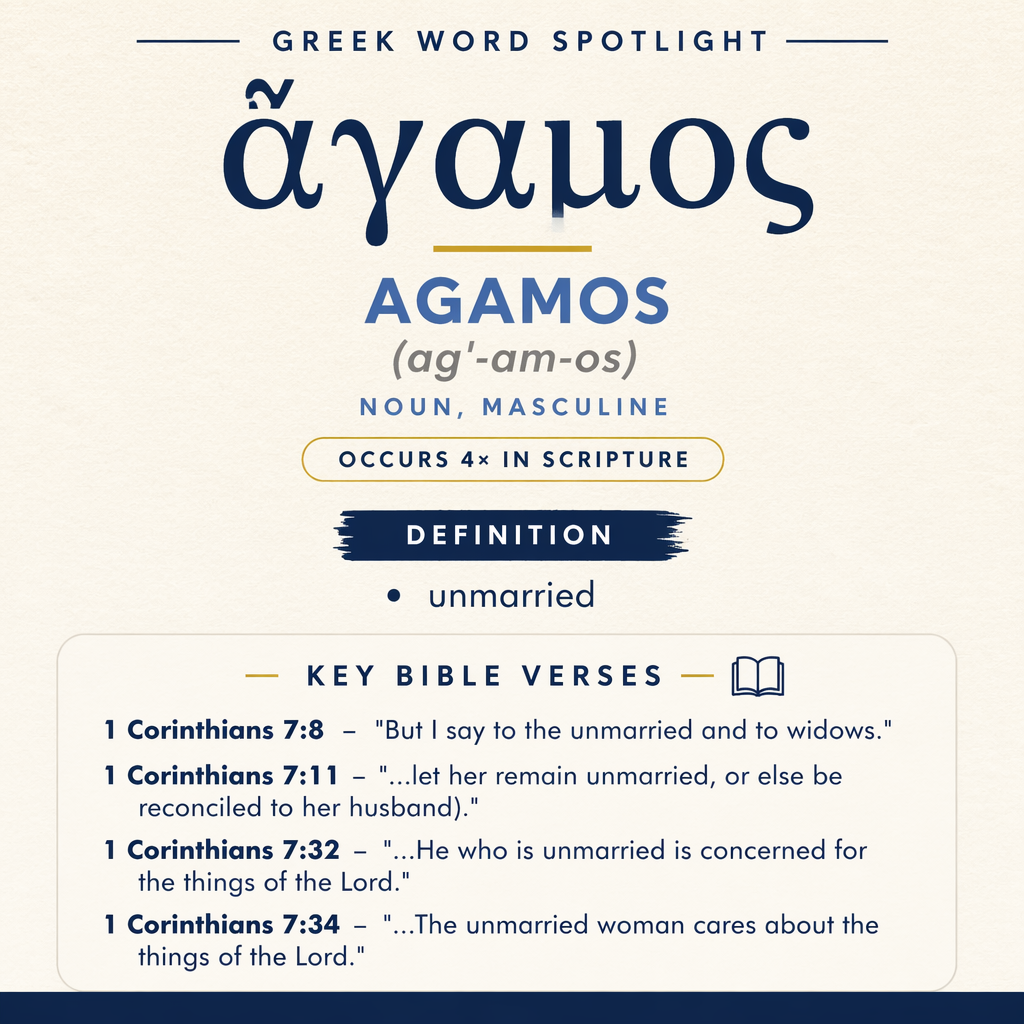
ἄγαμος means “unmarried” and occurs four times, all in 1 Corinthians 7 (vv. 8, 11, 32, 34).
Where It Appears
It occurs four times in Scripture, all in 1 Corinthians 7:8, 7:11, 7:32, and 7:34.
Learn More →Context in 1 Corinthians
In 1 Corinthians 7, it is used for the unmarried and widows, and for a woman remaining unmarried or being reconciled to her husband.
Learn More →ἄγαμος refers to one who is unmarried. In the New Testament it appears in Paul’s counsel about marital status and devotional priorities in 1 Corinthians 7.
Root and Related Words
ἄγαμος is connected with gamos (γάμος), “wedding” (Strong’s G1062). It is also associated with A (α, Ἀλφα), “Alpha” (Strong’s G1).

Occurrences
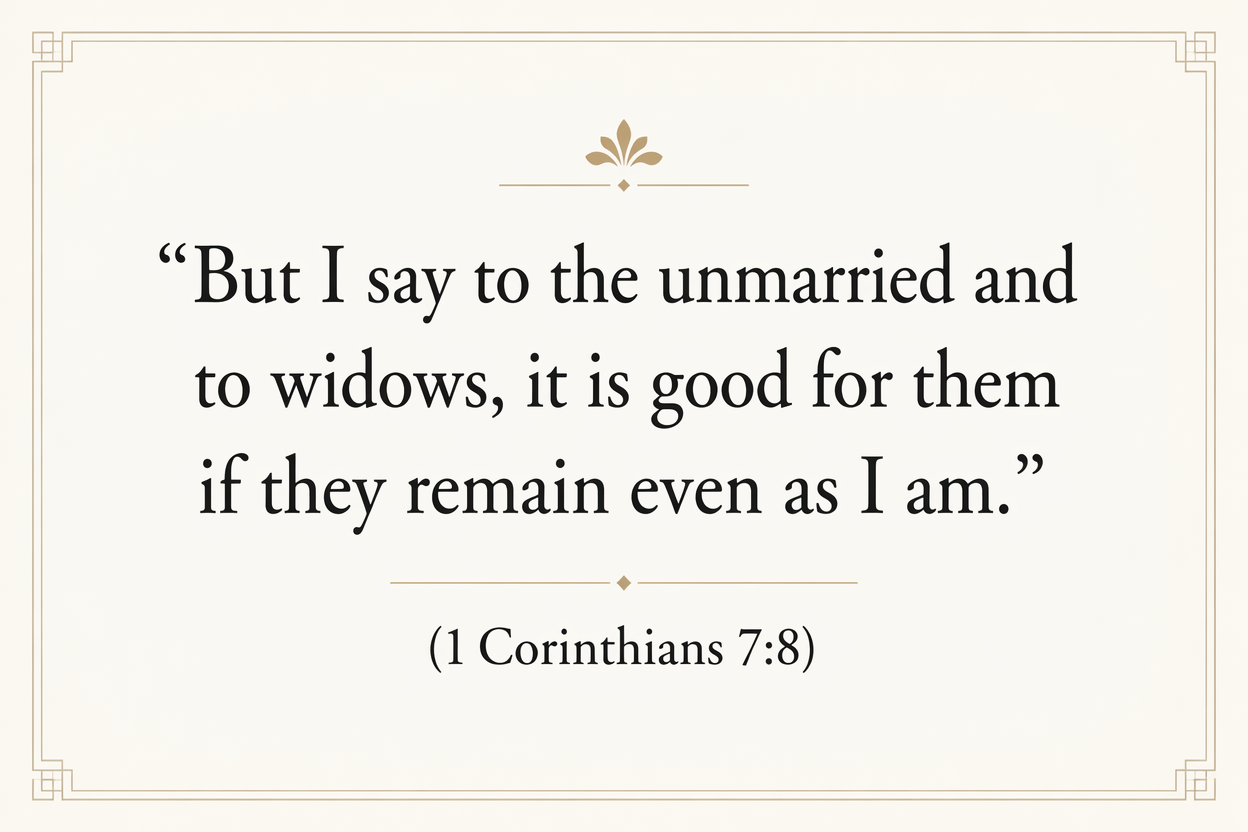
“But I say to the unmarried and to widows, it is good for them if they remain even as I am.” (1 Corinthians 7:8)
Here ἄγαμος stands alongside “widows” as a defined audience for Paul’s instruction. The verse frames “the unmarried” as people for whom “remain” is a live option, and it sets that option within Paul’s own personal example (“even as I am”). In this scene the word functions as a social and pastoral category: it gathers certain believers into a group addressed directly, then links their situation to a recommended course of life described as “good.”
“(but if she departs, let her remain unmarried, or else be reconciled to her husband), and that the husband not leave his wife.” (1 Corinthians 7:11)
In this parenthetical instruction, ἄγαμος describes a woman’s status after a departure: she is to “remain unmarried” or take the alternative of being “reconciled to her husband.” The contrast drawn in the sentence makes the word an important marker of a temporary or ongoing condition that can follow marital disruption. The counsel is framed with two parallel imperatives—what the woman is to do if separation happens, and what “the husband” is not to do—so ἄγαμος helps name the concrete state that results from a departure, distinguishing it from reconciliation.
“But I desire to have you to be free from cares. He who is unmarried is concerned for the things of the Lord, how he may please the Lord;” (1 Corinthians 7:32)
Here ἄγαμος is placed inside an argument about “cares” and single-minded attention. The immediate context defines the unmarried person’s characteristic focus: he “is concerned for the things of the Lord” and aims at “how he may please the Lord.” The word therefore contributes a status that, in Paul’s reasoning in this verse, corresponds to a particular set of concerns. The sentence does not merely label someone; it ties that label to an inward orientation (“concerned for”) and an outward aim (“please the Lord”), using the unmarried state as the setting for a specific kind of undivided preoccupation.
“There is also a difference between a wife and a virgin. The unmarried woman cares about the things of the Lord, that she may be holy both in body and in spirit. But she who is married cares about the things of the world—how she may please her husband.” (1 Corinthians 7:34)
In this extended contrast, ἄγαμος qualifies “woman” and is set over against “she who is married.” The verse first signals distinction (“a difference between a wife and a virgin”), then develops that difference by describing what each “cares about.” The unmarried woman’s care is directed “about the things of the Lord,” with an expressed purpose “that she may be holy both in body and in spirit.” By contrast, the married woman’s care is directed toward “the things of the world—how she may please her husband.” Within the flow of thought, ἄγαμος anchors one side of a paired comparison: not simply a civil condition, but a condition correlated here with the kinds of obligations and attentions that shape daily concern.
Sense and Usage
Across these four contexts, ἄγαμος consistently names the state of not being married, but it does so in more than one practical frame. In 1 Corinthians 7:8 it operates as a direct address category—“the unmarried and … widows”—placing certain believers within the scope of specific apostolic counsel and presenting remaining in that state as “good” in relation to Paul’s own pattern of life. In 7:11 it becomes a term for the post-separation condition a woman may occupy, contrasted with reconciliation; the word serves to specify what her life should look like if she does not return to her husband.
In 7:32 and 7:34, the unmarried state is woven into an argument about “cares” and about what a person is “concerned” with or “cares about.” The word helps articulate a difference in attentional pressures: the unmarried person is depicted as oriented toward “the things of the Lord,” whereas the married person is depicted as oriented toward “how” to please a spouse and toward “the things of the world.” These verses present ἄγαμος as a condition that affects the direction and division of one’s concerns. Even where holiness is mentioned (“holy both in body and in spirit”), the word’s role remains to specify the social state in which such a focus is described in the verse’s contrast.
Another feature of usage is the word’s adaptability to different subjects: it can describe a group (“the unmarried”), an individual male (“He who is unmarried”), and an individual female (“The unmarried woman”). The same label applies across these varying referents, allowing Paul to speak about unmarried believers broadly (7:8), about an unmarried state that can follow a marital rupture (7:11), and about unmarried men and women in relation to their devotional priorities (7:32, 7:34). In every case, the term functions as a clear boundary marker between life with a spouse and life without one, and the surrounding clauses develop the implications of that boundary for decisions (“remain”) and for the texture of daily concern (“free from cares,” “cares about”).
Imagery in Context
Within these passages the imagery attached to ἄγαμος is practical and relational: remaining as one is, departing or reconciling, and the competing “cares” that fill a person’s attention. The word sits at the crossroads of household realities (“husband,” “wife”) and inward aims (“please the Lord,” “be holy both in body and in spirit”), so the unmarried state is portrayed not as an abstraction but as a lived setting in which a person’s concerns and loyalties take concrete shape.
Sources: Lexical data from Strong’s Exhaustive Concordance and the Translators Brief Lexicon of Extended Strongs for Greek (STEPBible, CC BY). Occurrence data from the Translators Amalgamated Greek New Testament (STEPBible, CC BY). Scripture quotations from the World English Bible (public domain).




