Exploring the Meaning of ‘Aei’ in Greek
ἀεί means “always” and occurs 8 times in Scripture, including Mark 15:8, Acts 7:51, and 1 Peter 3:15.
Core Meaning
ἀεί is translated “always,” expressing continual or constant action or condition.
Learn More →Scripture Occurrences
It appears 8 times, including Mark 15:8; Acts 7:51; 2 Corinthians 4:11; and Titus 1:12.
Learn More →Usage Examples
It describes persistent resistance (Acts 7:51) and continual readiness (1 Peter 3:15).
Learn More →ἀεί expresses an unbroken “always,” marking what is customary, characteristic, or continually true. In the New Testament it appears in narratives about public expectation and in apostolic speech and letters describing steady patterns of action, disposition, or readiness.
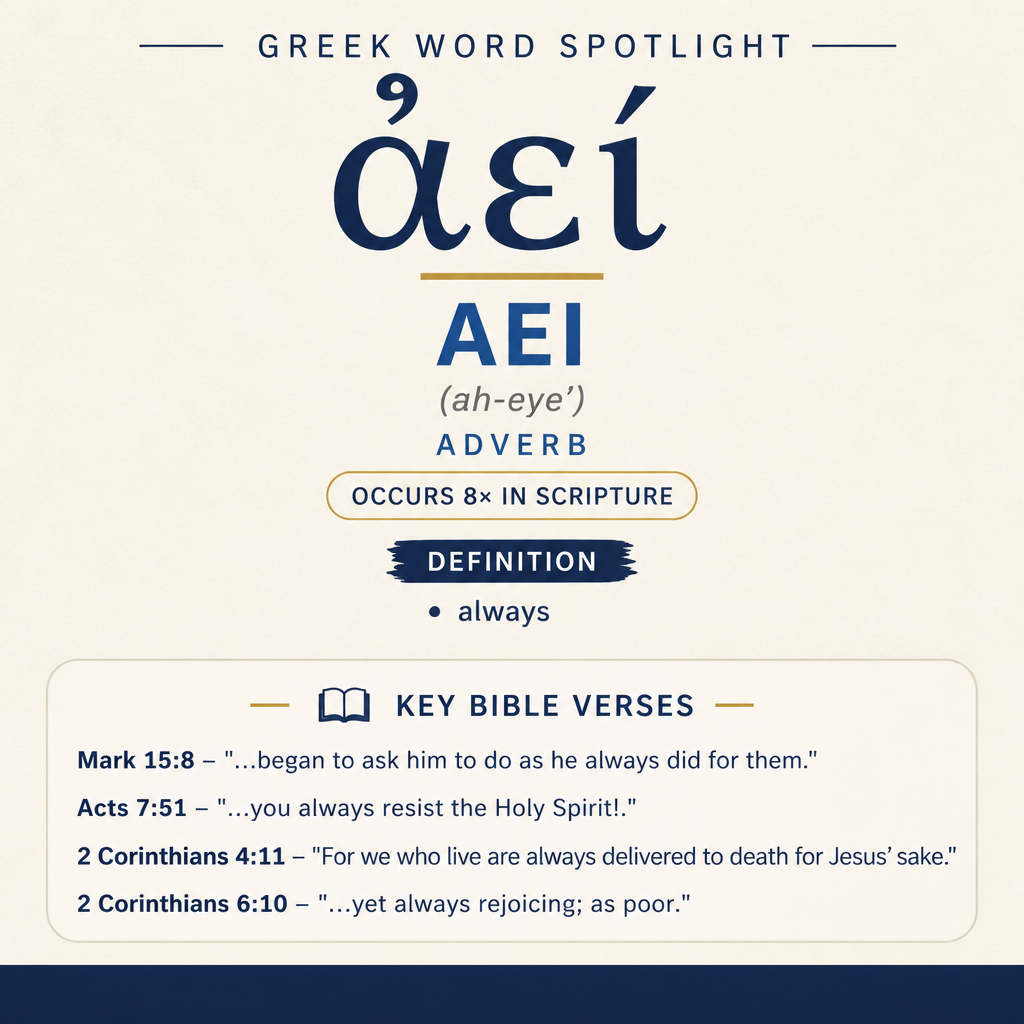
Occurrences
“The multitude, crying aloud, began to ask him to do as he always did for them.” (Mark 15:8)
Here ἀεί anchors the crowd’s request in established practice. The multitude is not inventing a new demand; they press for what has become the governor’s regular way of acting “for them.” The adverb frames their appeal as an expectation built on repetition: what is asked is presented as the customary arrangement they have come to rely on.

“You stiff-necked and uncircumcised in heart and ears, you always resist the Holy Spirit! As your fathers did, so you do.” (Acts 7:51)
In this direct address, ἀεί intensifies the accusation by portraying resistance as continual rather than occasional. The line pairs an “always” habit with intergenerational continuity (“As your fathers did, so you do”), so the force of ἀεί is to place the hearers’ opposition in the category of a persistent pattern—resistance that characterizes them as a group across time.
“For we who live are always delivered to death for Jesus’ sake, that the life also of Jesus may be revealed in our mortal flesh.” (2 Corinthians 4:11)
ἀεί describes a recurring condition of apostolic life: being “delivered to death for Jesus’ sake.” The statement sets ongoing exposure to death alongside a purpose clause (“that the life also of Jesus may be revealed”), so “always” does more than report frequency. It locates this experience as a constant backdrop against which the revelation of Jesus’ life in “mortal flesh” is seen.
“as sorrowful, yet always rejoicing; as poor, yet making many rich; as having nothing, and yet possessing all things.” (2 Corinthians 6:10)
Here ἀεί belongs to a series of contrasts that hold two realities together. The phrase “always rejoicing” does not erase “sorrowful”; it asserts that rejoicing persists even when sorrow is also present. The adverb supplies steadiness: amid changing circumstances described by the surrounding clauses (“poor… having nothing”), rejoicing is presented as continuous.
“One of them, a prophet of their own, said, “Cretans are always liars, evil beasts, and idle gluttons.”” (Titus 1:12)
In this quotation, ἀεί functions as an absolute generalization about a group’s character. The adverb heightens the claim by presenting the label “liars” as not merely frequent but constant—part of the stereotype’s rhetorical force. Within the cluster (“liars, evil beasts, and idle gluttons”), “always” makes the first accusation sound settled and pervasive, not limited to some instances.
“Therefore I was displeased with that generation, and said, ‘They always err in their heart, but they didn’t know my ways.’” (Hebrews 3:10)
Here ἀεί modifies inner wandering: “always err in their heart.” The adverb does not describe a single misstep but an enduring direction of the “heart.” The second clause (“but they didn’t know my ways”) sits alongside this continual erring, so “always” portrays an entrenched inner pattern that corresponds to ongoing ignorance of God’s ways.
“But sanctify the Lord God in your hearts. Always be ready to give an answer to everyone who asks you a reason concerning the hope that is in you, with humility and fear,” (1 Peter 3:15)
In this exhortation, ἀεί governs a posture of preparedness: “Always be ready.” The readiness envisioned is not occasional or reactive; it is a standing state that flows from the prior command to “sanctify the Lord God in your hearts.” The adverb makes the instruction comprehensive in time, extending to “everyone who asks” and shaping the manner of response (“with humility and fear”) as a consistent practice.
“Therefore I will not be negligent to remind you of these things, though you know them, and are established in the present truth.” (2 Peter 1:12)
In this verse, the idea of constantness is carried by the speaker’s settled resolve to keep reminding: “I will not be negligent to remind you.” In that setting, ἀεί underscores ongoing attentiveness rather than a one-time reminder. The statement anticipates repeated reinforcement of “these things” even for people who already “know them” and are “established,” portraying reminder as a continuing responsibility.

Sense and Usage
Across these passages ἀεί consistently marks continuity—what persists as a regular practice, an ongoing condition, or a settled characterization. In Mark 15:8 it points to customary public policy: the crowd appeals to what the ruler “always did,” leveraging the weight of precedent. In Acts 7:51 the same adverb turns a charge into a portrait of enduring resistance, framed as behavior that repeats across generations. In 2 Corinthians 4:11 it attaches to lived experience, presenting repeated exposure to death as a constant feature of ministry life, set in purposeful relation to the revealing of Jesus’ life in mortal bodies.
In 2 Corinthians 6:10, ἀεί functions differently: it qualifies an inner response (“rejoicing”) amid paradoxical circumstances. Here the adverb emphasizes steadiness, portraying rejoicing as a continuing thread that runs through sorrow, poverty, and apparent lack. In Titus 1:12 it appears in a blunt, sweeping judgment: “Cretans are always liars.” The adverb’s effect is maximal, pressing the statement toward totality and giving the stereotype its sharp edge. Hebrews 3:10 likewise applies ἀεί to a persistent inward orientation—erring “in their heart”—so that “always” describes not merely repeated acts but an ongoing direction of the inner life.
When ἀεί enters exhortation, as in 1 Peter 3:15, it shapes discipleship as a constant readiness rather than an occasional performance. Readiness is portrayed as a stable habit formed in the heart (“sanctify the Lord God in your hearts”) and expressed in consistent demeanor (“with humility and fear”). In 2 Peter 1:12, the adverb’s force complements a vowed pattern of care: reminders are not redundant because the audience already knows; they are an enduring means of strengthening those “established in the present truth.” Taken together, these uses show ἀεί as a word that binds actions, attitudes, and conditions to a horizon of ongoing time—habitual, continual, and comprehensive in scope.
Imagery in Context
The scenes where ἀεί appears often carry the feel of repetition: a crowd returning to an expected custom, a people characterized by a recurring stance of resistance, and communities sustained by repeated readiness and repeated reminder. Even where circumstances shift—sorrow alongside rejoicing, poverty alongside enrichment—the adverb paints a steady line through the change, presenting “always” as the thread that holds a pattern together over time.
Sources: Lexical data from Strong’s Exhaustive Concordance and the Translators Brief Lexicon of Extended Strongs for Greek (STEPBible, CC BY). Occurrence data from the Translators Amalgamated Greek New Testament (STEPBible, CC BY). Scripture quotations from the World English Bible (public domain).