Understanding the Significance of Adelphos in Greek
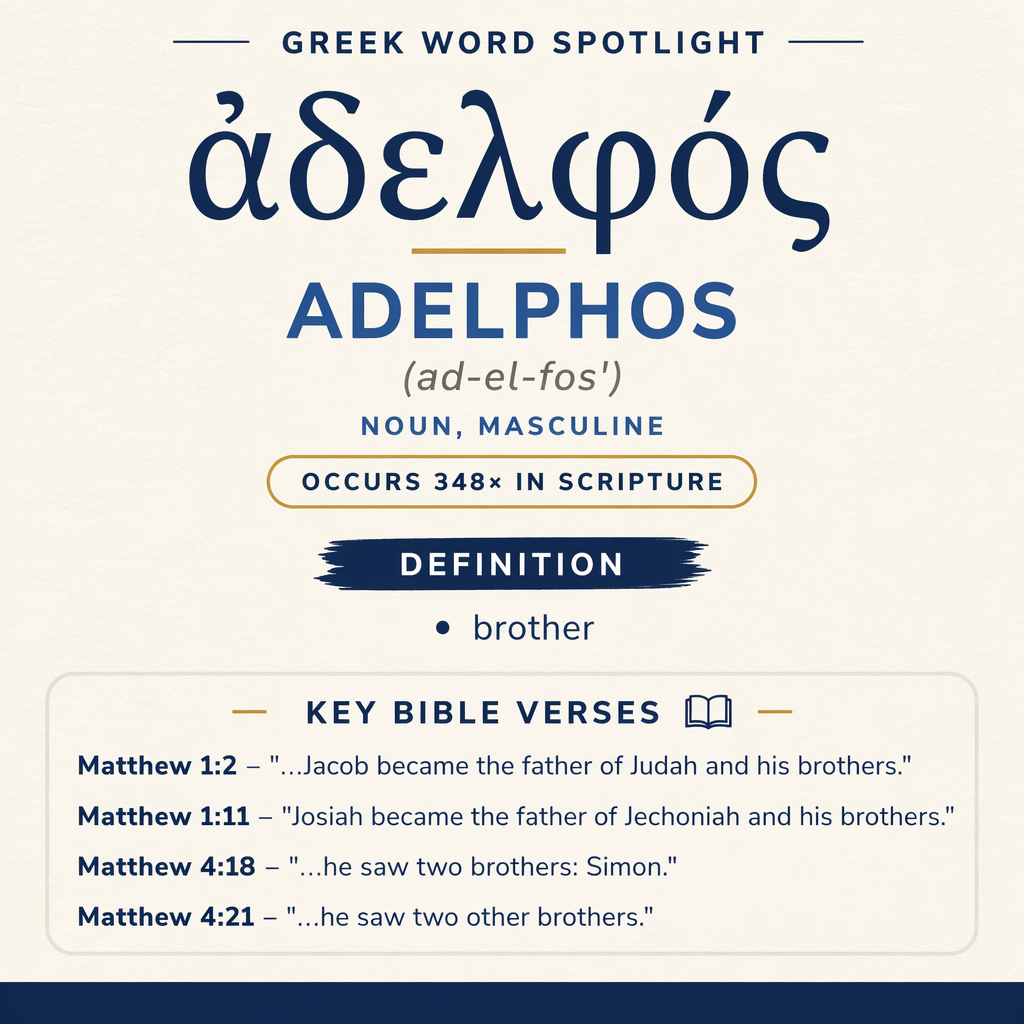
ἀδελφός (Adelphos) means “brother” in Greek and occurs 348 times in Scripture, including Matthew 1 and Matthew 4–5.
Family Contexts
In Matthew 1:2 and 1:11 it refers to “his brothers” within genealogical listings.
Learn More →Relational Ethics
In Matthew 5:22–24 it appears in commands about anger and reconciliation with your brother.
Learn More →ἀδελφός means “brother.” In the passages quoted here, it appears in narrative scenes that name literal brothers and in teachings that address a “brother” as the immediate neighbor within one’s moral responsibility.
Occurrences
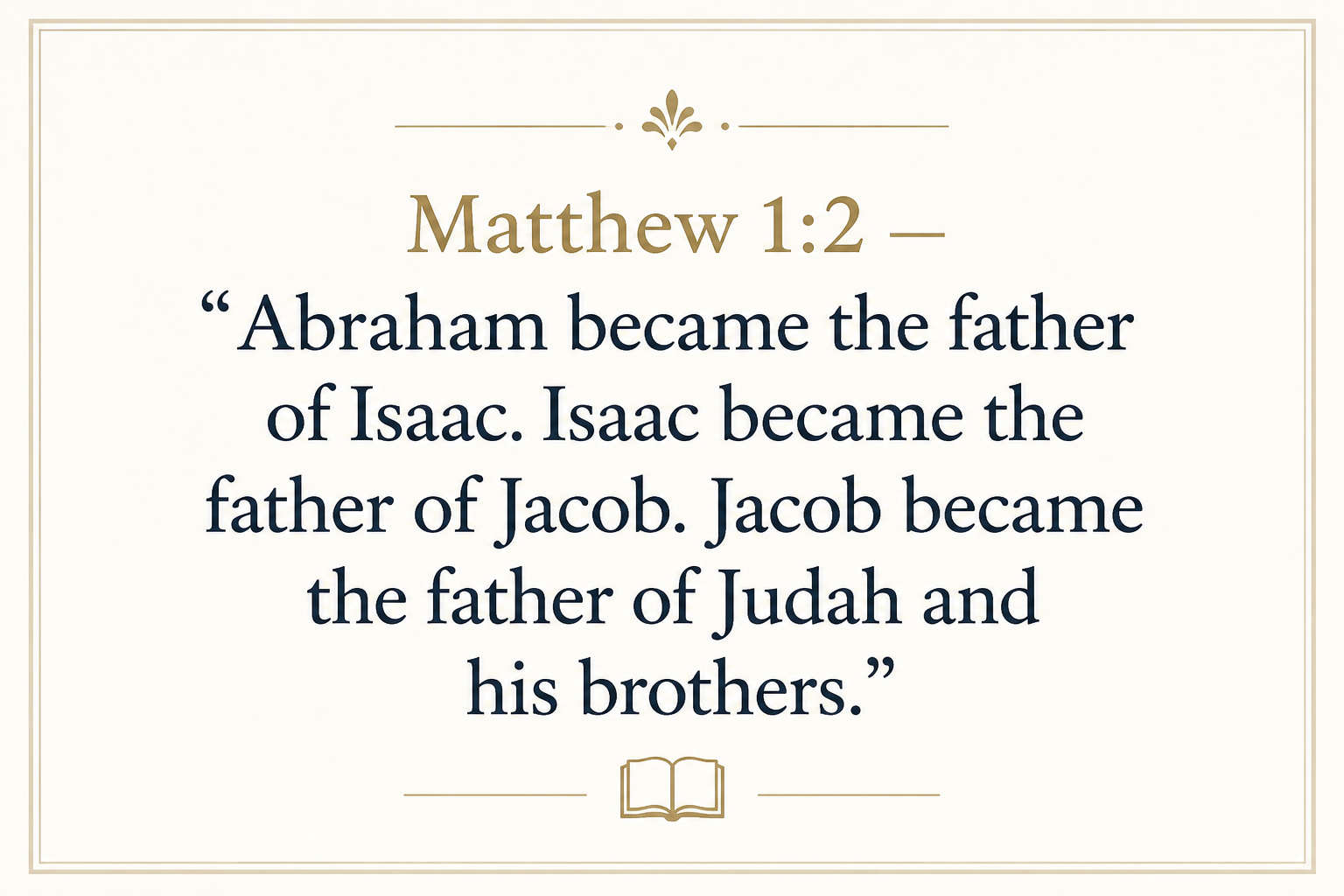
Matthew 1:2 — “Abraham became the father of Isaac. Isaac became the father of Jacob. Jacob became the father of Judah and his brothers.”
Here ἀδελφός marks Judah’s place within a family line by naming him alongside “his brothers.” The word frames Judah not as an isolated figure but as one among siblings, emphasizing shared descent and a clustered family identity within the genealogy’s rhythm of fathers and sons.
Matthew 1:11 — “Josiah became the father of Jechoniah and his brothers, at the time of the exile to Babylon.”
Again the term groups Jechoniah with “his brothers,” presenting a set of siblings situated within a specific historical moment (“at the time of the exile to Babylon”). ἀδελφός contributes the sense of a family unit whose story is caught up together in a turning point that the genealogy highlights.
Matthew 4:18 — “Walking by the sea of Galilee, he saw two brothers: Simon, who is called Peter, and Andrew, his brother, casting a net into the sea; for they were fishermen.”
In this calling scene, ἀδελφός identifies Simon Peter and Andrew as siblings while they work side by side (“casting a net into the sea; for they were fishermen”). The word does more than label relationship; it helps the scene cohere as a shared life—two men linked by kinship and occupation encountered together on the shoreline.
Matthew 4:21 — “Going on from there, he saw two other brothers, James the son of Zebedee, and John his brother, in the boat with Zebedee their father, mending their nets. He called them.”
Here ἀδελφός again situates two men as a pair—“James… and John his brother”—but within a fuller household setting: “in the boat with Zebedee their father.” The mention of “brothers” alongside “their father” and their work (“mending their nets”) anchors the term in a concrete family and trade context, strengthening the impression that the call interrupts an ordinary, shared family routine.
Matthew 5:22 — “But I tell you that everyone who is angry with his brother without a cause will be in danger of the judgment. Whoever says to his brother, ‘Raca!’ will be in danger of the council. Whoever says, ‘You fool!’ will be in danger of the fire of Gehenna.”
In this teaching, ἀδελφός functions as the direct object of escalating sins of speech and attitude: anger, contempt (“Raca!”), and insult (“You fool!”). “Brother” names the person against whom these acts are directed, making the warning concrete and interpersonal: the danger is tied to how one treats a brother, not merely to an inner disposition abstracted from relationships.
Matthew 5:23 — ““If therefore you are offering your gift at the altar, and there remember that your brother has anything against you,”
ἀδελφός identifies the offended party whose grievance interrupts worship. The word places the remembered conflict within a relationship close enough to demand attention: the worshiper must reckon with “your brother” as someone who “has anything against you,” a living relational claim that reaches even into the altar scene.
Matthew 5:24 — “leave your gift there before the altar, and go your way. First be reconciled to your brother, and then come and offer your gift.”
The term anchors the command in a specific relational aim: reconciliation is not a vague ideal but an action directed “to your brother.” By repeating “brother” from the prior verse and attaching it to “be reconciled,” ἀδελφός becomes the focal point of restoring a broken bond before resuming the act of offering.
Matthew 5:47 — “If you only greet your friends, what more do you do than others? Don’t even the tax collectors do the same?”
This saying appears in the sequence of teachings in which “brother” has been a key relational term. In this line, the relational circle is expressed as “your friends,” and the question presses beyond selective warmth. Set near the earlier instructions about anger and reconciliation with a brother, the social setting implied here keeps the concern on everyday human relationships—who receives greeting and recognition.
Matthew 7:3 — “Why do you see the speck that is in your brother’s eye, but don’t consider the beam that is in your own eye?”
ἀδελφός designates the person being scrutinized—“your brother”—in a vivid comparison between “speck” and “beam.” The term makes the illustration ethically pointed: the scene is not about judging strangers at a distance but about the temptation to focus on a brother’s small fault while ignoring one’s own larger issue.
Matthew 7:4 — “Or how will you tell your brother, ‘Let me remove the speck from your eye;’ and behold, the beam is in your own eye?”
Here “brother” is the one addressed in an offer of help (“Let me remove the speck from your eye”). ἀδελφός frames the interaction as personal and direct speech, and it sharpens the irony: the would-be helper approaches a brother with corrective intent while remaining impaired by a “beam” in his own eye.
Matthew 7:5 — “You hypocrite! First remove the beam out of your own eye, and then you can see clearly to remove the speck out of your brother’s eye.”
In the resolution of the image, ἀδελφός remains central: the goal is finally to “remove the speck out of your brother’s eye.” The term keeps the action relational and constructive—clarity is not merely self-improvement but is aimed at being able to help a brother rightly.
Matthew 10:2 — “Now the names of the twelve apostles are these. The first, Simon, who is called Peter; Andrew, his brother; James the son of Zebedee; John, his brother;”
Within the formal listing of the twelve, ἀδελφός serves as a concise relational identifier: “Andrew, his brother… John, his brother.” The word ties the apostolic roster to known sibling pairs, reminding the reader that among the named apostles are brothers who stand together even in an official catalogue of names.

Sense and Usage
Across these texts, “brother” operates in two main ways. In the genealogy and the narrative calls by the sea, it is a straightforward kinship marker: a person is located among siblings (“Judah and his brothers,” “Jechoniah and his brothers”) or paired with a named sibling in shared work and family setting (“Simon… and Andrew, his brother”; “James… and John his brother, in the boat with Zebedee their father”). In these scenes the word helps the narrative present people as members of households and pairs, not merely as solitary individuals.
In the teaching passages, “brother” becomes the nearest, most obvious human counterpart in ethical instruction: the one toward whom anger is harbored, the one insulted, the one who has a grievance, and the one whose fault is examined. The word keeps the instruction from drifting into the abstract by repeatedly attaching moral commands to a concrete relationship—someone who can be addressed (“Whoever says to his brother”), remembered (“there remember that your brother has anything against you”), sought out (“be reconciled to your brother”), and helped (“remove the speck out of your brother’s eye”). Even when the imagery is exaggerated (speck versus beam), “brother” grounds the picture in an ordinary interpersonal setting where correction can easily become self-deception.
The repeated “your brother” language also shapes responsibility as personal rather than general. The acts described—anger, contemptuous speech, reconciliation, and corrective help—are all directed toward a brother who stands within one’s immediate sphere. In these sayings, ἀδελφός is the relational point at which inner attitudes, spoken words, worship practices (“offering your gift at the altar”), and acts of judgment intersect.
Imagery
These passages attach “brother” to striking settings: fishermen brothers handling nets by the sea, brothers working in a boat with their father, a worshiper at an altar halted by the memory of a brother’s grievance, and the close-up, almost physical picture of a brother’s eye needing careful help. Together, the word carries the feel of nearness—shared family life, direct speech, and face-to-face dealings where harm and healing both happen in the ordinary spaces of work, worship, and conversation.
Sources: Lexical data from Strong’s Exhaustive Concordance and the Translators Brief Lexicon of Extended Strongs for Greek (STEPBible, CC BY). Occurrence data from the Translators Amalgamated Greek New Testament (STEPBible, CC BY). Scripture quotations from the World English Bible (public domain).