Exploring the Meaning of Adelphe in Greek
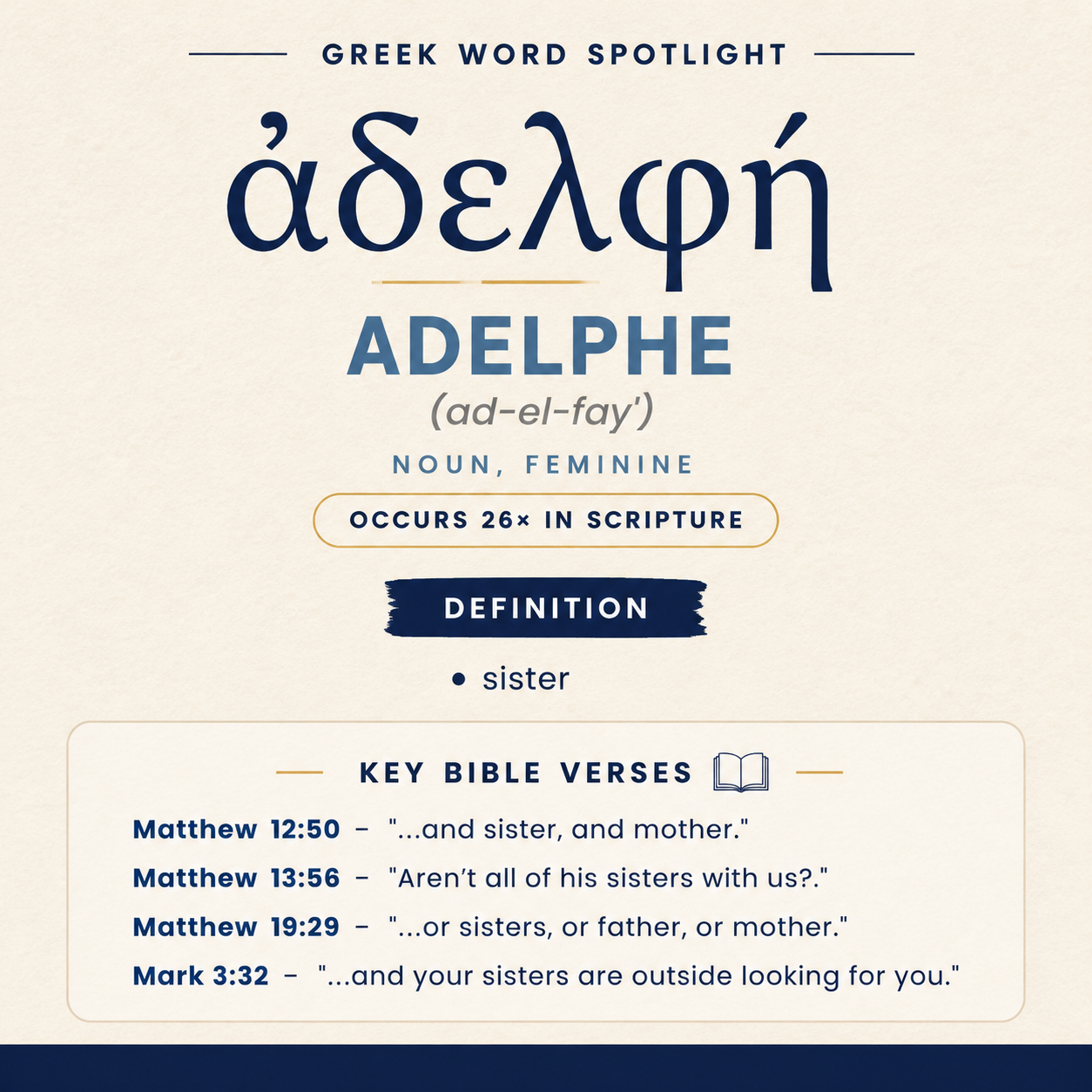
ἀδελφή (Adelphe) means “sister” and occurs 26 times in Scripture, including in Matthew and Mark.
Core Meaning
ἀδελφή is defined as “sister.” It appears in both literal family contexts and in Jesus’ teaching.
Learn More →Gospel Occurrences
In Matthew, it appears in 12:50, 13:56, and 19:29. In Mark, it appears in 3:32, 3:35, 6:3, 10:29, and 10:30.
Learn More →Teaching Contexts
Jesus uses “sister” while describing those who do the will of God (Matthew 12:50; Mark 3:35). It is also used when mentioning Jesus’ sisters (Matthew 13:56; Mark 6:3).
Learn More →ἀδελφή means “sister” and appears in Gospel scenes that speak of family ties, household relationships, and the redefinition of kinship around obedience to God. In these passages it can refer to sisters within a biological family, and it can also name a “sister” within the circle that belongs to Jesus.
Occurrences
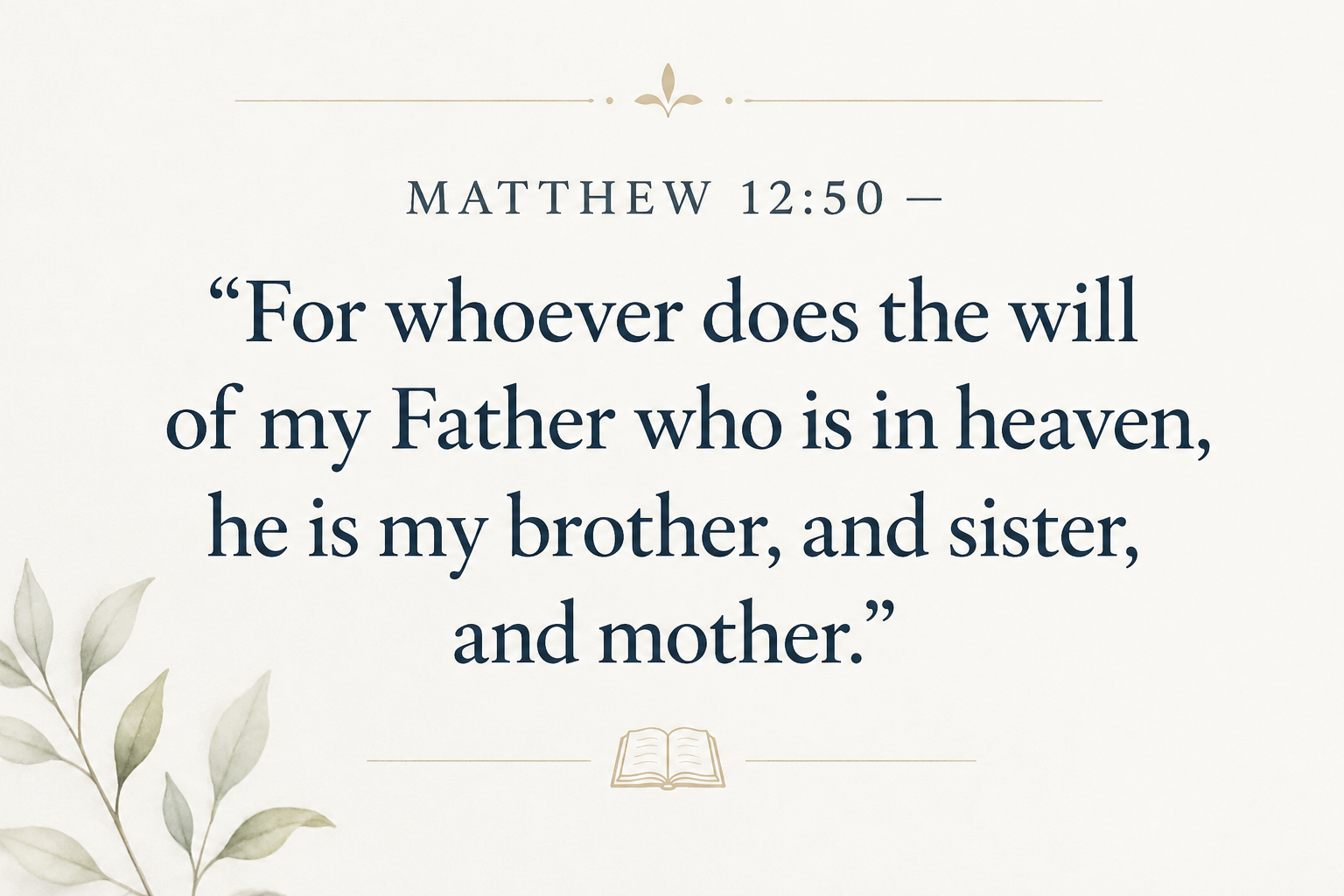
Matthew 12:50 — “For whoever does the will of my Father who is in heaven, he is my brother, and sister, and mother.”
Here “sister” is placed alongside “brother” and “mother” to describe a family that is created by doing “the will of my Father who is in heaven.” The word helps express the breadth of this familial language: discipleship is framed not merely as following a teacher, but as belonging in a household-like relationship to Jesus.
Matthew 13:56 — “Aren’t all of his sisters with us? Where then did this man get all of these things?”
In this question, “sisters” belongs to the townspeople’s familiarity with Jesus’ ordinary family setting: they know his relatives and assume that such familiarity should limit claims of extraordinary authority. The word functions as part of their appeal to what is local and known (“with us”), sharpening the contrast between Jesus’ public words and their perception of his family background.
Matthew 19:29 — “Everyone who has left houses, or brothers, or sisters, or father, or mother, or wife, or children, or lands, for my name’s sake, will receive one hundred times, and will inherit eternal life.”
“Sisters” is one item in a list of close relations and stable attachments that a person might “leave” for Jesus’ name. The term therefore contributes to the costliness described: devotion to Jesus can involve separation from the nearest bonds of the household, yet the verse pairs that loss with promise (“will receive one hundred times” and “will inherit eternal life”).
Mark 3:32 — “A multitude was sitting around him, and they told him, “Behold, your mother, your brothers, and your sisters are outside looking for you.”
“Sisters” is part of the message delivered to Jesus about his family’s physical location and their desire to see him (“outside looking for you”). The term helps draw the boundary the scene highlights: a “multitude” is “around him,” while his family—including his sisters—stands “outside.”
Mark 3:35 — “For whoever does the will of God is my brother, my sister, and mother.”
As in Matthew 12:50, “sister” belongs to a triad of kin terms that identifies the community shaped by obedience (“does the will of God”). The word extends the scope of that community to include women explicitly: the relationship Jesus names is not restricted to one gendered kin title, but embraces sisterhood as well as brotherhood and motherhood.
Mark 6:3 — “Isn’t this the carpenter, the son of Mary, and brother of James, Joses, Judah, and Simon? Aren’t his sisters here with us?” They were offended at him.
“Sisters” appears with specific markers of ordinary identity: trade (“the carpenter”), parentage (“the son of Mary”), siblings named, and the proximity of sisters (“here with us”). The word supports the speaker’s reasoning that Jesus is socially familiar and therefore, in their judgment, unworthy of the reaction his ministry requires; it stands in the sentence that precedes, “They were offended at him.”
Mark 10:29 — “Jesus said, “Most certainly I tell you, there is no one who has left house, or brothers, or sisters, or father, or mother, or wife, or children, or land, for my sake, and for the sake of the Good News,”
“Sisters” again appears within a list of close household relations whose loss may accompany allegiance to Jesus and “the Good News.” The word contributes to the realism of what can be surrendered: discipleship can reach into the deepest personal ties, including the bond with a sister.
Mark 10:30 — “but he will receive one hundred times more now in this time: houses, brothers, sisters, mothers, children, and land, with persecutions; and in the age to come eternal life.”
Here “sisters” is part of what is “received” in return—set within a new cluster of relationships and resources (“houses, brothers, sisters, mothers, children, and land”). The word thus participates in the promise of a broadened family-like network “now in this time,” but the same sentence also includes “with persecutions,” keeping the promise from sounding like simple comfort.
Luke 10:39 — “She had a sister called Mary, who also sat at Jesus’ feet, and heard his word.”
“Sister” identifies Mary in relation to “She” (Martha, implied by the next verse), establishing the household pair at the center of the scene. The word anchors the narrative in an ordinary domestic relationship while the verse foregrounds Mary’s posture and attention (“sat at Jesus’ feet, and heard his word”).
Luke 10:40 — “But Martha was distracted with much serving, and she came up to him, and said, “Lord, don’t you care that my sister left me to serve alone? Ask her therefore to help me.”
“My sister” is Martha’s relational claim as she speaks to Jesus; it gives emotional force to her complaint about being left “to serve alone.” The word marks the expectation of shared responsibility within the household: Martha frames Mary’s absence from serving not merely as a choice, but as a failure within the sister relationship.
Luke 14:26 — ““If anyone comes to me, and doesn’t disregard his own father, mother, wife, children, brothers, and sisters, yes, and his own life also, he can’t be my disciple.”
“Sisters” appears in a demanding statement about the requirements for discipleship. The word helps express the extremity of the claim: allegiance to Jesus reaches beyond public commitments into the most intimate loyalties (“his own father, mother… brothers, and sisters”), even extending to “his own life also.”
John 11:1 — “Now a certain man was sick, Lazarus from Bethany, of the village of Mary and her sister, Martha.”
“Her sister” functions as a simple identifier: Lazarus is located through the household of “Mary and her sister, Martha.” The term binds the characters together in a family unit, preparing for a story framed by sickness and the relational network of siblings in a particular place (“from Bethany”).

Sense and Usage
Across these passages, ἀδελφή operates in two main kinds of scenes: (1) references to ordinary family structure and (2) sayings where Jesus uses family language for those aligned with God’s will. In the family references, the word identifies sisters as concrete social realities—people whose presence is known (“with us,” “here with us”), whose location matters (“outside looking for you”), and whose household obligations can become points of tension (“left me to serve alone”). In such settings, “sister” contributes to the texture of village life and domestic life: it is part of the close circle by which a person is recognized and evaluated.
In the sayings about discipleship and allegiance, “sister” is included in lists that represent the strongest bonds and attachments. Matthew 19:29 and Mark 10:29–30 frame the sister relationship as something that may be relinquished “for my name’s sake” or “for my sake, and for the sake of the Good News,” and then strangely regained in multiplied form. In these verses “sisters” belongs to what is both lost and received: the term helps the reader hear the promise as relational, not merely material, since the recompense includes persons as well as possessions. Luke 14:26 intensifies the same theme by insisting that even these ties—explicitly including “sisters”—cannot hold first place over becoming Jesus’ disciple.
When Jesus speaks of “my sister” (Matthew 12:50; Mark 3:35), the word is used to reshape the idea of kinship around obedience: the defining feature is doing “the will of my Father who is in heaven” / “the will of God.” The inclusion of “sister” alongside “brother” and “mother” makes the redefined family comprehensive, embracing a full household set of relationships as an image for belonging to Jesus. In Mark 3:32–35, this redefinition is set against the concrete fact of his biological family standing “outside,” which heightens the contrast between physical proximity and the closer bond created by shared obedience.
Imagery
The word often evokes thresholds and circles: family members “outside” while a “multitude” sits around Jesus (Mark 3:32), sisters “with us” in the hometown’s shared space (Matthew 13:56; Mark 6:3), and a household scene where one sister sits listening while the other is busy serving (Luke 10:39–40). In these snapshots, “sister” carries the feel of ordinary closeness—shared place, shared name, shared expectation—while the sayings place that closeness under the larger claim that doing God’s will establishes an even deeper household bond (Matthew 12:50; Mark 3:35).
Sources: Lexical data from Strong’s Exhaustive Concordance and the Translators Brief Lexicon of Extended Strongs for Greek (STEPBible, CC BY). Occurrence data from the Translators Amalgamated Greek New Testament (STEPBible, CC BY). Scripture quotations from the World English Bible (public domain).