Understanding the Significance of Adelos in Greek
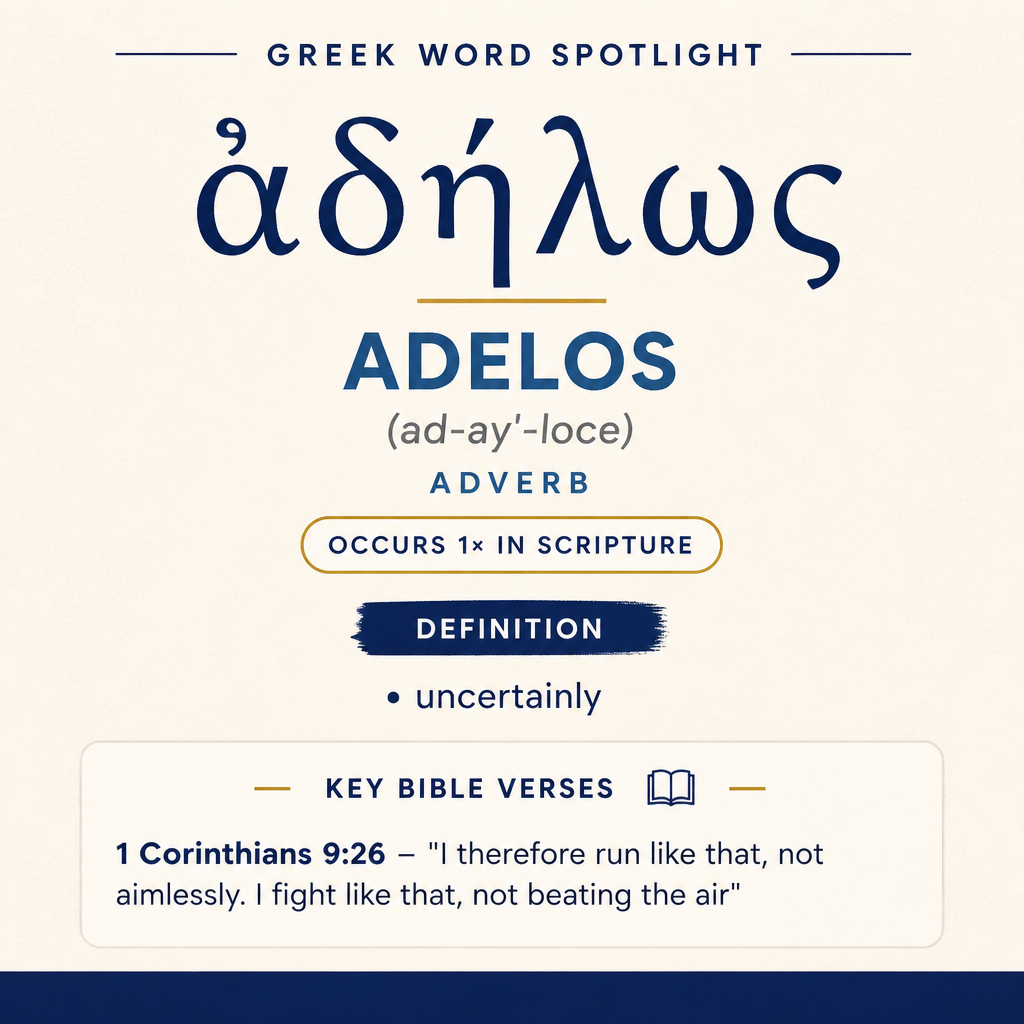
ἀδήλως means “uncertainly” and appears once in Scripture, in 1 Corinthians 9:26.
Verse Context
In 1 Corinthians 9:26 it contrasts purposeful effort with running aimlessly and fighting without effect.
Learn More →ἀδήλως means “uncertainly” and appears in Paul’s athletic-and-combat imagery in 1 Corinthians 9:26. In that setting it helps define what kind of effort his ministry resembles: not a vague exertion, but action with a settled target.
Root and Related Words
ἀδήλως derives from the adjective ἄδηλος (adelos, “unclear”; Strong’s G82). The relationship between the two forms is the ordinary one between an adjective and its corresponding adverb: the adjective describes something as “unclear,” and the adverb expresses the manner of an action in terms of that lack of clarity.
Occurrences
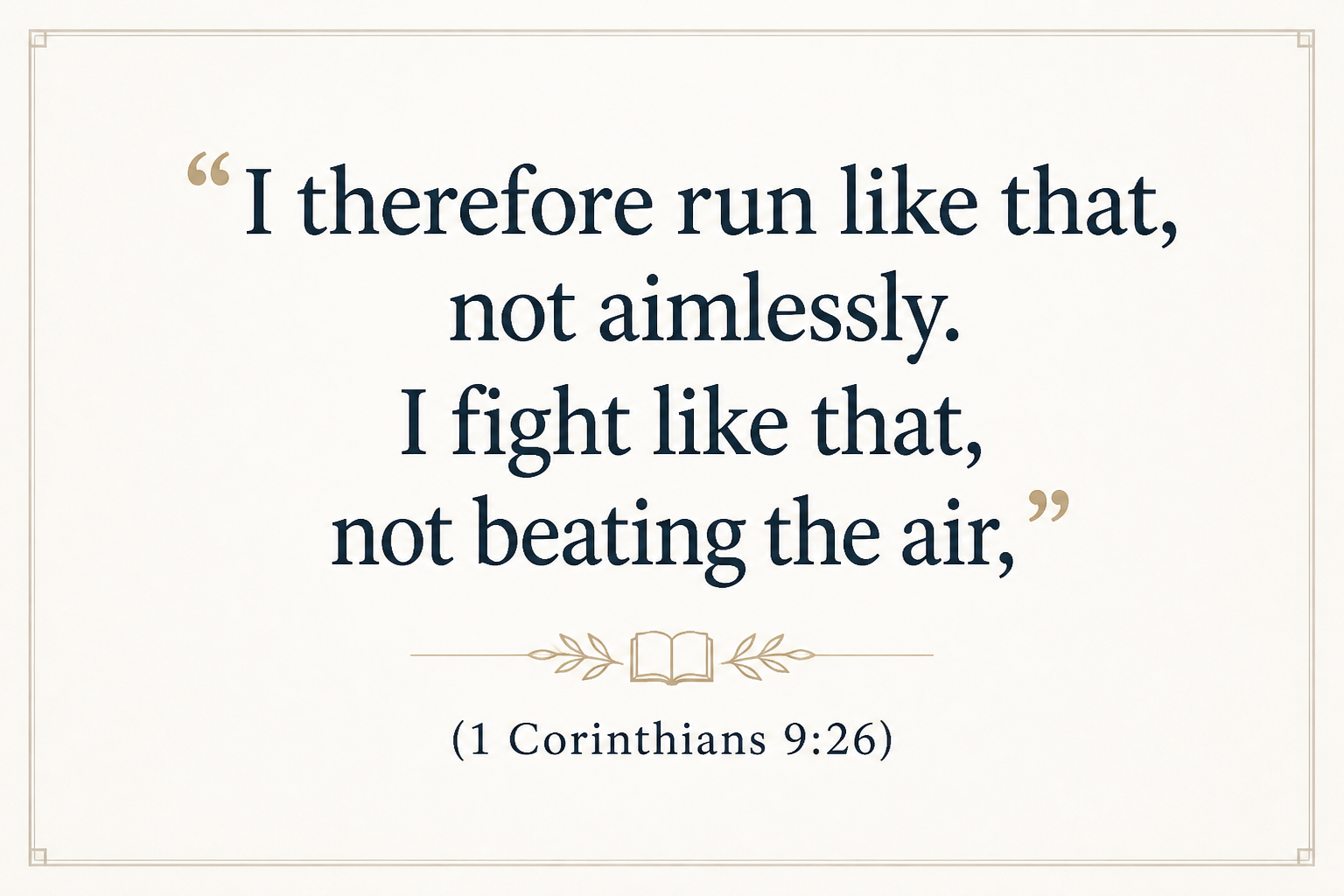
“I therefore run like that, not aimlessly. I fight like that, not beating the air,” (1 Corinthians 9:26)
In this verse Paul draws two parallel pictures: a runner and a fighter. Both images have a shared point: his exertion is not random, diffuse, or misdirected. ἀδήλως contributes by characterizing the manner he rejects—an “uncertain” kind of running, the sort that lacks a clear line of effort. The verse immediately spells out what this would look like: “aimlessly” running and “beating the air.” The two negatives reinforce each other. Running “not aimlessly” pictures motion that is organized toward a finish rather than wandering movement; fighting “not beating the air” pictures blows that land on a real opponent rather than empty gestures.
Within that paired structure, ἀδήλως belongs to the first image (“I therefore run…”). It functions as the adverbial counterpart to the concrete scenario: a runner’s path can be definite or indefinite, purposeful or uncertain. Paul places his own ministry-labor on the definite side of that contrast. The second clause (“I fight like that…”) does not repeat the adverb, but it restates the same idea through a fresh metaphor. Together, the two lines give the reader two ways to grasp what “uncertainly” would mean in practice: movement without direction, and effort without contact.
The verse also uses a tight, emphatic rhythm—“I therefore… like that… not… I… like that… not…”—so that the rejection of uncertain action is not incidental but programmatic. Paul’s point is not simply that he exerts himself; it is that his exertion is shaped by a clear aim. In that rhetorical environment, ἀδήλως marks the difference between the appearance of effort and the reality of effect. A runner can run hard and still run “uncertainly” if the course is not held clearly; a fighter can swing vigorously and still accomplish nothing if he “beat[s] the air.” By denying “uncertainly,” Paul is denying a kind of activity that looks energetic but is inwardly unfocused.
Sense and Usage
The definition “uncertainly” describes a manner of acting marked by lack of clarity and lack of settled direction. In 1 Corinthians 9:26, that manner is contrasted with action that has a definite object. Paul’s two comparisons show that “uncertainly” is not merely a private feeling; it is a practical quality visible in the shape of one’s effort.
First, “uncertainly” has to do with the line or path of action. The runner image brings to mind forward motion that ought to be channeled: a runner’s speed is not the whole story; the runner must also be oriented. In the verse’s own wording, this is the opposite of “aimlessly.” The word choice suggests that an “uncertain” manner is one in which the goal does not govern the movement. Paul’s denial of that manner implies that his work is guided by a known end, so his running is not simply motion but directed motion.
Second, “uncertainly” has to do with contact and effect. The fighter image is not a new topic but a second angle on the same quality. “Beating the air” is the picture of exertion that fails to engage a real opponent, resulting in no decisive outcome. The pairing of the two images shows that “uncertainly” can be expressed in either of two failures: (1) lack of direction (running without a true line), or (2) lack of engagement (striking without a target). Paul’s statement rejects both as descriptions of his own effort.
Because ἀδήλως is an adverb, it chiefly describes how an action is carried out rather than naming a thing or an abstract state. The verse’s repeated first-person verbs (“I… run… I… fight…”) keep the focus on manner. The point is not theoretical uncertainty but a style of action that is not governed by a clear aim. This is why the clarifying negatives (“not aimlessly… not beating the air”) fit so naturally: they interpret the adverb by portraying what uncertain action looks like when translated into bodily movement. In this context, “uncertainly” is not presented as a small flaw; it is the difference between meaningful exertion and wasted effort.
The tight coordination of the two clauses also suggests that “uncertainly” is the opposite of disciplined intentionality. The runner and fighter are both athletes whose training is meant to yield effectiveness; their movements are evaluated by whether they arrive and whether they connect. Paul’s use of these images implies that “uncertainly” is the kind of manner that undermines the very purpose of the exertion. A runner who runs without a clear line does not bring the race to its intended end; a fighter who strikes air does not accomplish the fight’s purpose. Thus the word’s force is sharpened by the practical field in which it is set: athletics and combat are arenas where unclear effort is quickly exposed as ineffective.
Imagery
The verse anchors ἀδήλως in concrete motion: feet on a course and fists in a fight. “Uncertainly” is not left as an invisible inner condition; it is pictured as aimless running and empty strikes. Paul’s language turns the adverb into a vivid warning about wasted exertion—movement that spends strength but fails to reach a goal or meet a real target.
Sources: Lexical data from Strong’s Exhaustive Concordance and the Translators Brief Lexicon of Extended Strongs for Greek (STEPBible, CC BY). Occurrence data from the Translators Amalgamated Greek New Testament (STEPBible, CC BY). Scripture quotations from the World English Bible (public domain).