Exploring the Meaning of Achaikos in Greek
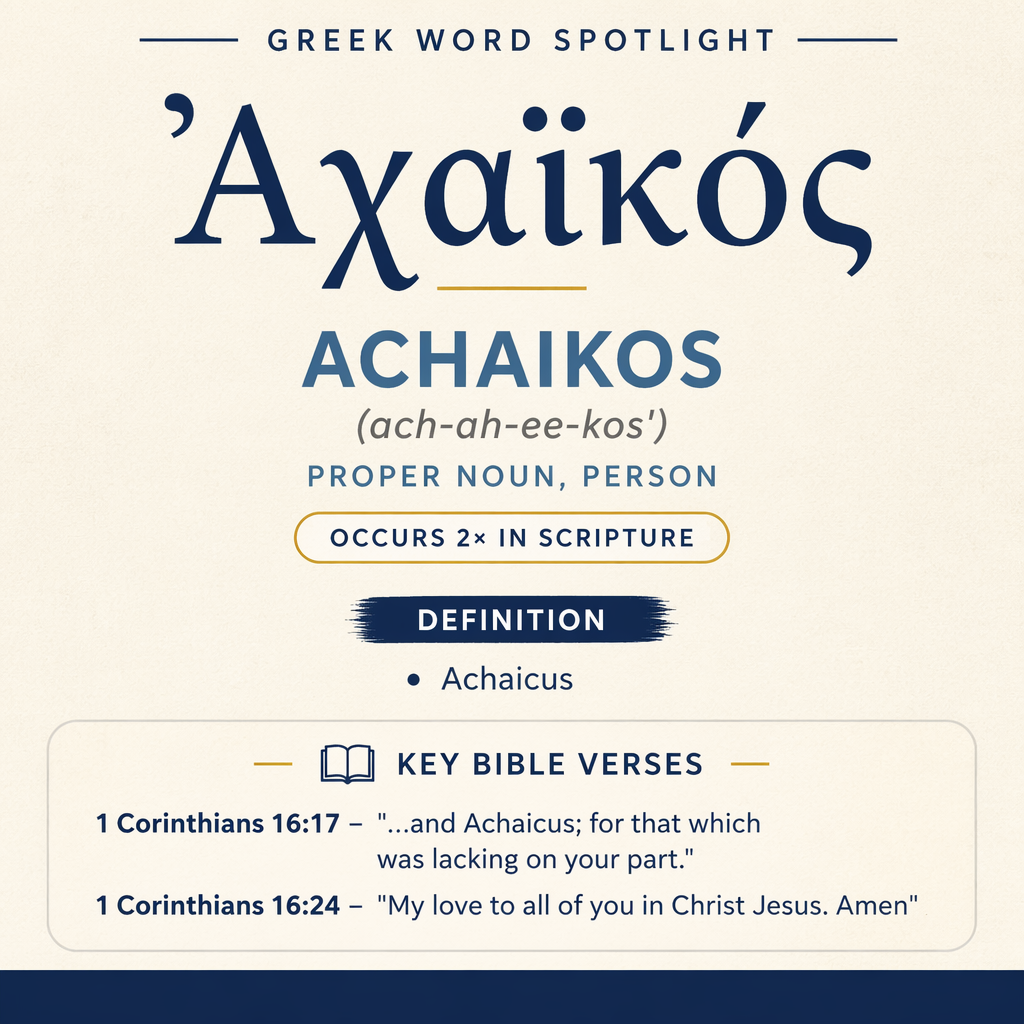
Ἀχαϊκός (Achaikos) means “Achaicus” and appears twice in Scripture, in 1 Corinthians 16:17 and 1 Corinthians 16:24.
Scripture Occurrences
The name occurs 2 times in Scripture. Both occurrences are in 1 Corinthians 16.
Learn More →Context in Corinthians
In 1 Corinthians 16:17, Achaicus is mentioned with Stephanas and Fortunatus as supplying what was lacking. In 1 Corinthians 16:24, the letter closes with a message of love in Christ Jesus.
Learn More →Ἀχαϊκός means “Achaicus,” a personal name. It appears in Paul’s closing material in 1 Corinthians, where it is linked with the arrival of fellow workers and the expression of love to the church.
Root and Related Words
Achaikos is related to the place-name Achaia (Ἀχαΐα), “Achaia” (Strong’s G882).

Occurrences
“I rejoice at the coming of Stephanas, Fortunatus, and Achaicus; for that which was lacking on your part, they supplied.” (1 Corinthians 16:17)
Here Achaicus is named alongside Stephanas and Fortunatus as part of a trio whose “coming” brings Paul joy. The sentence gives Achaicus narrative weight by placing him among identifiable people who bridge distance between Paul and the Corinthian believers: their arrival is presented as a concrete event with a pastoral effect (“I rejoice”). In the explanation that follows—“for that which was lacking on your part, they supplied”—the name Achaicus participates in a corporate action attributed to the group. The wording frames their presence as a compensating gift: something the Corinthians, as a whole, were not providing is now “supplied” through these men. Within this verse, then, Achaicus functions as one of the emissaries whose bodily arrival and service complete what had been incomplete in the relationship, whether in communication, encouragement, material help, or some other form of support implied by the broad phrase “that which was lacking.” The focus is less on Achaicus as an individual personality and more on the relational role signaled by his inclusion in the list of names and in the plural “they supplied.”
“My love to all of you in Christ Jesus. Amen.” (1 Corinthians 16:24)
This closing line is a direct, inclusive affirmation: “My love to all of you in Christ Jesus.” In the immediate texture of the letter’s conclusion, such a statement helps interpret the preceding mentions of co-workers and visitors (including Achaicus) within the larger atmosphere of affection and unity. Even though Achaicus is not named in this verse, the placement of this closing blessing-like sentence at the end of the same section gives a frame for how the earlier arrival of named individuals is to be received: Paul’s interaction with the Corinthians and with those associated with them is carried out within “love” that is explicitly located “in Christ Jesus.” The verse contributes a tone of personal warmth that matches the earlier rejoicing at the coming of Stephanas, Fortunatus, and Achaicus; it signals that the movement of people and the supplying of what was lacking belongs inside a relationship governed by Christ-centered love.
Sense and Usage
As a personal name, Achaicus functions in 1 Corinthians as a marker of concrete, embodied connection. Paul does not treat relationships only as ideas or sentiments; he attaches them to recognizable individuals whose travel (“the coming”) and service (“they supplied”) have real effects on the life of the churches and on Paul himself. Achaicus is therefore part of the letter’s social geography: the Corinthians are addressed as a community with responsibilities and limitations (“that which was lacking on your part”), and Achaicus is one of the people through whom a deficit is met. The text’s emphasis is not on biographical detail but on what the name accomplishes rhetorically—anchoring Paul’s joy and the Corinthians’ participation in the gospel’s work to particular persons who can be named.
The verse in which Achaicus appears also shows how a name can carry representative significance. Paul addresses the Corinthians collectively (“your part”) yet points to specific men who act in a way that serves the whole relationship between apostle and congregation. In that setting, Achaicus is not an isolated figure but a member of a small delegation. The structure “Stephanas, Fortunatus, and Achaicus” underscores cooperation and shared purpose, and the plural verb “they supplied” assigns the group a unified role. This fits naturally with the closing affirmation, “My love to all of you in Christ Jesus,” where Paul’s affection is not limited to a subset but reaches “all.” Taken together, the closing material portrays a network of persons—some named, some encompassed under “all of you”—held together by service that meets needs and by love grounded in Christ Jesus.
Closing Imagery
The imagery around Achaicus is the imagery of arrival and replenishment: a joyful welcome to travelers and the satisfaction of what had been “lacking.” In the same closing context, the final declaration of love gathers those movements into a single relational horizon—love “to all of you in Christ Jesus”—so that the coming of messengers like Achaicus is seen not as mere logistics but as part of a living bond between Paul and the church.
Sources: Lexical data from Strong’s Exhaustive Concordance and the Translators Brief Lexicon of Extended Strongs for Greek (STEPBible, CC BY). Occurrence data from the Translators Amalgamated Greek New Testament (STEPBible, CC BY). Scripture quotations from the World English Bible (public domain).