
Discovering the Meaning of ‘Abraham’ in Hebrew
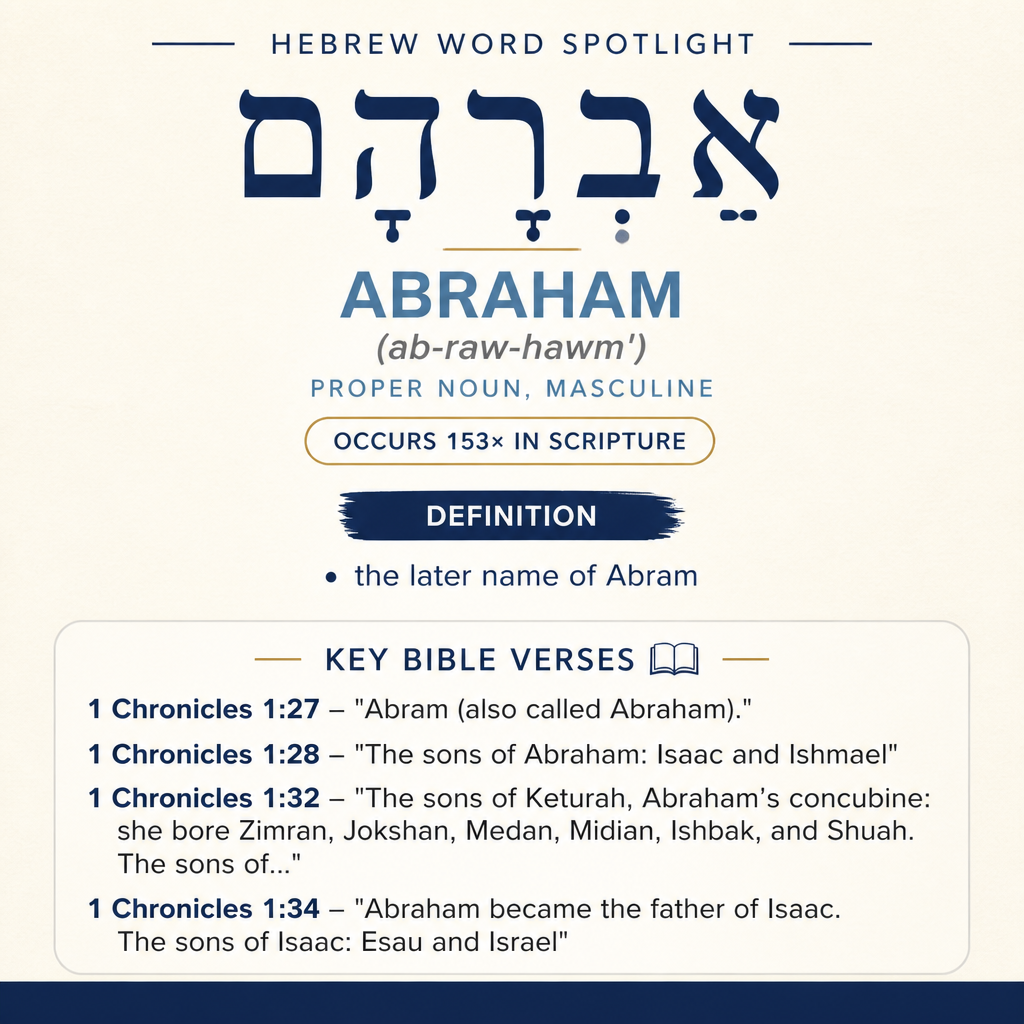
אַבְרָהָם means “the later name of Abram” and appears 153 times in Scripture, including genealogies and covenant references in Chronicles and Kings.
Name & Identity
אַבְרָהָם is the later name of Abram. In 1 Chronicles 1:27 Abram is noted as “also called Abraham.”
Learn More →Family Lines
1 Chronicles lists Abraham’s sons Isaac and Ishmael (1 Chronicles 1:28). It also names sons by Keturah, Abraham’s concubine (1 Chronicles 1:32).
Learn More →Covenant Mentions
Abraham appears in covenant language: “the covenant which he made with Abraham” (1 Chronicles 16:16). He is invoked with Isaac and Israel in prayer and worship (1 Chronicles 29:18; 1 Kings 18:36).
Learn More →Abraham is the later name of Abram. In the passages cited here, the name appears in genealogical lists, covenant language, and prayers that address Yahweh as the God bound to Israel’s ancestral line.
Occurrences
1 Chronicles 1:27 — “Abram (also called Abraham).”
Here the name functions explicitly as an alternate designation for the same individual: Abram is identified as “also called Abraham.” The wording places “Abraham” as a later appellation attached to a figure already known by an earlier name, anchoring the definition within a brief parenthetical note.

1 Chronicles 1:28 — “The sons of Abraham: Isaac and Ishmael.”
In this genealogical statement, “Abraham” marks the father from whom two named sons are traced. The name’s contribution is to serve as the organizing head of a lineage line, with Isaac and Ishmael presented as belonging to him as “sons.”
1 Chronicles 1:32 — “The sons of Keturah, Abraham’s concubine: she bore Zimran, Jokshan, Medan, Midian, Ishbak, and Shuah. The sons of Jokshan: Sheba and Dedan.”
This occurrence places “Abraham” in a household description: Keturah is defined relationally as “Abraham’s concubine.” The name therefore locates Keturah and her children within Abraham’s family structure, and it frames the list that follows as offspring connected to Abraham through that relationship.
1 Chronicles 1:34 — “Abraham became the father of Isaac. The sons of Isaac: Esau and Israel.”
“Abraham” appears as the generational link that precedes Isaac. The text emphasizes a direct fathering relationship—“became the father of Isaac”—and then moves forward to Isaac’s descendants, so Abraham functions as the starting point of a multi-step genealogical chain.
1 Chronicles 16:16 — “the covenant which he made with Abraham, his oath to Isaac.”
Here “Abraham” is named as the recipient of a covenant. The verse pairs covenant and oath language, connecting “the covenant” with Abraham and “his oath” with Isaac, so Abraham’s name is tied to the establishment of an ongoing commitment remembered alongside Isaac.
1 Chronicles 29:18 — “Yahweh, the God of Abraham, of Isaac, and of Israel, our fathers, keep this desire forever in the thoughts of the heart of your people, and prepare their heart for you;”
In this prayer address, “Abraham” appears in a triad naming Yahweh as “the God of Abraham, of Isaac, and of Israel.” The name contributes to the invocation of ancestral continuity (“our fathers”) while the request asks God to preserve a “desire” in the people’s thoughts and to “prepare their heart,” linking present communal devotion to the God known in the patriarchal line.
1 Kings 18:36 — “At the time of the evening offering, Elijah the prophet came near, and said, “Yahweh, the God of Abraham, of Isaac, and of Israel, let it be known today that you are God in Israel, and that I am your servant, and that I have done all these things at your word.”
“Abraham” again occurs in the formal address “the God of Abraham, of Isaac, and of Israel.” In this scene, that address frames a public petition: “let it be known today that you are God in Israel.” Abraham’s name therefore helps anchor Elijah’s appeal in the ancestral identity of Israel’s God while the speaker seeks recognition of Yahweh’s present sovereignty and of the prophet’s obedience (“at your word”).
2 Chronicles 20:7 — “Didn’t you, our God, drive out the inhabitants of this land before your people Israel, and give it to the offspring of Abraham your friend forever?”
This rhetorical question recalls a divine act: driving out inhabitants and giving land “to the offspring of Abraham.” Abraham’s name defines the people who receive the land as his descendants, and the phrase “your friend” attaches a relational designation to Abraham within the prayer’s memory of God’s actions. The scope is extended by “forever,” which situates Abraham’s offspring as beneficiaries in an enduring frame.
2 Chronicles 30:6 — “So the couriers went with the letters from the king and his princes throughout all Israel and Judah, and according to the commandment of the king, saying, “You children of Israel, turn again to Yahweh, the God of Abraham, Isaac, and Israel, that he may return to the remnant of you that have escaped out of the hand of the kings of Assyria.”
In this proclamation, “Abraham” appears in the title “the God of Abraham, Isaac, and Israel.” The name supports a call to repentance—“turn again to Yahweh”—and the promised outcome is relational reciprocity: “that he may return to the remnant of you.” Abraham’s name thus belongs to language that identifies Yahweh in continuity with the ancestors even as the message targets a current “remnant” in a situation of escape and survival.
2 Kings 13:23 — “But Yahweh was gracious to them, and had compassion on them, and had respect for them, because of his covenant with Abraham, Isaac, and Jacob, and would not destroy them, and he didn’t cast them from his presence as yet.”
“Abraham” is included in the covenant formula “his covenant with Abraham, Isaac, and Jacob.” The verse explains Yahweh’s mercy—grace, compassion, and “respect”—as grounded “because of” that covenant, resulting in restraint from destruction and continued presence. Abraham’s name therefore contributes as a key figure within a covenantal relationship that is presented as a reason for divine forbearance toward the people.
Deuteronomy 1:8 — “Behold, I have set the land before you. Go in and possess the land which Yahweh swore to your fathers—to Abraham, to Isaac, and to Jacob—to give to them and to their offspring after them.’ ”
This command links present action (“Go in and possess the land”) to a prior sworn promise. “Abraham” is the first named among “your fathers,” and the oath is said to be “to Abraham, to Isaac, and to Jacob,” with the land granted “to them and to their offspring after them.” Abraham’s name therefore functions within the legal-promissory logic of the passage: an oath to the fathers authorizes and motivates possession by descendants.
Deuteronomy 6:10 — “It shall be, when Yahweh your God brings you into the land which he swore to your fathers, to Abraham, to Isaac, and to Jacob, to give you, great and goodly cities which you didn’t build,”
“Abraham” appears again within the oath-to-the-fathers formula. The verse looks ahead to Yahweh bringing the people into “the land” promised by oath “to Abraham, to Isaac, and to Jacob,” and it specifies the character of the gift: “great and goodly cities which you didn’t build.” Abraham’s name here stands as part of the ancestral anchor for a promised inheritance experienced concretely as prepared urban places.
Sense and Usage
Across these occurrences, “Abraham” operates as a later name attached to a foundational ancestor and used as a stable point of reference in multiple kinds of discourse. The brief identification “Abram (also called Abraham)” (1 Chronicles 1:27) sets the basic relationship between the earlier and later designations, after which “Abraham” functions consistently as the settled name by which the man is referenced.
In genealogical contexts, “Abraham” serves as a heading that gathers descendants under him and orders lines of descent. The name introduces lists (“The sons of Abraham: Isaac and Ishmael,” 1 Chronicles 1:28), defines household relations (“Keturah, Abraham’s concubine,” 1 Chronicles 1:32), and anchors a sequence that moves from one generation to another (“Abraham became the father of Isaac,” 1 Chronicles 1:34). In these statements, the name’s function is not merely identification but organization: it marks a pivotal node from which subsequent family branches are traced.
In covenant and oath language, “Abraham” appears as a recipient of divine commitment (“the covenant which he made with Abraham,” 1 Chronicles 16:16) and as part of recurring ancestral formulas that explain present realities. The covenant is invoked as a reason for mercy (“because of his covenant with Abraham, Isaac, and Jacob,” 2 Kings 13:23), and the oath is invoked as the basis for land possession and settlement (“Yahweh swore to your fathers—to Abraham, to Isaac, and to Jacob,” Deuteronomy 1:8; Deuteronomy 6:10). In this cluster, Abraham’s name does covenant work: it ties present commands (“Go in and possess”) and present gifts (“cities which you didn’t build”) to a remembered sworn relationship.
In prayers and public appeals, “Abraham” is included in a title for Yahweh that links the worshiping community to its ancestral identity: “the God of Abraham, of Isaac, and of Israel” (1 Chronicles 29:18; 1 Kings 18:36), and “the God of Abraham, Isaac, and Israel” (2 Chronicles 30:6). This address is not ornamental; it frames requests and declarations aimed at the present community—hearts prepared for Yahweh (1 Chronicles 29:18), public recognition that Yahweh is God in Israel (1 Kings 18:36), and a summons for the children of Israel to return so that Yahweh may return to a remnant (2 Chronicles 30:6). Abraham’s name thus participates in the rhetoric of continuity: the God who is invoked now is named through longstanding relationships embodied in the ancestral line.
Imagery
The passages attach Abraham’s name to concrete, communal images: family lines branching through named sons (1 Chronicles 1:28, 1 Chronicles 1:34), a household with a concubine and her children (1 Chronicles 1:32), land set before a people for possession (Deuteronomy 1:8), and “great and goodly cities which you didn’t build” awaited as a gift (Deuteronomy 6:10). Alongside these are liturgical scenes—prayer and proclamation that call on “the God of Abraham” (1 Chronicles 29:18; 2 Chronicles 30:6)—and a public moment “at the time of the evening offering” where that same ancestral title frames a request for open recognition (1 Kings 18:36).
Sources: Lexical data from Strong’s Exhaustive Concordance and the Open Scriptures Hebrew Lexicon. Occurrence data from the Westminster Leningrad Codex with STEPBible reference data (CC BY). Scripture quotations from the World English Bible (public domain).




