Understanding the Meaning of Agalliasis in Greek
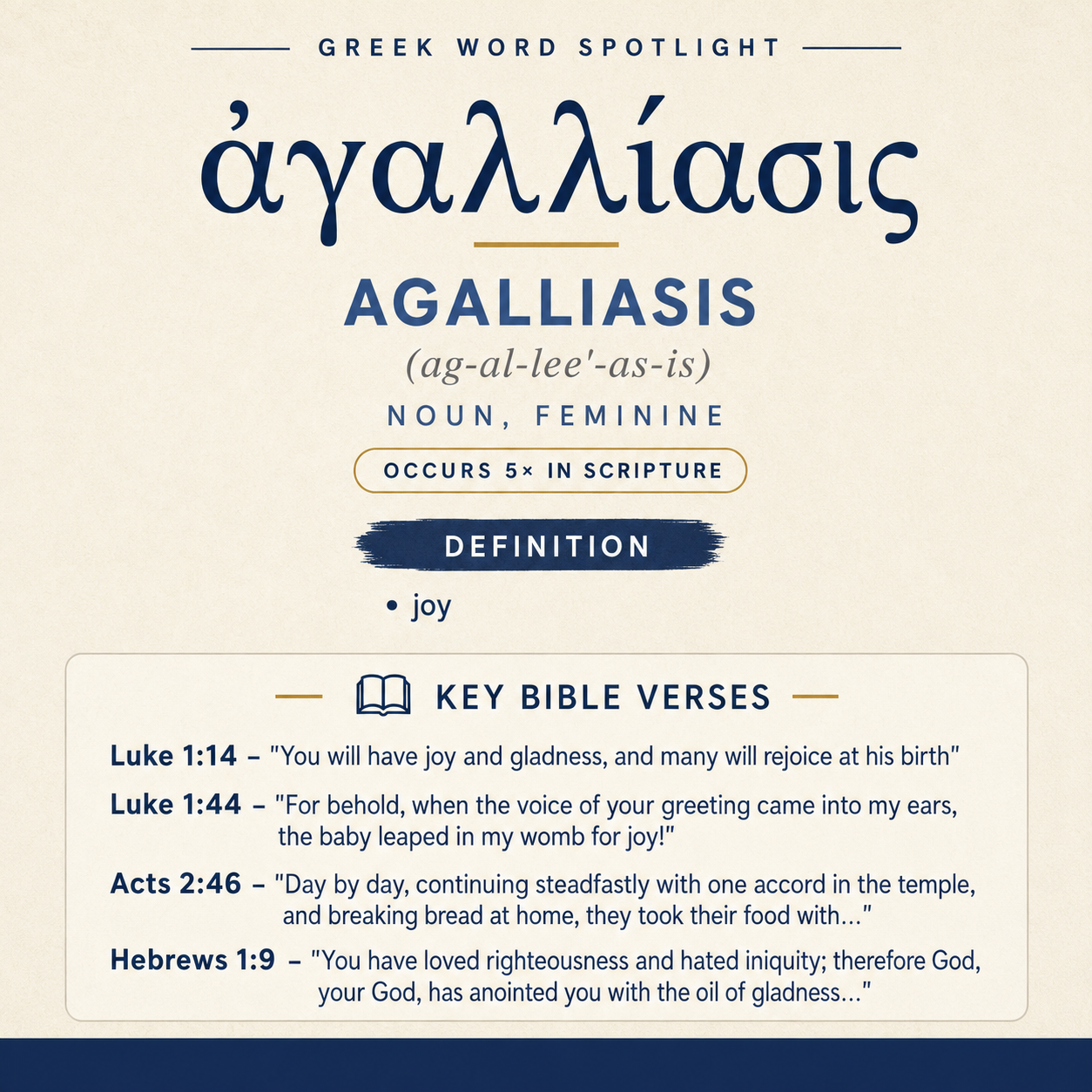
ἀγαλλίασις means “joy” and occurs five times in Scripture: Luke 1:14, Luke 1:44, Acts 2:46, Hebrews 1:9, and Jude 1:24.
Where It Appears
It occurs five times in Scripture: Luke 1:14; Luke 1:44; Acts 2:46; Hebrews 1:9; Jude 1:24.
Learn More →Verse Snapshots
In Luke 1:44 it describes the baby leaping in the womb “for joy.” In Hebrews 1:9 it appears in the phrase “oil of gladness.”
Learn More →ἀγαλλίασις expresses “joy” as it appears in five New Testament settings: two in Luke’s opening chapter, one in the shared life of the early believers in Acts, one in a quotation about the anointed one in Hebrews, and one in Jude’s doxology. Across these contexts, the word marks joy as something felt, expressed, and even presented before God.
Root and Related Words
ἀγαλλίασις (Agalliasis) is related to ἀγαλλιάω (agalliao), “to rejoice” (Strong’s G21). The noun names the joy that corresponds to that rejoicing.

Occurrences
“You will have joy and gladness, and many will rejoice at his birth.” (Luke 1:14)
Here ἀγαλλίασις stands at the head of a cluster of celebratory responses surrounding a birth. The sentence distinguishes personal experience (“You will have joy and gladness”) from the wider, outward reaction it will generate (“many will rejoice at his birth”). The word therefore contributes to a picture in which joy is not merely private emotion but part of a larger social response—something that can be possessed by one person and yet spill over into communal rejoicing.

“For behold, when the voice of your greeting came into my ears, the baby leaped in my womb for joy!” (Luke 1:44)
In this scene joy is tied to an immediate, bodily reaction. The reason given is sensory and specific: “when the voice of your greeting came into my ears.” ἀγαλλίασις names the joy associated with the baby’s movement (“leaped in my womb for joy”), so the word frames joy as an impetus for visible action rather than an invisible state alone. The verse places joy in a moment of recognition triggered by a greeting, making the emotion responsive and occasioned rather than abstract.
“Day by day, continuing steadfastly with one accord in the temple, and breaking bread at home, they took their food with gladness and singleness of heart,” (Acts 2:46)
Although the wording here speaks of “gladness,” the setting illuminates how ἀγαλλίασις functions when it is connected to ordinary patterns of life. The believers’ shared practices are emphasized: “Day by day,” “one accord in the temple,” “breaking bread at home.” Joy belongs inside these rhythms, accompanying meals (“they took their food”) and describing the tone of their fellowship. The verse also pairs this affective quality with an inner disposition (“singleness of heart”), so the joy is portrayed as compatible with steadiness, unity, and simplicity rather than as a passing spike of feeling.
“You have loved righteousness and hated iniquity; therefore God, your God, has anointed you with the oil of gladness above your fellows.” (Hebrews 1:9)
In Hebrews, joy is presented through a concrete image: “the oil of gladness.” The verse sets the joy in a moral and relational frame—“You have loved righteousness and hated iniquity; therefore…”—and then connects it to divine action: “God, your God, has anointed you.” ἀγαλλίασις, expressed here as gladness, is not only an emotion but something pictured as poured out in an anointing, marking a distinction “above your fellows.” The word thus contributes to a portrayal of joy as bestowed, abundant, and associated with honor, without separating that joy from the evaluative language of loving and hating that precedes it.
“Now to him who is able to keep them from stumbling, and to present you faultless before the presence of his glory in great joy,” (Jude 1:24)
Jude places ἀγαλλίασις at the climax of a sentence that focuses on divine ability and preservation. Joy belongs to an eschatological presentation scene: being “present[ed]… faultless before the presence of his glory.” The phrase “in great joy” makes the joy the atmosphere of that encounter, not merely a reaction afterward. The word therefore contributes to the sense that joy is fitting to God’s saving action—paired with being kept from stumbling and with standing in God’s presence—so that joy becomes part of the goal and outcome of faithful keeping.
Sense and Usage
Across these passages, ἀγαλλίασις functions as “joy” with varied textures depending on context. In Luke 1:14 it is anticipatory and expansive: joy is promised, and its impact reaches “many.” In Luke 1:44 it is immediate and embodied: joy is linked to hearing a greeting and to a leap in the womb. Acts 2:46 places joy inside sustained communal practice; it accompanies daily worship and meals, pairing emotional gladness with a unified and undivided inward posture. Hebrews 1:9 portrays joy with ceremonial imagery: it is like oil used in anointing, presented as something granted and distinguishing. Jude 1:24 situates joy in the setting of divine presence and vindication: joy surrounds the act of being presented “faultless,” framed by God’s power to keep.
What emerges is a consistent core—joy as a real and positive human experience—yet the word’s narrative function shifts. Sometimes it is personal and promised, sometimes it is the cause or description of movement, sometimes it is the tone of shared life, sometimes it is pictured as a gift poured out, and sometimes it is the fitting environment of final standing before glory. These uses show joy operating at multiple levels: individual emotion (“You will have joy”), bodily expression (“leaped… for joy”), communal practice (“they took their food with gladness”), bestowed honor (“anointed you with the oil of gladness”), and worshipful anticipation of being in God’s presence (“before the presence of his glory in great joy”).
Imagery in Context
The passages attach joy to tangible scenes and images rather than leaving it as a mere concept. Joy gathers around a birth that prompts rejoicing (Luke 1:14), registers in a physical leap prompted by a heard greeting (Luke 1:44), sits at the table in ordinary homes as believers “break” bread and eat together (Acts 2:46), flows like oil in an anointing that marks someone out “above” others (Hebrews 1:9), and fills the moment of being presented “faultless” before divine glory (Jude 1:24). In these settings ἀγαλλίασις is consistently portrayed as fitting, responsive, and expressive—joy that belongs to God’s acts and to the community’s life, and that can be spoken of as both felt and seen.
Sources: Lexical data from Strong’s Exhaustive Concordance and the Translators Brief Lexicon of Extended Strongs for Greek (STEPBible, CC BY). Occurrence data from the Translators Amalgamated Greek New Testament (STEPBible, CC BY). Scripture quotations from the World English Bible (public domain).