
Exploring the Meaning of Opheleia in Greek
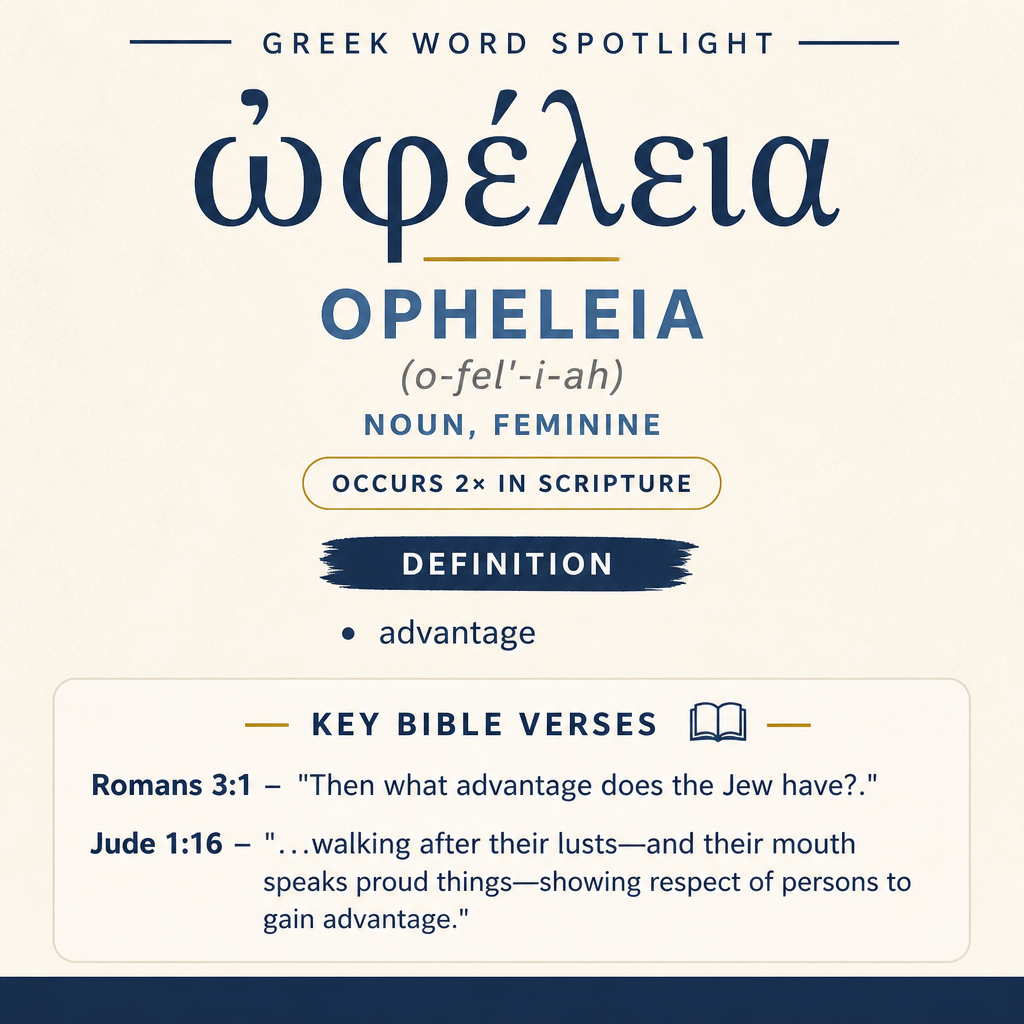
ὠφέλεια (Opheleia) means “advantage” and appears twice in Scripture: Romans 3:1 and Jude 1:16.
Context Snapshot
Romans 3:1 uses it in a question about the Jew’s advantage. Jude 1:16 includes it within a description of people showing respect.
Learn More →ὠφέλεια refers to “advantage,” the kind of gain that can be asked about, weighed, or sought. It appears in a rhetorical question in Romans and in a character sketch in Jude, where it marks what someone hopes to obtain.
Root and Related Words
ὠφέλεια (Opheleia) is derived from ὠφέλιμος (ophelimos), “valuable” (Strong’s G5624). The relationship points to a conceptual link between what has value and what is pursued as a gain.

Occurrences
“Then what advantage does the Jew have? Or what is the profit of circumcision?” (Romans 3:1)
In Romans 3:1, ὠφέλεια stands in the opening question: “what advantage does the Jew have?” The immediate parallel question—“Or what is the profit of circumcision?”—places “advantage” alongside “profit” as two ways of asking about benefit. The word works here as a measuring term: it invites a reckoning of whether something confers a real gain. Because the question is framed as “what advantage,” ὠφέλεια is not merely an abstract label; it functions as the object of inquiry, the expected outcome that the speaker anticipates someone might claim or defend. The verse’s structure makes the advantage something that can be compared and evaluated, put into words, and then argued about.

At the same time, the question form leaves the “advantage” open for explanation: it signals that the discussion is not about a vague positive feeling but about a definable benefit that can be articulated. In the flow of the verse itself, “advantage” is set at the intersection of identity (“the Jew”) and practice (“circumcision”), so the term is used to ask whether those realities yield gain.
“These are murmurers and complainers, walking after their lusts—and their mouth speaks proud things—showing respect of persons to gain advantage.” (Jude 1:16)
In Jude 1:16, ὠφέλεια is the explicit goal of a certain kind of speech and social behavior. The verse strings together a portrayal of conduct—“murmurers and complainers,” “walking after their lusts,” and a mouth that “speaks proud things”—and then adds a calculated posture: “showing respect of persons to gain advantage.” Here “advantage” is not posed as a question to be answered but as a motive that explains manipulation. The phrase “to gain advantage” makes ὠφέλεια the payoff at the end of a chain of actions, the intended reward for flattering or favoring people on the basis of who they are.
The wording “showing respect of persons” depicts selective regard, and ὠφέλεια names what that selective regard is trying to secure. In this scene, “advantage” is portrayed as something obtainable through relational maneuvering: the advantage is sought, not received freely, and the pursuit of it shapes how these people speak (“proud things”) and how they treat others (“respect of persons”). The term therefore carries a tangible, transactional feel within the sentence: an advantage is something one can “gain,” the way one gains a benefit from a situation or a person.
Sense and Usage
Across these two occurrences, ὠφέλεια functions as a concrete idea of benefit that can be discussed as an outcome. In Romans 3:1, it is placed on the table for evaluation: the speaker asks whether a particular identity and practice yield an “advantage,” and the paired question about “profit” underscores that this advantage is conceived in terms of gain. The verse’s phrasing treats advantage as something a listener might presume exists, so the word helps frame the debate in terms of measurable benefit rather than mere sentiment.
In Jude 1:16, the same “advantage” is not the topic of legitimate inquiry but the aim of self-serving behavior. The description makes advantage an end that governs means: murmuring, complaining, desire-driven walking, and proud speech culminate in strategic partiality, all in order “to gain advantage.” The word thus belongs to the realm of motive and method—why someone flatters, why they angle for favor, why their speech is shaped to impress or sway.
Read together, the two passages show how “advantage” can be placed in a public, disputable question (Romans) or in a private calculus of self-interest (Jude). In both, ὠφέλεια is conceived as something real enough to be pursued or defended. The term’s proximity to “profit” in Romans and to the verb “gain” in Jude highlights its practical orientation: an advantage is a benefit that counts in someone’s reasoning, whether in theological argumentation or in social manipulation.
Imagery
Though ὠφέλεια is abstract, both verses give it the feel of an item to be obtained. Romans 3:1 pictures advantage as something that can be weighed in the balance of argument—asked about openly and compared with “profit.” Jude 1:16 pictures advantage as a prize at the end of calculated speech: respect is shown selectively “to gain advantage,” as though advantage were the hidden object behind the outward posture.
Sources: Lexical data from Strong’s Exhaustive Concordance and the Translators Brief Lexicon of Extended Strongs for Greek (STEPBible, CC BY). Occurrence data from the Translators Amalgamated Greek New Testament (STEPBible, CC BY). Scripture quotations from the World English Bible (public domain).




