Exploring the Meaning of Phortion in Greek
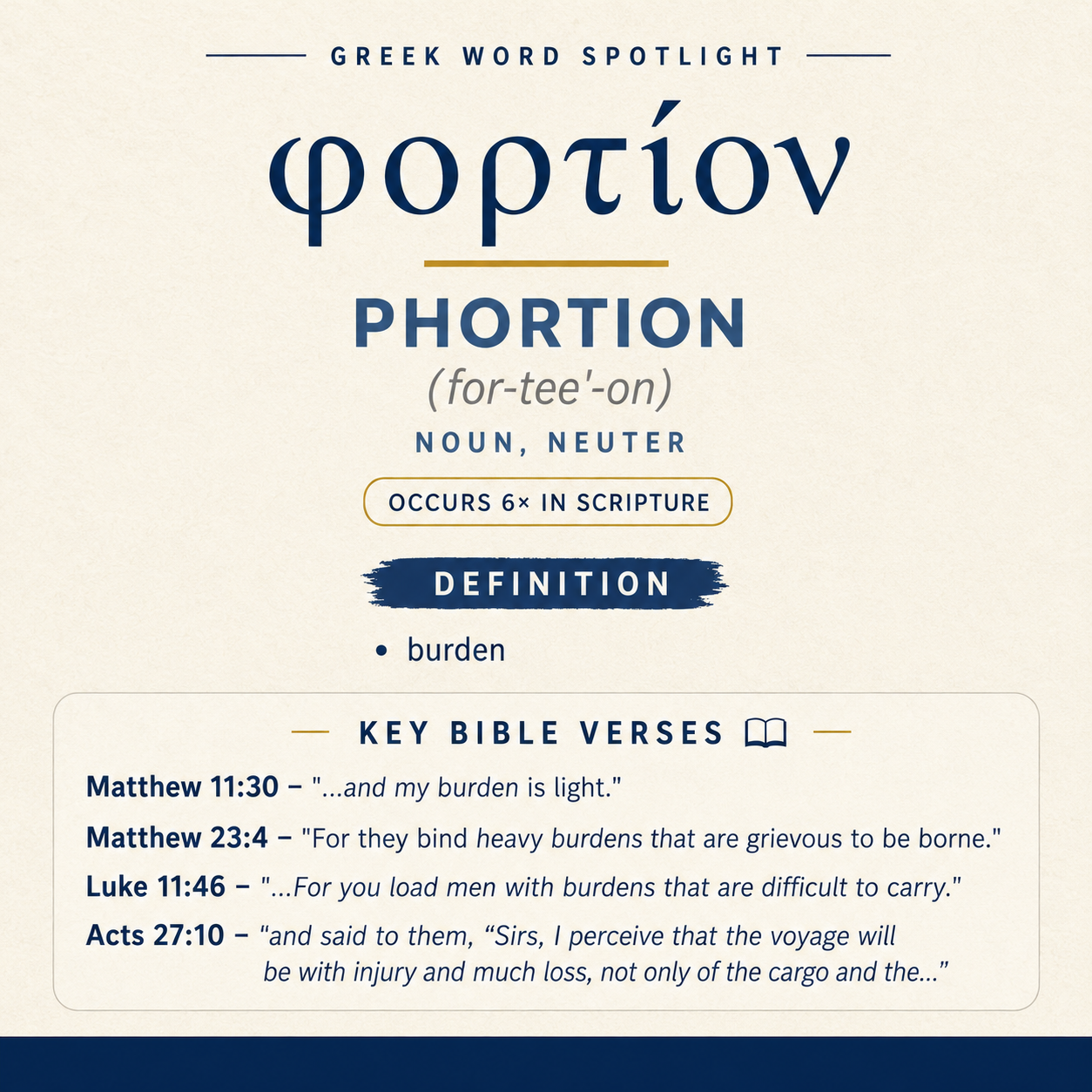
φορτίον means “burden” and occurs six times in Scripture, including Matthew 11:30; Matthew 23:4; Luke 11:46; Acts 27:10; and Galatians 6:5.
Gospel Usage
In Matthew 11:30, Jesus calls His burden light. In Matthew 23:4 and Luke 11:46 it describes heavy burdens laid on others.
Learn More →Other Contexts
Acts 27:10 uses φορτίον for cargo in a voyage. Galatians 6:5 states each person will bear his own burden.
Learn More →φορτίον speaks of a “burden,” a load conceived as something borne or carried. In the passages where it appears, it is used both for the weight of obligations placed on people and for literal freight carried on a ship.
Occurrences
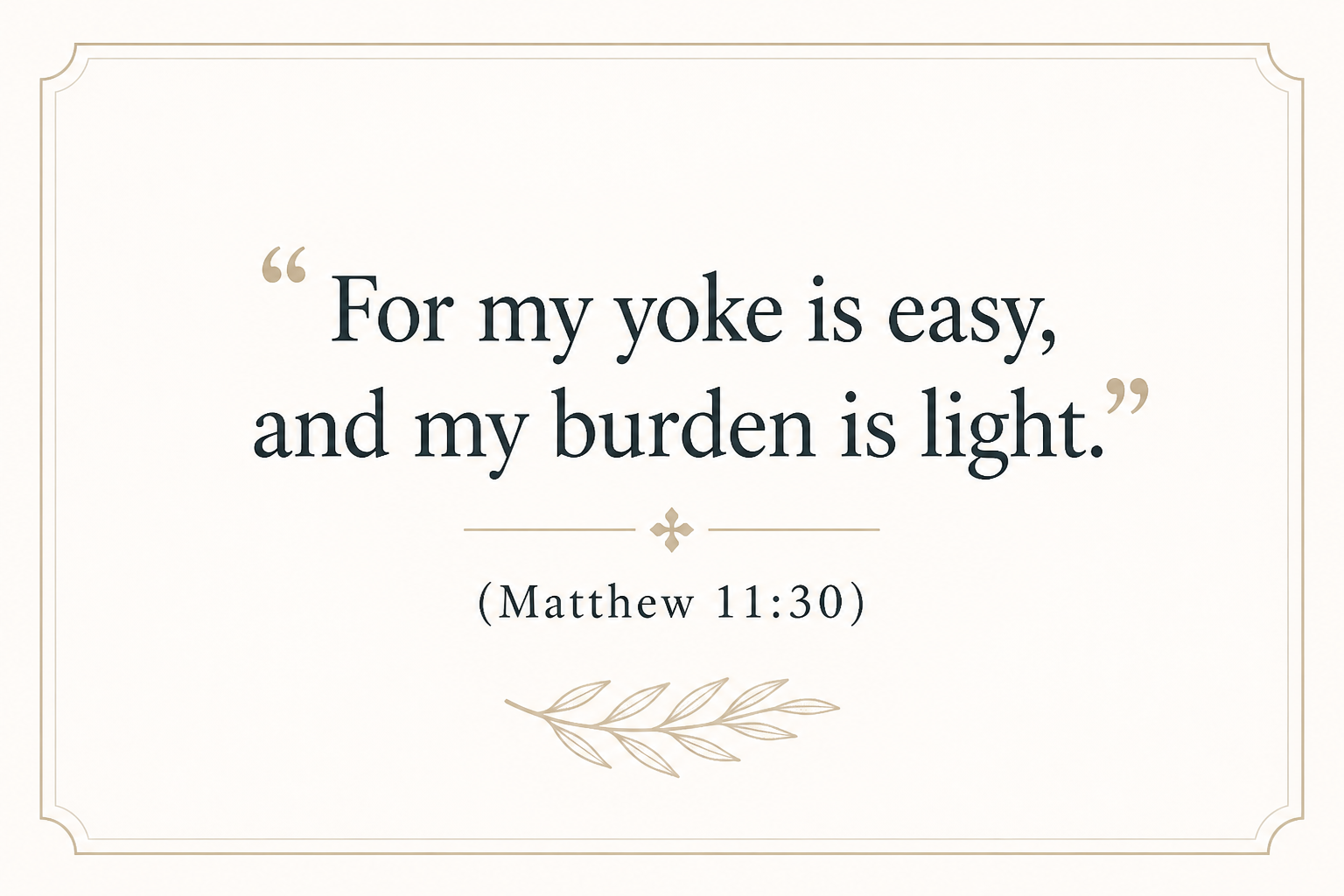
“For my yoke is easy, and my burden is light.” (Matthew 11:30)
Here φορτίον is paired with “yoke,” and the burden is described as “light.” The word contributes the image of something real enough to be weighed, yet in this context characterized by its comparative ease. The point of the sentence rests on the contrast: a yoke that is “easy” corresponds to a burden that is “light,” so φορτίον supplies the concrete metaphor of a carried load to express the experienced weight of what is being taken up.
“For they bind heavy burdens that are grievous to be borne, and lay them on men’s shoulders; but they themselves will not lift a finger to help them.” (Matthew 23:4)
In this setting φορτίον appears in the plural: “heavy burdens.” The verse describes these burdens as “grievous to be borne” and depicts them being placed directly “on men’s shoulders.” The word thus functions as a vivid load-image: the burden is not merely an abstract demand but something bound together, laid on, and carried. The second half of the verse sharpens the effect by contrasting the laying-on of burdens with the refusal to “lift a finger to help,” so φορτίον stands at the center of an indictment of imposing weight without assistance.
“He said, “Woe to you lawyers also! For you load men with burdens that are difficult to carry, and you yourselves won’t even lift one finger to help carry those burdens.” (Luke 11:46)
This occurrence is closely aligned with the previous one, but with its own phrasing. The action is “you load men,” and the burdens are explicitly “difficult to carry.” The repetition of “lift one finger” again frames the scene as one where burdens are put upon others while help is withheld. φορτίον here underscores the felt strain of the load: the burden is something that requires carrying, and the sentence focuses on the unfairness of increasing that load while refusing even minimal assistance in bearing it.
“and said to them, “Sirs, I perceive that the voyage will be with injury and much loss, not only of the cargo and the ship, but also of our lives.” (Acts 27:10)
In Acts, φορτίον is rendered “cargo,” placing the word in a plainly physical setting: a sea voyage in which the ship’s freight is at risk. The verse speaks of “injury and much loss,” and the threatened losses are layered: “not only of the cargo and the ship, but also of our lives.” Here φορτίον contributes a concrete object of jeopardy, the kind of load a ship carries and could lose. Within the sentence’s structure, “the cargo” is listed as one of the tangible stakes of the voyage, showing that φορτίον can name a burden in the sense of transportable load, not only the burdens laid on people.
“For each man will bear his own burden.” (Galatians 6:5)
In Galatians, φορτίον is singular and individualized: “his own burden.” The verb “bear” makes the carrying sense explicit, and the emphasis falls on personal responsibility—each person has a burden that he bears. The brevity of the line gives the word its force: φορτίον is the item borne, and it is framed as belonging to the person who carries it. Unlike the burdens in Matthew 23:4 and Luke 11:46, which are loaded onto others, this burden is described as one’s own and is borne accordingly.

Sense and Usage
Across these passages, φορτίον consistently evokes the idea of a load that can be placed on a bearer and carried, whether the bearer is a person or a vessel. The word’s imagery is physical—shoulders, carrying, lifting a finger, cargo at sea—and that physicality is used to speak about how burdens are experienced: heavy or light, difficult or manageable, imposed by others or borne as one’s own.
Two distinct situations help define its usage. First, the word is used for burdens that people place on other people. In Matthew 23:4 and Luke 11:46, the burdens are “heavy” and “difficult to carry,” and their defining feature is the moral posture of those who impose them: they “bind” burdens and “load” men, yet refuse even the smallest help. φορτίον, by picturing obligations as a weight on the shoulders, highlights how demands can become oppressive when compounded and when those who require them detach themselves from the act of carrying.
Second, the word can denote a load in transit, as in Acts 27:10. There, φορτίον is “cargo,” not a demand but a freighted weight tied to economic loss and to the fate of the voyage. The cargo belongs to the ship’s business and journey; it is something whose loss can be counted alongside the loss of the ship itself and even lives. This usage keeps the core idea of a borne load but locates it in the domain of transport rather than interpersonal imposition.
Matthew 11:30 and Galatians 6:5 frame the notion of burden from different angles. Matthew 11:30 assigns a qualitative description: the burden is “light,” set parallel to a yoke that is “easy.” The sentence depends on the reader’s sense that burdens can vary by weight; φορτίον supplies the measurable load-image that makes “light” meaningful. Galatians 6:5, by contrast, focuses not on weight but on ownership and responsibility: “each man” bears “his own burden.” Here φορτίον is individualized, and the line presents burden-bearing as an expected human act, an obligation that belongs to the person who carries it.
Read together, the occurrences show φορτίον operating along several axes within the single definition of “burden.” It may be evaluated (light; heavy; difficult to carry), assigned (laid on shoulders; loaded on men), refused (no finger lifted to help), endangered (cargo at risk of loss), and owned (his own burden). Each axis uses the same core picture: a burden is something that can be carried—and precisely because it can be carried, it can also be made heavier, shared, or left to crush someone alone.
Imagery in Context
The passages repeatedly rely on tactile details to make φορτίον felt rather than merely named. Men’s “shoulders” in Matthew 23:4, the physical act of “carry” in Luke 11:46, and the maritime risk to “the cargo and the ship” in Acts 27:10 place the word in scenes where burden is visible and weighty. Against that, Matthew 11:30 offers a contrasting picture of a burden that remains a burden yet is described as “light,” while Galatians 6:5 narrows the image to the solitary act of bearing what is “his own.” Together these scenes keep the word grounded in the concrete world of loads and carrying, using that shared picture to speak about how burdens are assigned, endured, and assessed.
Sources: Lexical data from Strong’s Exhaustive Concordance and the Translators Brief Lexicon of Extended Strongs for Greek (STEPBible, CC BY). Occurrence data from the Translators Amalgamated Greek New Testament (STEPBible, CC BY). Scripture quotations from the World English Bible (public domain).