
Exploring the Meaning of Hupophero in Greek
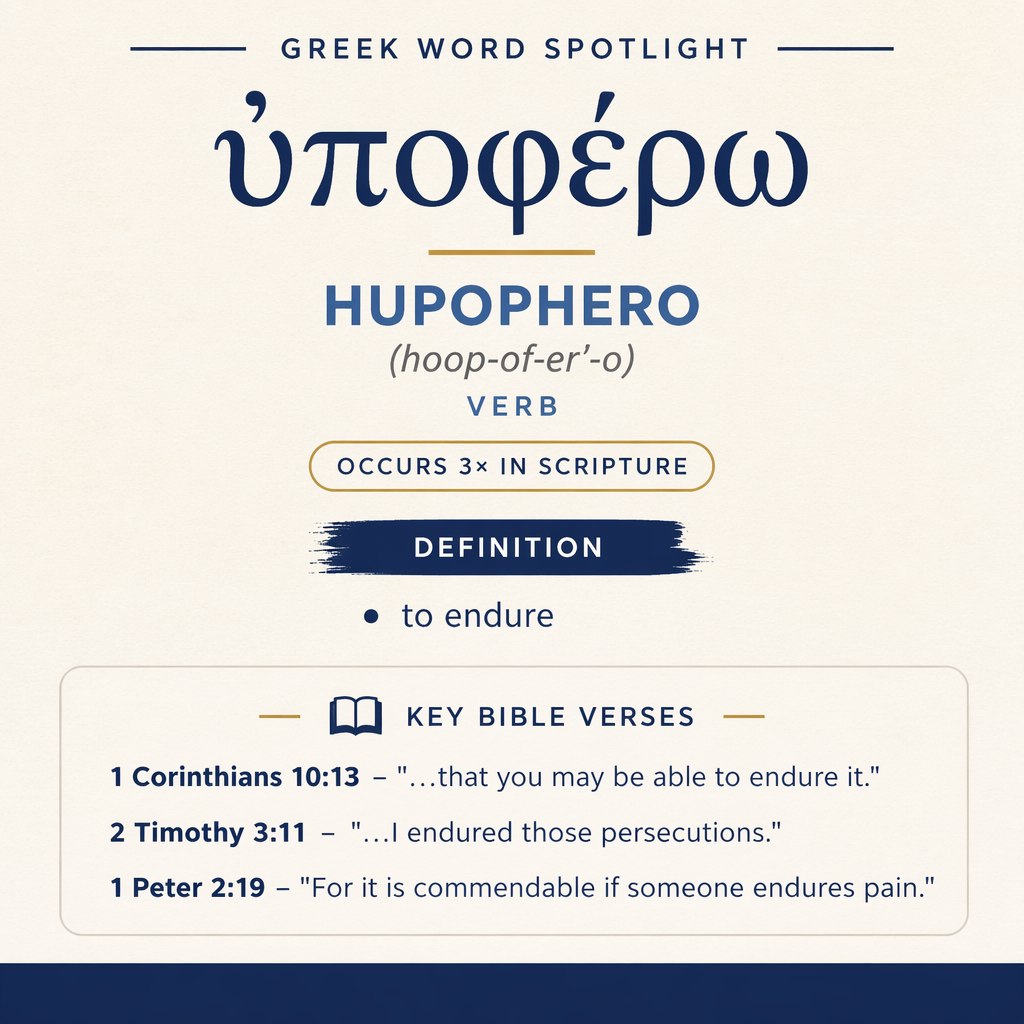
ὑποφέρω means “to endure” and occurs three times in Scripture: 1 Corinthians 10:13, 2 Timothy 3:11, and 1 Peter 2:19.
Core Meaning
ὑποφέρω is defined as “to endure.” In its New Testament uses, it describes enduring under pressure or suffering.
Learn More →Scripture Occurrences
This verb appears 3 times in Scripture. The references are 1 Corinthians 10:13, 2 Timothy 3:11, and 1 Peter 2:19.
Learn More →Context Snapshots
In 2 Timothy 3:11 it describes enduring persecutions and sufferings. In 1 Peter 2:19 it refers to enduring pain while suffering unjustly.
Learn More →ὑποφέρω means “to endure,” and it appears in three New Testament settings that speak of temptation, persecution, and unjust suffering. In each, the word marks the capacity to remain under a difficult pressure without yielding to it.
Root and Related Words
ὑποφέρω (Hupophero) is formed from ὑπό (hypo), “by/under” (Strong’s G5259), and φέρω (phero), “to bear/lead” (Strong’s G5342). The combined shape of the word fits the scenes where endurance is described as bearing a weight that comes “under” a person’s experience—temptation, pain, and persecution.

Occurrences
“No temptation has taken you except what is common to man. God is faithful, who will not allow you to be tempted above what you are able, but will with the temptation also make the way of escape, that you may be able to endure it.” (1 Corinthians 10:13)
Here ὑποφέρω stands at the end of a tightly reasoned assurance about the limits of temptation. The verse places temptation within a shared human category (“common to man”) and then frames God’s faithfulness in two coordinated actions: not permitting temptation to exceed ability, and providing “the way of escape” alongside the temptation itself. Within that structure, “to endure” names the intended outcome—an ability exercised inside the trial rather than outside it. Endurance is not pictured as ignoring temptation or never encountering it; the scene assumes temptation comes and must be borne. The “way of escape” is paired with endurance, so that endurance is portrayed as possible and purposeful under a divinely bounded load.
“persecutions, and sufferings: those things that happened to me at Antioch, Iconium, and Lystra. I endured those persecutions. The Lord delivered me out of them all.” (2 Timothy 3:11)
In this sentence ὑποφέρω is used in a first-person recollection: “I endured those persecutions.” The word attaches directly to “persecutions, and sufferings” and to the concrete list of places where those experiences occurred. Endurance here is retrospective and specific—something done through particular episodes rather than a general temperament. The clause that follows, “The Lord delivered me out of them all,” sets endurance alongside deliverance: endurance describes what happened in the midst of persecutions, while deliverance describes the outcome in relation to them. The pairing does not blur the reality of persecution; it highlights that endurance can coexist with severe events and with eventual rescue.
“For it is commendable if someone endures pain, suffering unjustly, because of conscience toward God.” (1 Peter 2:19)
In this occurrence ὑποφέρω is tied to “pain” and to “suffering unjustly,” and it is evaluated morally: “it is commendable” when such endurance is practiced “because of conscience toward God.” The verse locates endurance within a situation where the suffering is not deserved; the focus is not on proving strength but on the inner reason that guides the response. The word therefore carries the sense of remaining steady under painful pressure while one’s conscience is oriented toward God. Endurance is framed as a chosen stance in an unjust circumstance, and the commendation falls not on the injustice itself but on the act of enduring it for a God-ward reason.
Sense and Usage
Across these passages, “to endure” functions as the verb of staying power under strain, but the strain takes distinct forms. In 1 Corinthians 10:13 the pressure is temptation—an inward and situational test described as “common to man,” yet bounded by God’s faithfulness; endurance is presented as a capacity made viable by God’s limiting of the trial and provision of “the way of escape.” In 2 Timothy 3:11 the pressure is persecution and suffering tied to identifiable events; endurance is narrated as the speaker’s response across multiple episodes, and it stands beside God’s later deliverance without being reduced to it. In 1 Peter 2:19 the pressure is pain that comes from unjust treatment; endurance is explicitly linked to conscience toward God and is called “commendable,” emphasizing that endurance can be an ethically meaningful response within an unequal and wrongful situation.
These uses together show endurance as something exercised under real constraints: temptation that presses but does not exceed what a person “is able,” persecutions that happen in the public course of ministry life, and unjust pain that tests the integrity of conscience. The word’s contribution is to name the sustained bearing of such experiences. It can be forward-looking (so that one “may be able to endure it”), backward-looking (“I endured those persecutions”), and evaluative in the present (“it is commendable if someone endures pain”). Yet in each case, the verb remains attached to a concrete burden and highlights the persistence that holds steady while that burden remains in force.
Imagery
The three scenes share a common picture of pressure resting on a person: temptation that arrives and must be carried until it passes, persecutions that strike in successive places and must be borne through, and unjust pain that weighs on the body and conscience. In these verses, endurance is not treated as a vague ideal but as the action of continuing under what is heavy—supported by God’s faithfulness, accompanied by God’s deliverance, and marked by a conscience oriented toward God.
Sources: Lexical data from Strong’s Exhaustive Concordance and the Translators Brief Lexicon of Extended Strongs for Greek (STEPBible, CC BY). Occurrence data from the Translators Amalgamated Greek New Testament (STEPBible, CC BY). Scripture quotations from the World English Bible (public domain).





