
Exploring the Meaning of Hupotasso in Greek
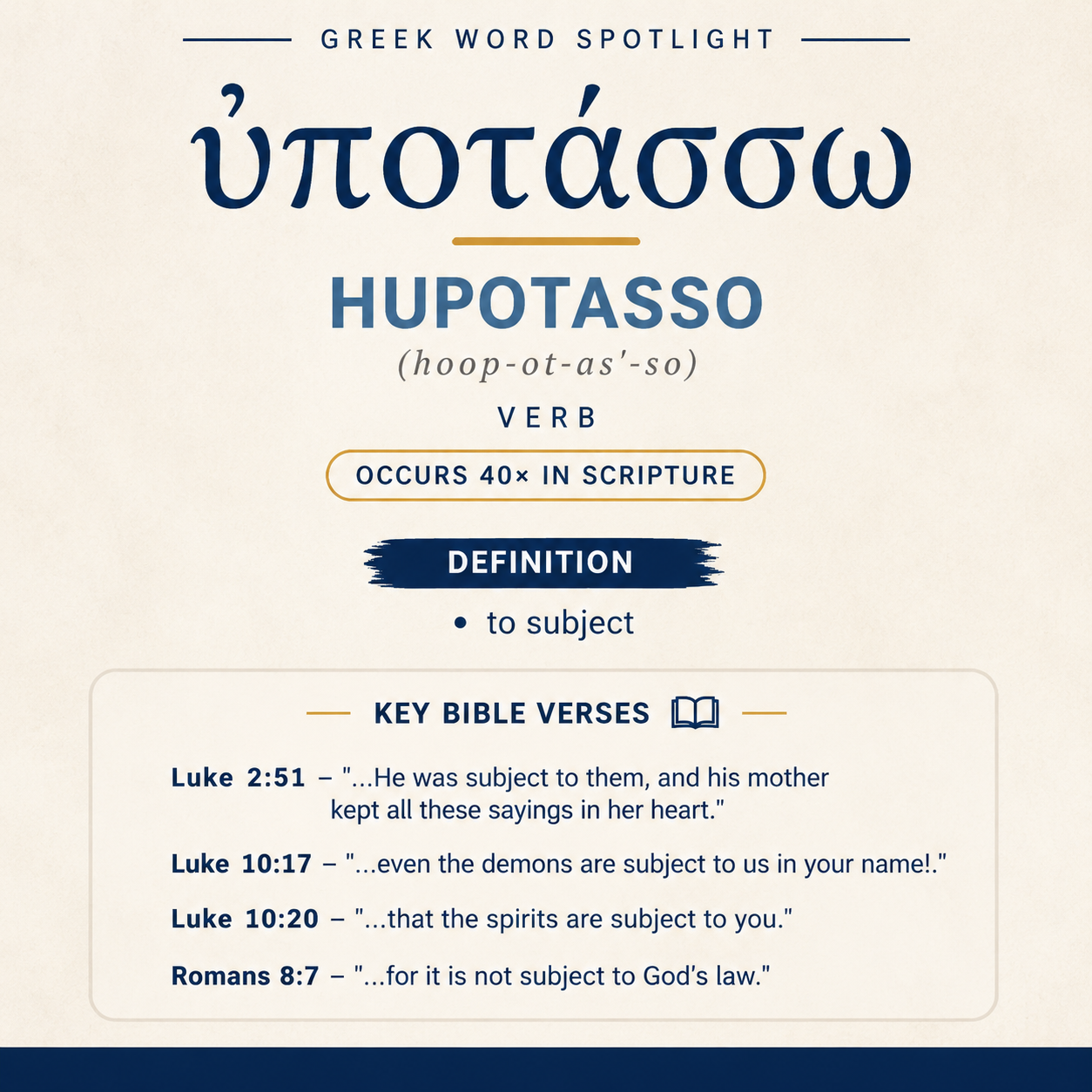
ὑποτάσσω means “to subject” and appears 40 times in Scripture, including Luke 2:51; Luke 10:17, 20; and Romans 8, 10, 13.
Core Meaning
ὑποτάσσω is defined as “to subject.” In Luke 2:51, Jesus “was subject” to his parents.
Learn More →Luke Occurrences
In Luke 10:17 and 10:20, the seventy report that demons and spirits “are subject” in Jesus’ name. These verses highlight subjection in spiritual conflict.
Learn More →Romans Occurrences
Romans uses ὑποτάσσω for subjection to God’s law (Romans 8:7), for creation being subjected (Romans 8:20), and for subjection to authorities (Romans 13:1, 13:5). Romans 10:3 describes people who “didn’t subject themselves” to God’s righteousness.
Learn More →ὑποτάσσω expresses the action of making someone or something subject. In the cited passages it describes relationships of ordered subjection within family life, spiritual conflict, inner posture toward God’s righteousness and law, civic life, congregational order, and the final placing of “all things” under rightful rule.
Occurrences
“And he went down with them, and came to Nazareth. He was subject to them, and his mother kept all these sayings in her heart.” (Luke 2:51)
Here ὑποτάσσω frames Jesus’ life at Nazareth in terms of being “subject to” his parents. The verb highlights a real, lived ordering of relations in the household: he “went down with them” and his posture toward them is characterized as subjection. The narrative pairs that outward arrangement with Mary’s inward response—she “kept all these sayings in her heart”—so that subjection is set within a scene of remembered words and attentive reflection rather than mere external compliance.

“The seventy returned with joy, saying, “Lord, even the demons are subject to us in your name!”” (Luke 10:17)
In this report ὑποτάσσω is used for the demons’ being “subject” to the disciples. The astonishment lies in the reversal of expected power: hostile spiritual forces are placed in a position of subjection, and the disciples explicitly connect that subjection to acting “in your name.” The verb contributes the idea of an enforced ordering—demons do not merely withdraw; they stand as subjects under a superior authority invoked by the disciples.
“Nevertheless, don’t rejoice in this, that the spirits are subject to you, but rejoice that your names are written in heaven.” (Luke 10:20)
Jesus repeats the same reality (“the spirits are subject to you”) but reorients what that reality should mean to them. ὑποτάσσω marks a genuine victory—spirits placed under their authority—yet the command “don’t rejoice in this” treats that subjection as an inadequate foundation for joy. The contrast with “your names are written in heaven” puts the experience of subjection in a larger frame: subjection can be a true outcome without being the central ground of identity or celebration.
“because the mind of the flesh is hostile toward God; for it is not subject to God’s law, neither indeed can it be.” (Romans 8:7)
In Romans 8:7 ὑποτάσσω describes the mind’s relation to “God’s law.” The mind of the flesh is defined not only by hostility but by a refusal of subjection: it “is not subject,” and this is reinforced with “neither indeed can it be.” The verb here carries the idea of an ordered stance toward a governing standard. “God’s law” stands as the rightful ordering principle, and the “mind of the flesh” is characterized by its incapacity to be placed under that ordering.
“For the creation was subjected to vanity, not of its own will, but because of him who subjected it, in hope” (Romans 8:20)
This occurrence uses ὑποτάσσω for the condition of “creation” being “subjected to vanity.” The verb is applied to the whole created order, portraying it as placed under a state described as “vanity.” The sentence carefully specifies agency and intent: creation did not enter this subjection “of its own will”; rather, the subjection came “because of him who subjected it.” Yet the subjection is not narrated as sheer futility, since it is explicitly bounded by “in hope,” holding together imposed subjection and a forward-looking purpose.
“For being ignorant of God’s righteousness, and seeking to establish their own righteousness, they didn’t subject themselves to the righteousness of God.” (Romans 10:3)
Here ὑποτάσσω describes an active, personal refusal: “they didn’t subject themselves to the righteousness of God.” The verse sets this refusal alongside two explanatory clauses—ignorance of God’s righteousness and a competing project of establishing “their own righteousness.” The verb therefore contributes more than a static condition; it depicts a deliberate posture in which persons decline to place themselves under God’s righteousness as the ordering standard for their standing and behavior.
“Let every soul be in subjection to the higher authorities, for there is no authority except from God, and those who exist are ordained by God.” (Romans 13:1)
In Romans 13:1 ὑποτάσσω governs civic relations: “every soul” is exhorted to be “in subjection to the higher authorities.” The verb marks an arrangement in which individuals are positioned as subjects relative to governing powers. The verse grounds that call in a theological rationale: authority as such is not treated as self-originating (“no authority except from God”), and existing authorities are described as “ordained by God.” Subjection here is presented as a fitting response within that ordered framework.
“Therefore you need to be in subjection, not only because of the wrath, but also for conscience’ sake.” (Romans 13:5)
This verse returns to the same civic theme and specifies motives. ὑποτάσσω is expressed as a necessity—“you need to be in subjection”—and the verb is placed between two kinds of reasons. One is external consequence (“because of the wrath”); the other is internal moral awareness (“for conscience’ sake”). Subjection thus includes an inward dimension: it is not only an avoidance of penalty but a chosen alignment that conscience can endorse.
“The spirits of the prophets are subject to the prophets,” (1 Corinthians 14:32)
In the context of congregational speech and prophecy, ὑποτάσσω describes control within spiritual expression: “the spirits of the prophets are subject to the prophets.” The verb asserts an ordering in which the prophet is not overrun by ecstatic impulse; rather, the prophet stands in a governing relation to what is happening in and through him. Subjection here functions to support orderly, responsible participation: the spiritual aspect of prophecy is not independent but placed under the prophet’s own direction.
“Let the wives be quiet in the assemblies, for it has not been permitted for them to be talking except in submission, as the law also says,” (1 Corinthians 14:34)
Here ὑποτάσσω appears in a directive about conduct “in the assemblies.” The instruction combines two elements: restraint in speech (“be quiet… not been permitted… to be talking”) and a contrasting permitted posture (“except in submission”). The verb contributes the idea that participation is to occur under an ordered relation rather than in self-assertive speech. The phrase “as the law also says” adds an appeal to an acknowledged norm, presenting subjection as consistent with an established ordering principle.
“For, “He put all things in subjection under his feet.” But when he says, “All things are put in subjection”, it is evident that he is excepted who subjected all things to him.” (1 Corinthians 15:27)
In this argument about “all things” being placed under rule, ὑποτάσσω is used repeatedly to mark universal subjection: “He put all things in subjection under his feet… All things are put in subjection.” The imagery of being “under his feet” portrays comprehensive dominance and ordered hierarchy. Yet the verse also introduces a careful exception: the one “who subjected all things to him” is “excepted” from the category of “all things” being subjected. The verb thus serves a precise logical function: it describes the scope of subjection while allowing for a necessary distinction between the subjecting agent and the subjected totality.
“When all things have been subjected to him, then the Son will also himself be subjected to him who subjected all things to him, that God may be all in all.” (1 Corinthians 15:28)
This verse extends the same framework to its culminating order. ὑποτάσσω describes both the comprehensive outcome (“all things have been subjected to him”) and a further relational subjection: “the Son will also himself be subjected to him who subjected all things to him.” The verb here articulates a final arrangement of relations in which subjection is not merely imposed on hostile powers but also expresses rightful order within the climax of God’s purpose—stated in the closing clause, “that God may be all in all.”

Sense and Usage
Across these passages ὑποτάσσω consistently marks a structured relationship in which one party is placed under another’s authority or ordering standard. In narrative settings (Luke 2:51; Luke 10:17, 20) it describes both ordinary human hierarchy (“He was subject to them”) and extraordinary spiritual hierarchy (“the demons… the spirits are subject to you in your name”), showing that the verb can characterize domestic life and contested spiritual space alike. In Paul’s argumentation it functions in two broad domains: the inner-moral domain (Romans 8:7; 10:3) and the public-social domain (Romans 13:1, 5). There the word captures a person’s stance toward a governing norm—God’s law, God’s righteousness, governing authorities—and it can name either inability/ refusal (“it is not subject… neither indeed can it be”; “they didn’t subject themselves”) or an urged, chosen posture (“be in subjection… for conscience’ sake”).
In Romans 8:20 and 1 Corinthians 15:27–28 the verb scales up from individual behavior to cosmic ordering. “Creation was subjected to vanity” portrays subjection as something effected by an agent and experienced as a condition not chosen “of its own will,” yet set “in hope.” In 1 Corinthians 15 the repeated “in subjection” language, paired with the spatial picture “under his feet,” uses the verb to articulate total dominion while maintaining logical clarity about who stands outside the class of the subjected. The final clause “that God may be all in all” frames subjection not as a temporary expedient but as a component of an ultimate arrangement of reality.
Imagery
Several texts give ὑποτάσσω a vivid spatial feel: “put all things in subjection under his feet” (1 Corinthians 15:27) portrays subjection as being placed beneath someone’s feet, an image of decisive superiority. Elsewhere the word’s imagery is relational rather than spatial: a son “subject to” parents (Luke 2:51), spirits “subject to” those acting “in your name” (Luke 10:17), and the “mind of the flesh” refusing to be “subject to God’s law” (Romans 8:7). Together these scenes present subjection as an ordering that can be embodied in daily life, manifested in spiritual confrontation, resisted inwardly, practiced in civic settings, and ultimately extended to “all things.”
Sources: Lexical data from Strong’s Exhaustive Concordance and the Translators Brief Lexicon of Extended Strongs for Greek (STEPBible, CC BY). Occurrence data from the Translators Amalgamated Greek New Testament (STEPBible, CC BY). Scripture quotations from the World English Bible (public domain).




