
Exploring the Meaning of Hupopneo in Greek
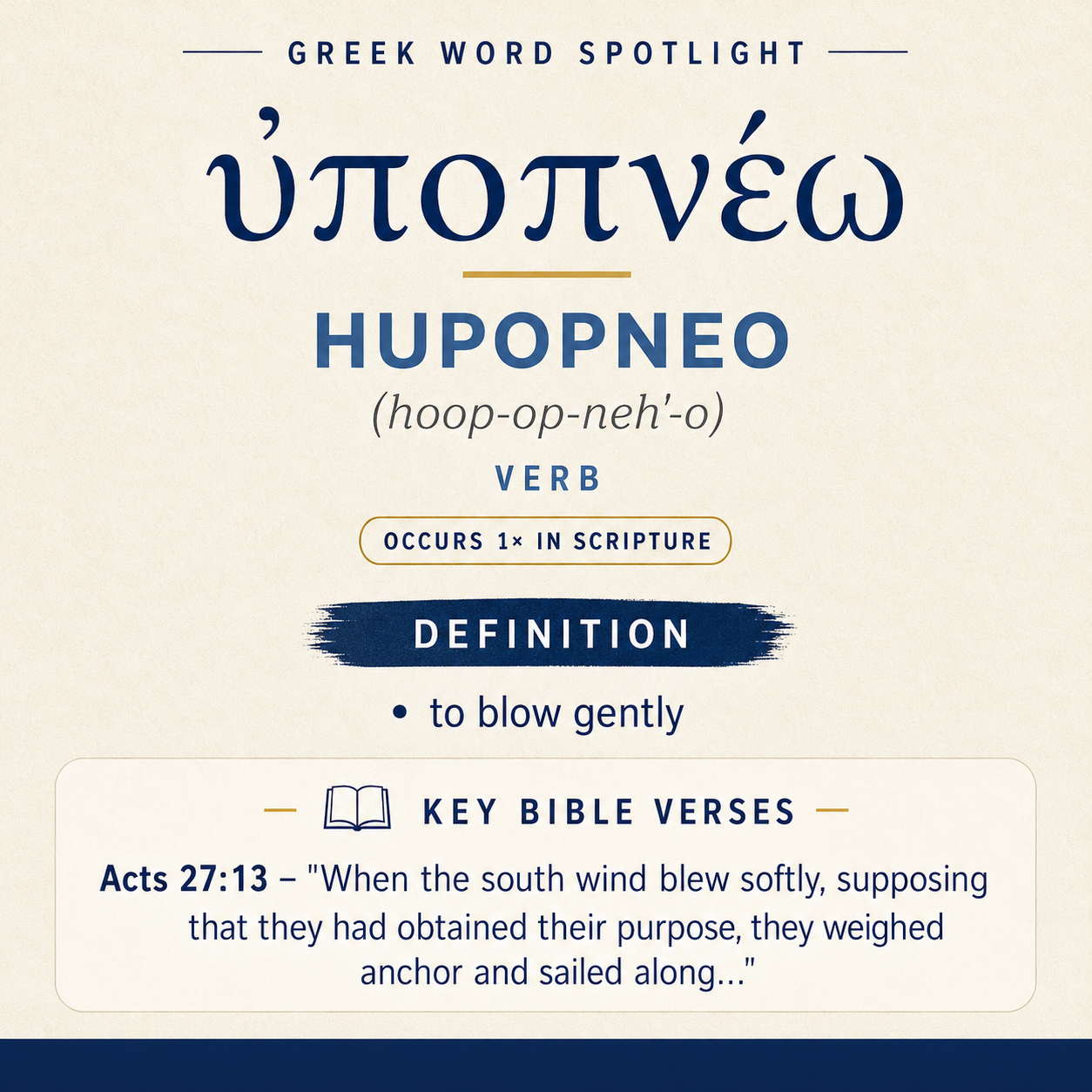
ὑποπνέω means “to blow gently” and appears once in Scripture, in Acts 27:13.
Acts 27 Context
In Acts 27:13, it describes the south wind blowing softly. This leads them to weigh anchor and sail along Crete.
Learn More →ὑποπνέω means “to blow gently,” and it appears in the narrative of Paul’s sea voyage as a description of a favorable wind. The term helps set the tone of calm conditions that lead the sailors to act with confidence.
Root and Related Words
ὑποπνέω (Hupopneo) is formed from πνέω (pneo), “to blow” (Strong’s G4154), with the preposition ὑπό (hypo), “by/under: by” (Strong’s G5259). The combined form presents the action of blowing with a moderated, “understated” character in keeping with the scene it describes.

Occurrences
“When the south wind blew softly, supposing that they had obtained their purpose, they weighed anchor and sailed along Crete, close to shore.” (Acts 27:13)
Here ὑποπνέω describes a “south wind” that “blew softly,” a detail that immediately shapes the sailors’ interpretation of their circumstances: “supposing that they had obtained their purpose.” The gentle quality of the wind functions as more than weather reporting; it supplies the apparent justification for decisive movement—“they weighed anchor and sailed.” In the verse’s logic, the soft blowing is the sensory cue that turns intention into action.
The verb also supports the nautical precision of the scene. The crew’s response is not merely to depart, but to “sailed along Crete, close to shore.” A softly blowing south wind coheres with this cautious coastal strategy, where wind conditions and proximity to land matter for safe handling of a ship. By choosing a verb that portrays the wind as mild, the sentence frames their decision as reasonable based on immediate conditions, even if the broader voyage narrative will test such confidence.
Sense and Usage
The single use of ὑποπνέω places the idea of gentle blowing in a concrete, observable setting: wind that feels favorable to sailors. The gentleness is not an abstract evaluation; it is embedded in a chain of perceptions and conclusions. The wind’s soft blowing leads to “supposing,” and “supposing” leads to “they weighed anchor.” The verb therefore works as a hinge between environment and human judgment, depicting a condition that seems to promise control and progress.
Within the verse, the gentle wind is explicitly directional (“the south wind”), which keeps the sense grounded in actual seamanship: wind is something received, assessed, and acted upon. ὑποπνέω contributes the nuance of a wind that does not press with force but nevertheless provides enough movement to invite travel. The calmness implied by “blew softly” is reinforced by the resulting route choice, “close to shore,” suggesting a situation that appears manageable and safe.
Because ὑποπνέω is built on πνέω (“to blow”), its force in context is to specify the manner of blowing rather than introduce a different phenomenon. The addition of ὑπό (“by/under: by”) aligns with the impression of something subdued or restrained: the wind is present and effective, but in a way that seems mild rather than threatening. In Acts 27:13 this manner is rhetorically significant: gentle wind becomes the basis for optimism (“obtained their purpose”), highlighting how quickly a shift in conditions can be interpreted as success.
Imagery
The imagery carried by ὑποπνέω in Acts 27:13 is the feel of a light breeze that encourages motion—enough to move a ship, gentle enough to reassure those on board. It evokes a moment of apparent ease: anchor lifted, coastline near, the voyage continuing under a soft south wind.
Sources: Lexical data from Strong’s Exhaustive Concordance and the Translators Brief Lexicon of Extended Strongs for Greek (STEPBible, CC BY). Occurrence data from the Translators Amalgamated Greek New Testament (STEPBible, CC BY). Scripture quotations from the World English Bible (public domain).




