
Exploring the Meaning of Hubris in Greek
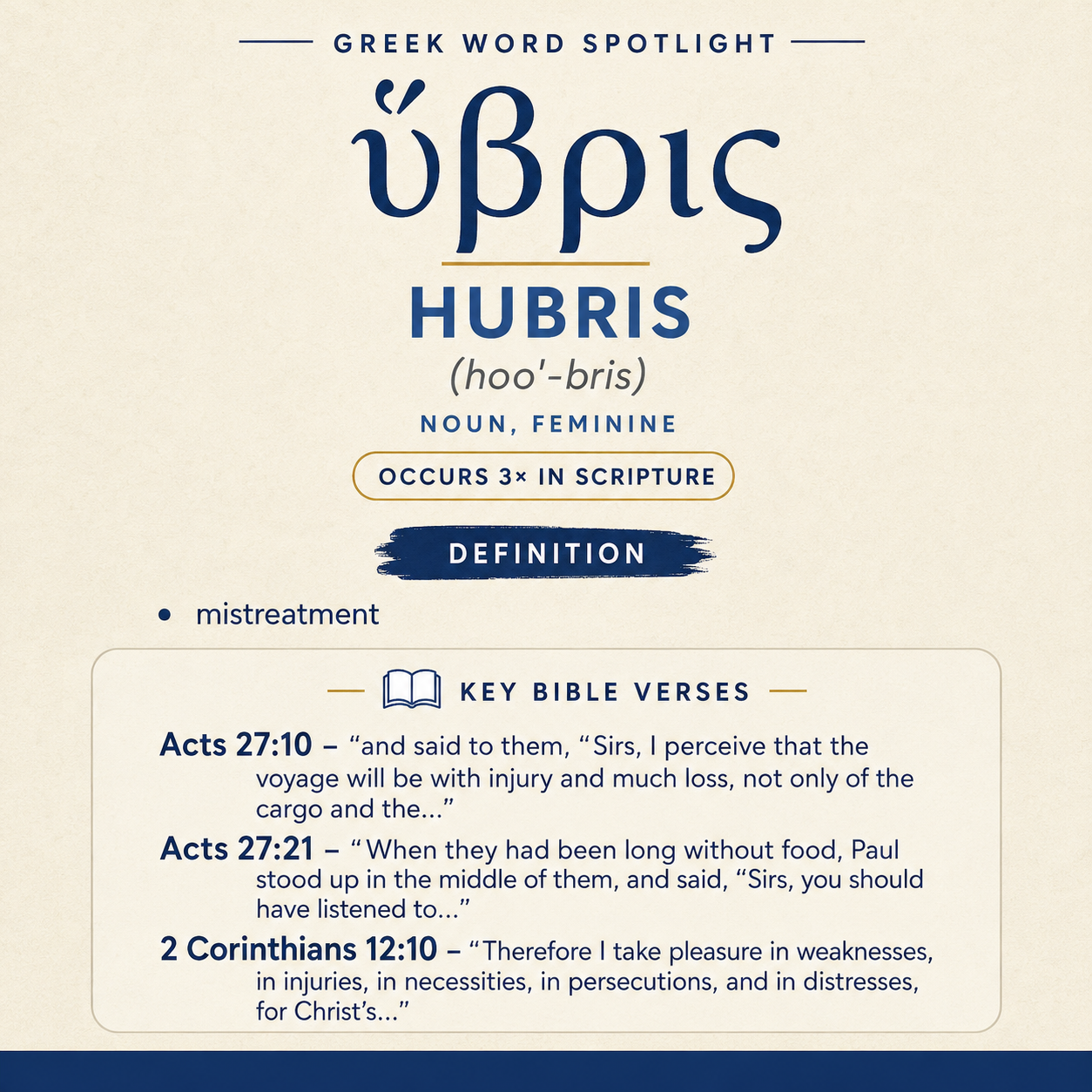
ὕβρις (Hubris) means “mistreatment” and appears three times in Scripture: Acts 27:10, Acts 27:21, and 2 Corinthians 12:10.
Acts Usage
In Acts 27:10 and 27:21, Paul warns the voyage will involve “injury and much loss.”
Learn More →Pauline Example
In 2 Corinthians 12:10, Paul mentions “injuries” among hardships he endures for Christ’s sake.
Learn More →ὕβρις refers to mistreatment, appearing in Paul’s warning about a dangerous sea voyage in Acts 27 and in his list of hardships endured for Christ’s sake in 2 Corinthians 12. In each setting, the term marks harm experienced or anticipated, whether through circumstances at sea or through the pressures of apostolic ministry.
Root and Related Words
ὕβρις is connected with the preposition ὑπέρ (hyper), “above/for” (Strong’s G5228).

Occurrences
Acts 27:10: and said to them, “Sirs, I perceive that the voyage will be with injury and much loss, not only of the cargo and the ship, but also of our lives.”
In Acts 27:10, ὕβρις belongs to Paul’s sober assessment of what continuing the voyage will bring. The scene is forward-looking: he “perceive[s]” the likely outcome before it happens, and he frames it as a combination of “injury and much loss.” The pairing places mistreatment alongside measurable damage (“loss”) and makes it part of the total cost of pressing on—harm that will touch not only property (“cargo and the ship”) but potentially the people themselves (“our lives”). In this warning, ὕβρις functions as the humanly felt side of the calamity: it conveys that the voyage is not merely risky in an abstract or financial sense; it is headed toward experienced harm.
Acts 27:21: When they had been long without food, Paul stood up in the middle of them, and said, “Sirs, you should have listened to me, and not have set sail from Crete and have gotten this injury and loss.
Acts 27:21 returns to the same term after events have begun to confirm Paul’s earlier perception. The setting has shifted from prediction to recollection in the midst of crisis: “When they had been long without food,” Paul speaks “in the middle of them,” placing his words into a moment of shared deprivation and strain. Here ὕβρις is no longer a possibility attached to “the voyage” but an outcome already “gotten”—“this injury and loss.” The demonstrative “this” makes the mistreatment concrete and immediate, something the group can now recognize as present experience rather than theoretical warning. By coupling it again with “loss,” the verse presents two intertwined results of their choice to sail: the harm they are undergoing and the losses accruing around them. In this scene, ὕβρις helps Paul interpret their suffering as avoidable consequence (“you should have listened to me”), tying the present distress to an earlier ignored counsel.
2 Corinthians 12:10: Therefore I take pleasure in weaknesses, in injuries, in necessities, in persecutions, and in distresses, for Christ’s sake. For when I am weak, then am I strong.
In 2 Corinthians 12:10, ὕβρις appears in a different register: not the mistreatment expected from a journey, but mistreatment listed among the recurring pressures of Paul’s life and service. The term is placed within a catalog—“weaknesses, … injuries, … necessities, … persecutions, … distresses”—where each item names a form of hardship that constrains, wounds, or presses upon him. The surrounding statement is striking: “Therefore I take pleasure” in these things “for Christ’s sake.” Within this sentence, ὕβρις contributes the idea of harmful treatment as one recognizable category of suffering that accompanies apostleship. It is not isolated; it sits alongside the everyday pinch of “necessities” and the sharper edge of “persecutions” and “distresses,” suggesting that mistreatment is part of the varied landscape of adversity Paul embraces under a stated purpose. The closing line, “For when I am weak, then am I strong,” sets ὕβρις within a paradox where harm does not have the final word; it becomes one of the conditions under which Paul speaks of strength.
Sense and Usage
Across these passages, ὕβρις consistently marks mistreatment as harm that is experienced, not merely calculated. In Acts 27 it is tied to the concrete vulnerabilities of travel by sea: a voyage can bring consequences that touch bodies and lives, and the term captures the injurious dimension of that outcome. The repeated coupling with “loss” in Acts 27:10 and 27:21 helps distinguish categories of damage within the same crisis—there is what is lost (cargo, ship, and potentially life), and there is the inflicted harm endured along the way. ὕβρις names that endured harm as part of the toll of the voyage, whether anticipated or presently felt.
In 2 Corinthians 12:10, the term moves from the situational hazards of a single journey to the ongoing realities of ministry. The plural-like rhythm of the list (“in weaknesses, in injuries, in necessities, in persecutions, and in distresses”) presents mistreatment as one recurring element among many, rather than as a one-time event. Yet the word’s force remains personal and experiential: mistreatment is something that happens to a person, affecting the way life is lived moment by moment. The verse places this experience inside a chosen posture—“I take pleasure … for Christ’s sake”—so that ὕβρις becomes not only a description of what occurs but also part of Paul’s larger framing of adversity as the setting in which divine strength is known.
Taken together, these occurrences show ὕβρις operating in both prediction and reflection. In Acts 27:10 it belongs to sober foresight; in Acts 27:21 it is the acknowledged reality of a suffering group; in 2 Corinthians 12:10 it is one element within a deliberate embrace of hardship. In every case, the term points to mistreatment as a real injury suffered in the course of lived events—whether through the peril of the sea or through the strains associated with faithfulness “for Christ’s sake.”
Imagery in Context
The word’s imagery in these passages is bound to the feel of being battered by circumstances and still having to endure. Acts 27 places ὕβρις amid the threatened ruin of “cargo” and “ship” and even “our lives,” so mistreatment is imagined as part of a voyage that turns against its travelers. 2 Corinthians 12:10 places it among the pressures that narrow and trouble a person—“weaknesses… necessities… persecutions… distresses”—and then sets it under the surprising claim that weakness can coexist with strength. Together these scenes frame mistreatment as harm that can be foreseen, suffered, and, in a distinctively Christian account, borne without surrendering hope or purpose.
Sources: Lexical data from Strong’s Exhaustive Concordance and the Translators Brief Lexicon of Extended Strongs for Greek (STEPBible, CC BY). Occurrence data from the Translators Amalgamated Greek New Testament (STEPBible, CC BY). Scripture quotations from the World English Bible (public domain).





