Exploring the Meaning of Hupenantios in Greek
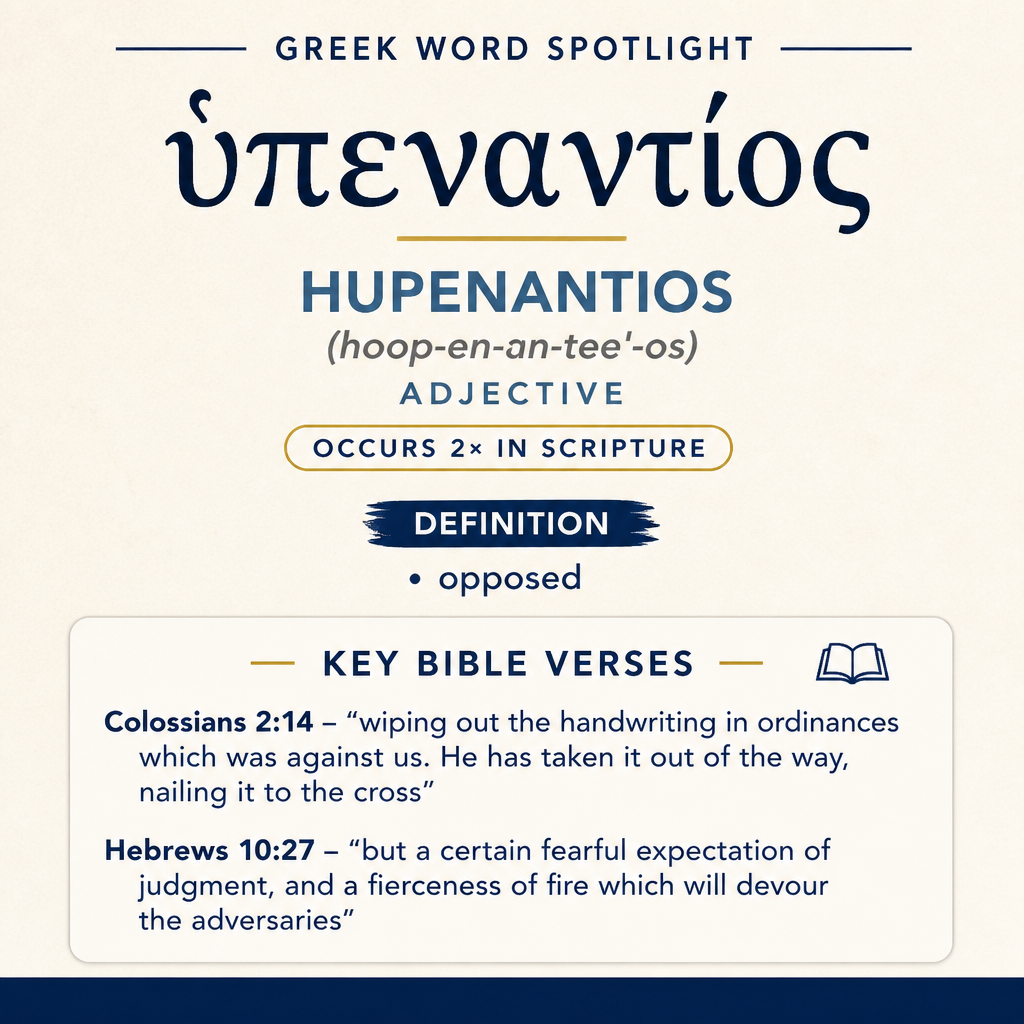
ὑπεναντίος means “opposed” and occurs in Colossians 2:14 and Hebrews 10:27.
Scripture Occurrences
It occurs 2 times in Scripture: Colossians 2:14 and Hebrews 10:27.
Learn More →Context Snapshots
In Colossians 2:14 it describes what was “against us.” In Hebrews 10:27 it appears with “the adversaries.”
Learn More →ὑπεναντίος expresses the idea of being “opposed,” and it appears in two New Testament contexts that frame opposition in judicial and eschatological terms. In one, something stands opposed “against us”; in the other, opposition marks those who face consuming judgment.
Root and Related Words
ὑπεναντίος (Hupenantios) is connected with ἐναντίος (enantios), “hostile” (Strong’s G1727), and ὑπό (hypo), “by/under: by” (Strong’s G5259). The resulting compound form brings these elements together into a single descriptive term.

Occurrences
“wiping out the handwriting in ordinances which was against us. He has taken it out of the way, nailing it to the cross.” (Colossians 2:14)
In this sentence, the word marks a specific relation: the “handwriting in ordinances” is described as standing “against us.” The opposition is not portrayed as a vague feeling of conflict but as something fixed and objective, as though a written instrument has an accusatory or contrary stance toward its subjects. The imagery is administrative and legal in tone: there is “handwriting,” there are “ordinances,” and there is a direct personal object—“us”—to whom the opposition is directed. The action verbs intensify how decisive the resolution is: it is “wiping out,” then “taken…out of the way,” and finally “nailing it to the cross.” Within that cascade of actions, ὑπεναντίος identifies what needed to be removed: a written record characterized by its opposition, now rendered powerless by being removed from its position of standing against.
“but a certain fearful expectation of judgment, and a fierceness of fire which will devour the adversaries.” (Hebrews 10:27)
Here the term belongs to a scene of impending “judgment,” described not only as feared but as “certain,” and paired with a vivid image: “a fierceness of fire.” The focus is not on something written, as in Colossians, but on people—“the adversaries”—who are the ones consumed by the coming fire. In this setting, the idea of being opposed is attached to a class of persons identified by their relationship to the judgment that approaches: they are set on the wrong side of what is coming. The verse does not pause to explain the adversaries’ motives; it presents them as the fixed object of the devouring fire. Thus ὑπεναντίος functions to draw a line of alignment: judgment approaches, and there are those who stand as adversaries in relation to it, defined by that oppositional stance.
Sense and Usage
Across these two uses, “opposed” works with two different grammatical anchors—first a thing (“the handwriting in ordinances”), then persons (“the adversaries”)—but the same core notion is maintained: a stance of direct contrariety. Colossians 2:14 uses the term to characterize an item that stands against a group; Hebrews 10:27 uses it to name a group characterized by opposition. This shows the adjective’s flexibility: it can describe something that takes an opposing position toward people, and it can describe people who occupy an opposing position within a moral-judicial horizon.
In Colossians 2:14, the opposition is expressed with a strong relational clarity—“against us”—which makes the adjective’s force personal and communal. The “handwriting in ordinances” is not merely external; it bears on “us,” and its being “against” carries the sense of pressure, accusation, or liability implied by the surrounding legal language. The verse’s sequence of removal—wiping out, taking out of the way, nailing—treats the opposed object as something that once had a standing place, a location from which it could confront or hinder. The adjective, therefore, does more than label hostility; it marks a positional reality that must be displaced for the resolution described in the verse to occur.
In Hebrews 10:27, the adjective’s sense is sharpened by the inevitability and intensity of the coming response: “a certain fearful expectation of judgment.” Opposition here is not merely interpersonal conflict; it is opposition within the field of judgment. The “adversaries” are defined in relation to what will happen to them: they are the ones whom the “fierceness of fire” “will devour.” The adjective’s contribution is to identify the target of the judgment’s consuming force as those who stand as opponents, so that the devouring fire is not indiscriminate but directed toward a defined category.
Taken together, these passages show ὑπεναντίος operating in contexts where opposition is not resolved by negotiation but by decisive action: in Colossians, by the removal and public fixing of the opposed instrument (“nailing it to the cross”); in Hebrews, by the unstoppable advance of judgment (“will devour the adversaries”). The term’s force is thus consistently relational and directional: it points to something or someone positioned over against another, with real consequences in view.
Imagery
The word carries two complementary images. Colossians 2:14 pictures opposition as a written, ordinance-shaped reality that stands “against us” until it is taken away and nailed to the cross; the visual weight falls on a record removed from its accusatory place. Hebrews 10:27 pictures opposition as embodied in “the adversaries,” and the image is kinetic and consuming: a “fierceness of fire” moving toward and devouring those set against what judgment brings.
Sources: Lexical data from Strong’s Exhaustive Concordance and the Translators Brief Lexicon of Extended Strongs for Greek (STEPBible, CC BY). Occurrence data from the Translators Amalgamated Greek New Testament (STEPBible, CC BY). Scripture quotations from the World English Bible (public domain).