Exploring the Meaning of Hupantao in Greek
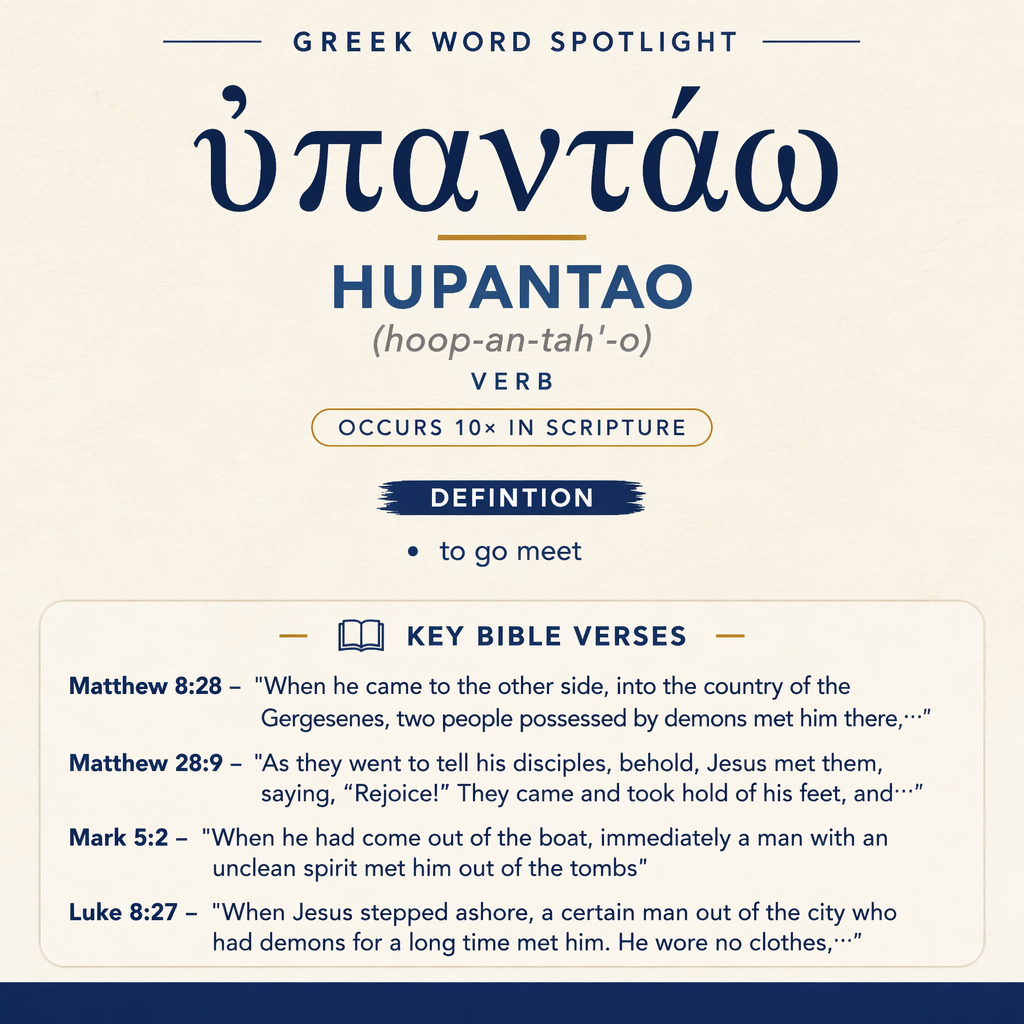
ὑπαντάω means “to go meet” and appears 10 times in Scripture, including Matthew 8:28; 28:9; Mark 5:2; Luke 8:27; 14:31; John 4:51; 11:20; 11:30.
Core Meaning
ὑπαντάω means “to go meet.” It describes going to meet someone, including meeting or encountering.
Learn More →Gospel Scenes
It is used when people meet Jesus, including demon-possessed men (Matthew 8:28; Mark 5:2; Luke 8:27) and Martha (John 11:20; 11:30). It also describes Jesus meeting the women after the resurrection (Matthew 28:9).
Learn More →Other Contexts
It is used for servants meeting a man with news: “Your child lives!” (John 4:51). It is also used for a king going to encounter another king in war (Luke 14:31).
Learn More →ὑπαντάω expresses the action of going to meet someone, often at a decisive point where two parties come into direct contact. In the New Testament it is used for encounters ranging from sudden confrontations to deliberate receptions, including one figurative use in a saying about warfare.
Occurrences
“When he came to the other side, into the country of the Gergesenes, two people possessed by demons met him there, coming out of the tombs, exceedingly fierce, so that nobody could pass that way.” (Matthew 8:28)
Here ὑπαντάω frames the encounter as an active approach toward Jesus: the possessed men do not merely appear; they come out of the tombs to meet him. The verb places the meeting at the boundary between spaces (“the other side”) and within a dangerous setting (“out of the tombs”), highlighting that Jesus’ arrival prompts an immediate, confrontational contact that affects movement in the area (“so that nobody could pass that way”).
“As they went to tell his disciples, behold, Jesus met them, saying, “Rejoice!” They came and took hold of his feet, and worshiped him.” (Matthew 28:9)
In this scene the direction of movement is emphasized: they are already “went to tell his disciples,” and Jesus meets them on the way. ὑπαντάω marks an intercepting encounter that turns their journey into worship; the meeting is confirmed by physical closeness (“took hold of his feet”) and by the response it elicits (“worshiped him”). The verb thus carries the force of a purposeful convergence rather than a casual crossing of paths.
“When he had come out of the boat, immediately a man with an unclean spirit met him out of the tombs.” (Mark 5:2)
ὑπαντάω is paired with immediacy: “immediately” as Jesus exits the boat, the man meets him. The meeting is localized (“out of the tombs”) and confrontational in tone because of the man’s condition (“with an unclean spirit”). The verb places the encounter right at the moment of landing, making the meeting the first event on shore.
“When Jesus stepped ashore, a certain man out of the city who had demons for a long time met him. He wore no clothes, and didn’t live in a house, but in the tombs.” (Luke 8:27)
Again ὑπαντάω presents the encounter as an approach to Jesus upon his arrival (“stepped ashore”). Luke’s description expands the man’s background—“out of the city,” long-term demonic oppression, and residence “in the tombs”—so the verb functions as the hinge between Jesus’ landing and the revelation of the man’s condition. The meeting is not neutral; it is charged with the man’s isolation and uncleanness as depicted in the verse.
“Or what king, as he goes to encounter another king in war, will not sit down first and consider whether he is able with ten thousand to meet him who comes against him with twenty thousand?” (Luke 14:31)
This occurrence uses ὑπαντάω within a hypothetical question about a king facing another king “in war.” The meeting is framed as a military confrontation, where the act of “meet[ing] him who comes against him” is a high-stakes contact requiring prior calculation. ὑπαντάω thus can describe a planned engagement, where “to meet” implies stepping into direct opposition with an advancing force.
“As he was now going down, his servants met him and reported, saying “Your child lives!”” (John 4:51)
Here the verb depicts a welcoming interception: while “going down,” the man is met by his servants, who bring urgent news. The meeting is defined by communication—“reported”—and by the turning point of the message (“Your child lives!”). ὑπαντάω therefore can mark a meeting arranged or prompted by developments, where those who meet do so to deliver decisive information.

“Then when Martha heard that Jesus was coming, she went and met him, but Mary stayed in the house.” (John 11:20)
ὑπαντάω highlights Martha’s intentional movement: she hears Jesus is coming and goes to meet him, contrasted with Mary’s remaining “in the house.” The verb foregrounds Martha’s initiative and the relational urgency of the moment—she does not wait for Jesus to arrive at the home but goes out to meet him, shaping the narrative around an outward step toward an approaching person.
“Now Jesus had not yet come into the village, but was in the place where Martha met him.” (John 11:30)
This verse uses the earlier meeting as a geographic marker: Jesus remains “in the place where Martha met him.” ὑπαντάω therefore not only describes the action of meeting but also establishes a remembered location defined by that encounter. The meeting becomes a fixed point in the story’s spatial layout—outside the village—showing how an act of going to meet can relocate the center of attention away from the expected destination.
“For this cause also the multitude went and met him, because they heard that he had done this sign.” (John 12:18)
Here ὑπαντάω is collective: “the multitude went and met him.” The verb portrays coordinated movement toward Jesus, motivated by a report—“because they heard that he had done this sign.” The meeting is not accidental; it is a response to reputation and news, and it casts the crowd as active participants who go out to create the encounter.
“As we were going to prayer, a certain girl having a spirit of divination met us, who brought her masters much gain by fortune telling.” (Acts 16:16)
In Acts the meeting occurs along a routine path (“going to prayer”) but introduces disruption: the girl with “a spirit of divination” meets “us.” ὑπαντάω sets up contact initiated by the girl, and the verse immediately supplies the social and economic context (“brought her masters much gain by fortune telling”), suggesting that this meeting is connected to an ongoing pattern of exploitation and public activity rather than a one-time greeting.

Sense and Usage
Across these passages, ὑπαντάω consistently portrays meeting as movement that produces contact at a particular moment and place. Often the verb is attached to arrival or transition: Jesus “came to the other side” (Matthew 8:28), “came out of the boat” (Mark 5:2), and “stepped ashore” (Luke 8:27), and in each case the meeting happens at the threshold—where travel ends and engagement begins. The verb can therefore function like a narrative trigger, turning arrival into confrontation or reception.
The subject who “meets” varies, and that variation colors the encounter. In Matthew 28:9, Jesus meets the women while they are on a mission, and the meeting becomes a moment of reassurance and worship, with closeness emphasized (“took hold of his feet”). In John 11:20 the meeting expresses Martha’s initiative and urgency, contrasted with another’s stillness (“Mary stayed in the house”). In John 12:18 the meeting becomes public and self-organizing: the multitude goes out, driven by what they have heard. In John 4:51 the servants meet with news; the meeting is oriented toward reporting and confirmation. The verb accommodates all of these without changing its basic force: it depicts an approach that results in face-to-face contact.
Several occurrences link ὑπαντάω with settings associated with danger or disorder. The demoniacs meet Jesus “coming out of the tombs” (Matthew 8:28; Mark 5:2; Luke 8:27), and the verb gives the encounters a confrontational edge—others avoid the area (“so that nobody could pass that way”), but the possessed approach directly. Acts 16:16 similarly introduces a disturbing element on a normal route, as the girl with a divining spirit meets the group on their way to prayer. These uses show that “meeting” can be sudden and unwanted, not only courteous or expected.
Luke 14:31 extends the verb into a figurative illustration about warfare: one king considers whether he can “meet him who comes against him.” Even here, the meeting remains concrete in imagery—two forces coming into direct contact—while the point of the saying is practical deliberation before engaging. This use underscores that ὑπαντάω can carry the weight of an encounter with consequences, where to “meet” is to enter a decisive confrontation.
Imagery
The passages cluster around roads, shorelines, and places just outside settled life: the landing place, the way to another destination, the place outside a village, and the tombs. In such settings ὑπαντάω depicts meetings that interrupt movement (Mark 5:2; Acts 16:16), redirect it (Matthew 28:9), or draw others outward (John 11:20; John 12:18). The verb’s repeated association with approaching, intercepting, and going out to meet gives these scenes a sense of convergence—two paths becoming one moment of contact, whether for conflict, announcement, or worship.
Sources: Lexical data from Strong’s Exhaustive Concordance and the Translators Brief Lexicon of Extended Strongs for Greek (STEPBible, CC BY). Occurrence data from the Translators Amalgamated Greek New Testament (STEPBible, CC BY). Scripture quotations from the World English Bible (public domain).