Exploring the Meaning of Hugies in Greek
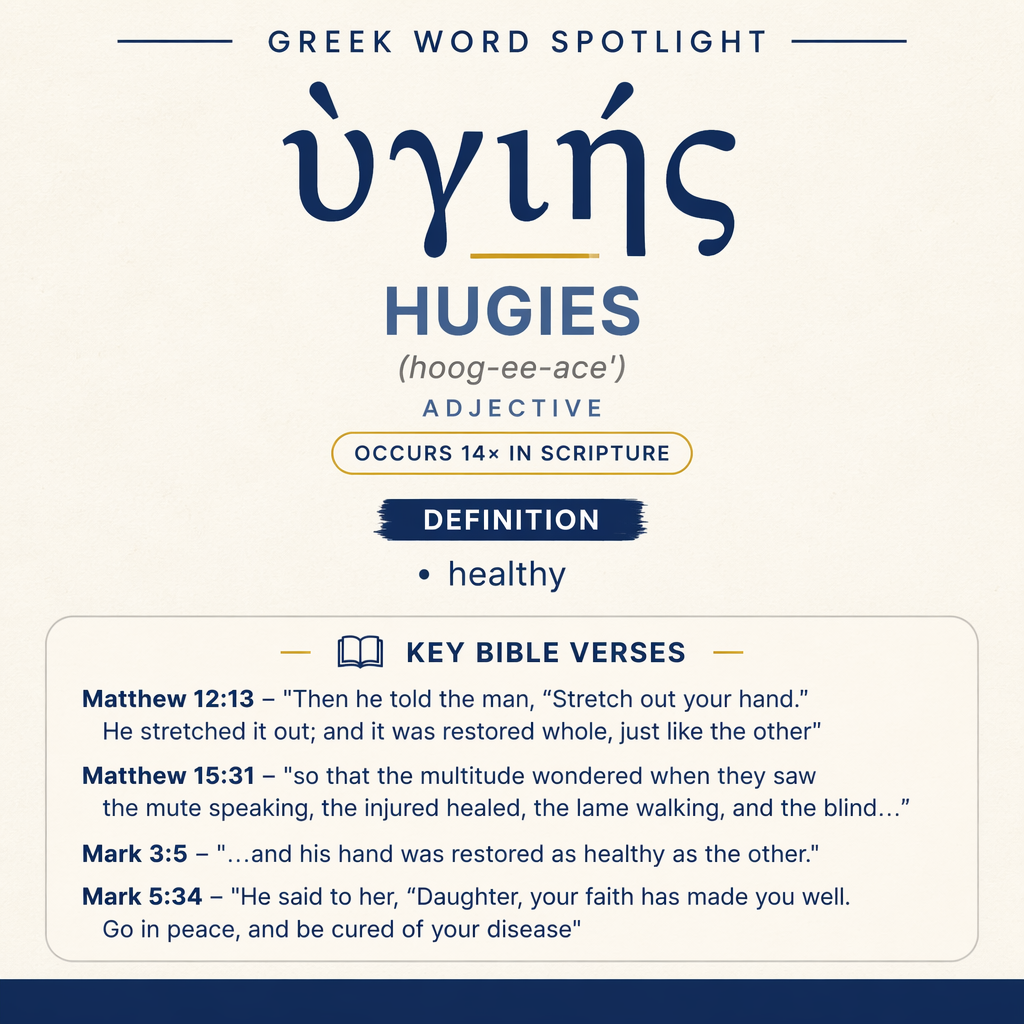
ὑγιής means “healthy” and appears 14 times in Scripture, including healing scenes in Matthew, Mark, Luke, and John 5.
Core Meaning
ὑγιής is defined as “healthy.” In the cited passages it describes restoration from illness or injury.
Learn More →Gospel Contexts
It occurs in accounts where Jesus restores what was damaged, such as a hand made whole (Matthew 12:13; Mark 3:5; Luke 6:10). It also appears in healing reports like Mark 5:34 and John 5:9.
Learn More →John 5 Focus
John 5 uses ὑγιής in the setting of the pool where a sick man is asked about being made well (John 5:6). The narrative reports he was immediately made well (John 5:9).
Learn More →ὑγιής means “healthy” and is used in Gospel scenes where sickness, disability, or impairment gives way to restored bodily soundness. The term repeatedly marks the concrete outcome of healing, whether in a specific body part (a hand) or in a person’s overall condition.
Occurrences
Matthew 12:13
“Then he told the man, “Stretch out your hand.” He stretched it out; and it was restored whole, just like the other.” (Matthew 12:13)
Here “healthy” is expressed as the hand being “restored whole,” with the comparison “just like the other” making health recognizable as symmetry and normal function. The word’s contribution is to present healing as a return to an undamaged state that can be measured against the person’s unaffected hand.
Matthew 15:31
“so that the multitude wondered when they saw the mute speaking, the injured healed, the lame walking, and the blind seeing—and they glorified the God of Israel.” (Matthew 15:31)
In this summary of many healings, “healthy” belongs to the cluster of visible reversals: “the injured healed” stands alongside restored speech, mobility, and sight. The term helps frame health as publicly observable change that produces communal astonishment and culminates in glorifying God.
Mark 3:5
“When he had looked around at them with anger, being grieved at the hardening of their hearts, he said to the man, “Stretch out your hand.” He stretched it out, and his hand was restored as healthy as the other.” (Mark 3:5)
Mark makes “healthy” explicit by stating that the hand “was restored as healthy as the other.” Health is again defined by comparability: the restored hand matches the sound hand. The surrounding conflict (“anger,” “hardening of their hearts”) places the bodily restoration in a tense social setting, where the reality of health stands in contrast to resistance among onlookers.
Mark 5:34
“He said to her, “Daughter, your faith has made you well. Go in peace, and be cured of your disease.” (Mark 5:34)
“Healthy” is conveyed through “made you well,” immediately paired with “be cured of your disease,” linking health to the removal of an identified condition. The address “Daughter” and the command “Go in peace” situate restored health within a personal encounter that sends the healed person away with both bodily change and a settled resolution to the episode.
Luke 6:10
“He looked around at them all, and said to the man, “Stretch out your hand.” He did, and his hand was restored as sound as the other.” (Luke 6:10)
Luke’s wording (“restored as sound as the other”) expresses the same health-concept in terms of bodily integrity. The action is simple—command, compliance, restoration—so that “healthy” is the direct result, presented as immediate and complete, without intermediate steps or medical process.
John 5:4
“for an angel went down at certain times into the pool and stirred up the water. Whoever stepped in first after the stirring of the water was healed of whatever disease he had.” (John 5:4)
In the pool scene, “healthy” appears as being “healed of whatever disease he had,” emphasizing breadth: any disease qualifies, and the result is full relief from that disease. The setting (water “stirred up”) highlights health as something sought by the sick through an anticipated moment of opportunity.
John 5:6
“When Jesus saw him lying there, and knew that he had been sick for a long time, he asked him, “Do you want to be made well?”” (John 5:6)
Here “healthy” is posed as a desired change—“Do you want to be made well?”—which treats health as a new state to be entered rather than a minor improvement. The detail that the man “had been sick for a long time” intensifies the contrast that “made well” would create: health would replace an extended period of sickness.
John 5:9
“Immediately, the man was made well, and took up his mat and walked. Now it was the Sabbath on that day.” (John 5:9)
Health is shown by capacity: being “made well” is followed by the practical acts of carrying a mat and walking. The adverb “Immediately” ties “healthy” to sudden effectiveness; it is not merely a diagnosis but a state that enables movement and ordinary action. The note about the Sabbath begins to connect restored health with public scrutiny.
John 5:11
“He answered them, “He who made me well said to me, ‘Take up your mat and walk.’”” (John 5:11)
In the man’s defense, “made me well” is the central fact that authorizes obedience to the command to carry the mat. Health functions as the premise: the one who produced the healthy condition also directed the behavior that others question. The healed man’s testimony keeps the focus on the agent of healing rather than on a technique.
John 5:14
“Afterward Jesus found him in the temple, and said to him, “Behold, you are made well. Sin no more, so that nothing worse happens to you.” (John 5:14)
“You are made well” identifies health as an established, present condition, now acknowledged after the healing event. The warning “so that nothing worse happens to you” treats health as something that can be followed by a negative turn; the statement does not redefine health, but it places the healthy state in a larger horizon of consequences.
John 5:15
“The man went away, and told the Jews that it was Jesus who had made him well.” (John 5:15)
Health here is the key fact reported to others: “had made him well” becomes the identifying deed that the man shares. The word’s contribution is to anchor the report in an observable transformation, and to attribute that transformation directly to Jesus.
John 7:23
“If a boy receives circumcision on the Sabbath, that the law of Moses may not be broken, are you angry with me, because I made a man completely healthy on the Sabbath?” (John 7:23)
“Completely healthy” sharpens the idea of health by stressing completeness rather than partial relief. In the argument, restored health is weighed against Sabbath concerns: the act of making someone healthy is presented as a substantial good, and the disagreement centers on whether such restoration should provoke anger when done on the Sabbath.

Sense and Usage
Across these passages, “healthy” consistently names the end-state of healing as a concrete, recognizable condition. In the hand-restoration accounts (Matthew 12:13; Mark 3:5; Luke 6:10), health is described through comparison—“as … as the other”—so that the reader is given a simple criterion: the restored limb matches what is already normal. Health is thus depicted as wholeness, soundness, and restored function, not merely the reduction of symptoms.
In Mark 5:34, “made you well” sits beside “be cured of your disease,” pairing the positive state (health) with the negative state removed (disease). John 5 expands this pattern: health is what the sick man is invited to desire (“Do you want to be made well?”), what he receives “Immediately,” and what he can point to when questioned (“He who made me well”). John also shows how the label “healthy” travels socially: it becomes part of a dispute about Sabbath practice (John 5:9; John 7:23), part of testimony to authorities (John 5:15), and part of a later personal admonition given in the temple (John 5:14). In these scenes, “healthy” is never an inward abstraction; it is a state that changes what a person can do (walking, carrying a mat) and how others react (wonder, anger, investigation, glorifying God).
Matthew 15:31 provides the broadest setting: health is one element in a spectrum of restored human capacities—speech, mobility, sight—so that “healthy” belongs to a public display of restoration that prompts worship. The cumulative effect of the occurrences is to present health as restoration that is visible, complete, and socially consequential, whether it is localized to a body part or summed up as a person being “made well.”
Imagery
The imagery tied to “healthy” is repeatedly tactile and ordinary: a hand extended and restored; a person rising, lifting a mat, and walking; crowds watching impairment give way to normal activity. John’s pool setting adds the picture of sick people waiting by stirred water, but the focus remains on the resulting condition—being made well—shown not by medical description but by the return of everyday bodily ability and the public reactions that follow.
Sources: Lexical data from Strong’s Exhaustive Concordance and the Translators Brief Lexicon of Extended Strongs for Greek (STEPBible, CC BY). Occurrence data from the Translators Amalgamated Greek New Testament (STEPBible, CC BY). Scripture quotations from the World English Bible (public domain).